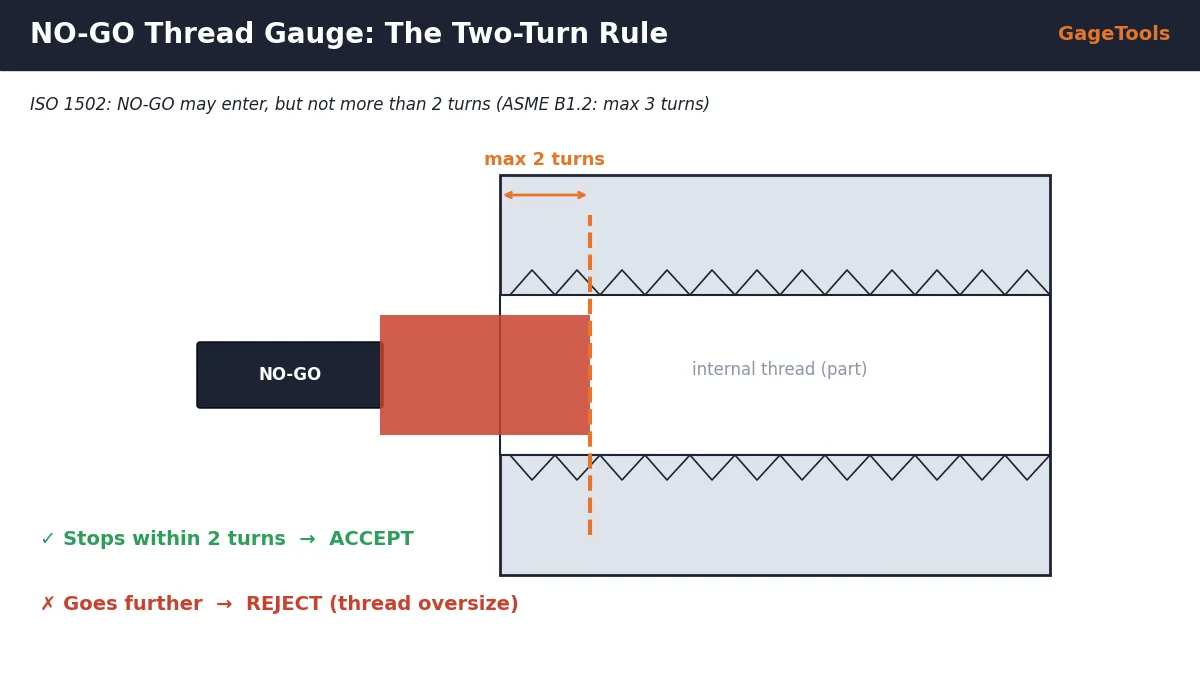
Quick answer: The two-turn rule means a NO-GO thread gauge is allowed to start entering a part, but it must not screw in more than two full turns. If it goes further, the thread is oversize (internal) or undersize (external) and the part is rejected. ISO 1502 uses two turns; ASME B1.2 allows up to three complete turns for NOT GO gauges, so always follow the standard named on the drawing.
Need gauges for this? GageTools makes NO-GO thread plug and ring gauges with MOQ 1 piece: plug gauges from USD 20, ring gauges from USD 30, and standard stock sizes ship within 72 hours. Send your thread size for a quote.
Need gauges for this? GageTools manufactures GO/NO-GO thread plug gauges and thread ring gauges in Dongguan, China. Standard sizes ship from stock within 72 hours, MOQ is 1 piece, and every RFQ gets a reply within 24 hours — request a quote.
Why the NO-GO Gauge Is Allowed to Enter at All
The first and last threads of a part are never perfect: chamfers, burrs and incomplete threads make the entry slightly larger. A NO-GO gauge will often catch there even on a good part. Allowing a small engagement stops good parts from being rejected just because of the thread start.
How to Apply the Rule Step by Step
- Clean the part and the gauge; chips and oil change the result.
- Check with the GO gauge first. It must pass through the full thread length by hand, without force.
- Apply the NO-GO gauge by hand only — never use a wrench or extra torque.
- Count full turns from first engagement. Stop as soon as the gauge resists.
- Accept the part if the NO-GO stops within the permitted turns; reject if it goes further.
- For through holes, check the NO-GO from both ends.
ISO vs ASME: What the Standards Say
| Standard | Thread system | NO-GO engagement allowed |
|---|---|---|
| ISO 1502 | ISO metric (M) threads | Not more than 2 turns |
| ASME B1.2 | Unified inch (UN/UNC/UNF) threads | Not more than 3 complete turns |
If the part has only three or fewer threads, the NO-GO gauge must not pass fully through. When in doubt, the requirement on the customer drawing wins over any general rule.
Common Mistakes That Cause Wrong Results
- Forcing the NO-GO gauge in with a wrench — a gauge that needs force is already telling you the part is good.
- Counting partial turns at the thread start as full turns.
- Using a worn NO-GO gauge that has not been calibrated, so bad parts pass.
- Checking plated parts with gauges sized for the pre-plating condition.
Sourcing NO-GO gauges? As a thread gauge manufacturer we supply no go ring gauges and NO-GO plugs to ISO 1502 and ASME B1.2, marked so the acceptance rule is clear at the bench.
Frequently Asked Questions
What if the NO-GO gauge enters exactly two turns?
Two turns is still inside the limit under ISO 1502, so the part is accepted. Only engagement beyond the limit is a reject.
Does the two-turn rule apply to GO gauges?
No. The GO gauge must go through the full length of the thread. The turn limit only applies to NO-GO gauges.
Does the rule apply to taper threads like NPT?
No. Taper threads such as NPT and BSPT are checked by stand-off position with L1 plug and ring gauges, not by counting NO-GO turns.
Related Buyer Guides
- GO/NO-GO Thread Gauge Principle, Types and How to Use
- What Is Taylor’s Principle of Gauging?
- Thread Gauges Before or After Plating: A Buyer’s Guide
- Thread Gauge Inspection Procedure: Step-by-Step Guide
✓ 20+ years gauge manufacturing
✓ ISO 9001:2015 certified
✓ In-house CNC grinding & inspection
✓ Drawing / RFQ reply within 24h
Get NO-GO and GO Thread Gauges for Your Inspection Line
Send your thread callout, tolerance class and quantity — or just your drawing. Standard sizes ship from stock within 72 hours, custom gauges in 10–15 working days, MOQ 1 piece. Reach us on WhatsApp at +86 173 1689 5054 or [email protected].