Quick answer: Taylor’s principle says a GO gauge should check all related features of a part at the same time, at the maximum-material limit, while a NO-GO gauge should check each feature separately, at the least-material limit. Every GO/NO-GO thread gauge is designed around this rule.
Need gauges for this? GageTools manufactures GO/NO-GO thread plug gauges and thread ring gauges in Dongguan, China. Standard sizes ship from stock within 72 hours, MOQ is 1 piece, and every RFQ gets a reply within 24 hours — request a quote.
Where the Principle Comes From
William Taylor patented the idea in 1905. He noticed that a part can have every individual dimension inside tolerance and still fail to assemble, because form errors add up. A hole can be the right size at every point yet be slightly bent, so the mating pin will not go in. The only reliable way to prove assembly is to use a gauge that behaves like the mating part.
GO Gauge vs NO-GO Gauge Under Taylor’s Principle
| GO gauge | NO-GO gauge | |
|---|---|---|
| Checks | All features together (size + form) | One feature at a time |
| Limit | Maximum material limit | Least material limit |
| Thread form | Full profile | Truncated (shortened) flanks |
| Length | Full length of engagement | Short, usually 2–3 pitches |
| Result proves | The part will assemble | The part is not too loose |
How It Applies to Thread Gauges
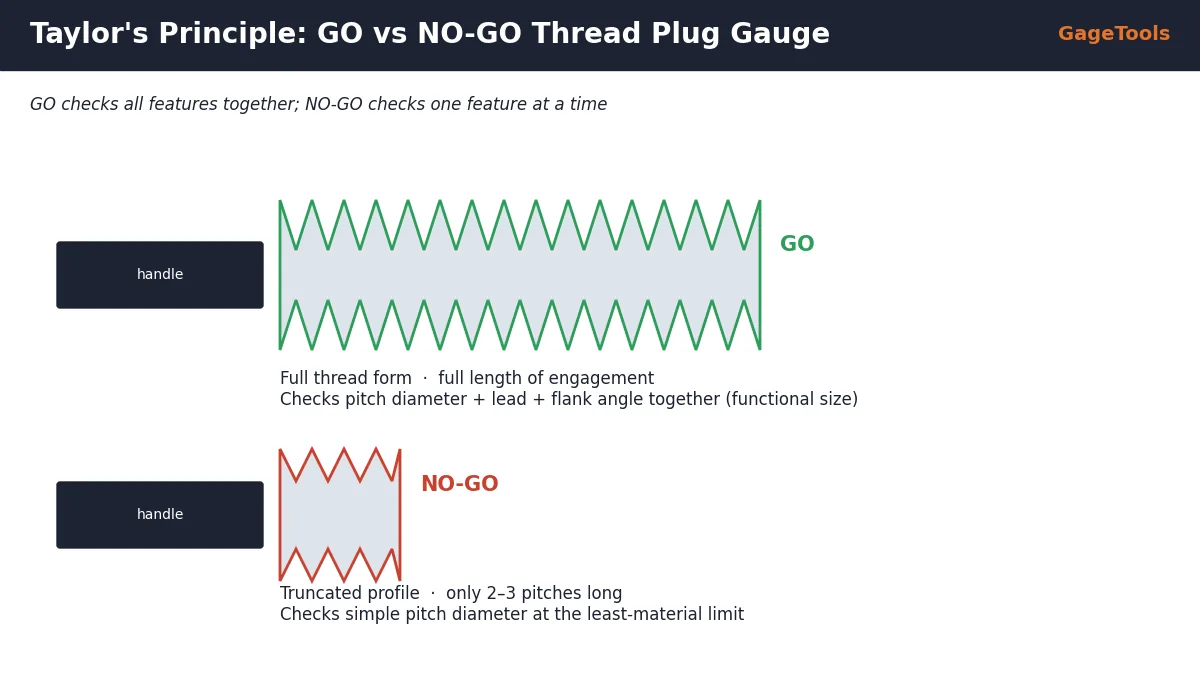
- GO thread plug/ring: full thread form and full length, so it checks pitch diameter, lead (pitch) error and flank angle together. This is the “functional” or “virtual” size of the thread.
- NO-GO thread plug/ring: truncated profile and only a few threads long, so it touches only the flanks near the pitch line. It measures simple pitch diameter without being affected by lead or angle errors.
- Plain plug and ring gauges follow the same logic: the GO member should ideally be as long as the fit length, the NO-GO member short.
Practical Limits of the Principle
Perfect Taylor gauges are sometimes impractical — a full-length GO gauge for a very deep bore may be too heavy, for example. In those cases manufacturers agree a compromise with the buyer, and form errors are checked separately with CMM or optical inspection. If your drawing calls for special gauge lengths, send it with your RFQ so the gauge is made to the right length.
Frequently Asked Questions
Does the NO-GO gauge ever have to go in at all?
Under thread-gauging standards it may enter a little. See the two-turn rule: a NO-GO thread gauge may start to engage, but must not pass more than the permitted number of turns.
Why is the NO-GO thread gauge shorter than the GO gauge?
So that it checks only simple pitch diameter at one location, as Taylor’s principle requires, instead of being blocked by lead or angle errors.
Is Taylor’s principle part of ISO or ASME standards?
Yes. The gauge designs in ISO 1502 (metric threads) and ASME B1.2 (unified threads) follow it, which is why their GO and NO-GO members have different profiles and lengths.
Related Buyer Guides
- GO/NO-GO Thread Gauge Principle, Types and How to Use
- What Is a GO Gauge? Definition and Inspection Rule
- What Is the Two-Turn Rule for NO-GO Gauges?
- What Is Pitch Diameter in Thread Gauging?
✓ 20+ years gauge manufacturing
✓ ISO 9001:2015 certified
✓ In-house CNC grinding & inspection
✓ Drawing / RFQ reply within 24h
Order GO/NO-GO Thread Gauges Built to ISO 1502 or ASME B1.2
Send your thread callout, tolerance class and quantity — or just your drawing. Standard sizes ship from stock within 72 hours, custom gauges in 10–15 working days, MOQ 1 piece. Reach us on WhatsApp at +86 173 1689 5054 or [email protected].