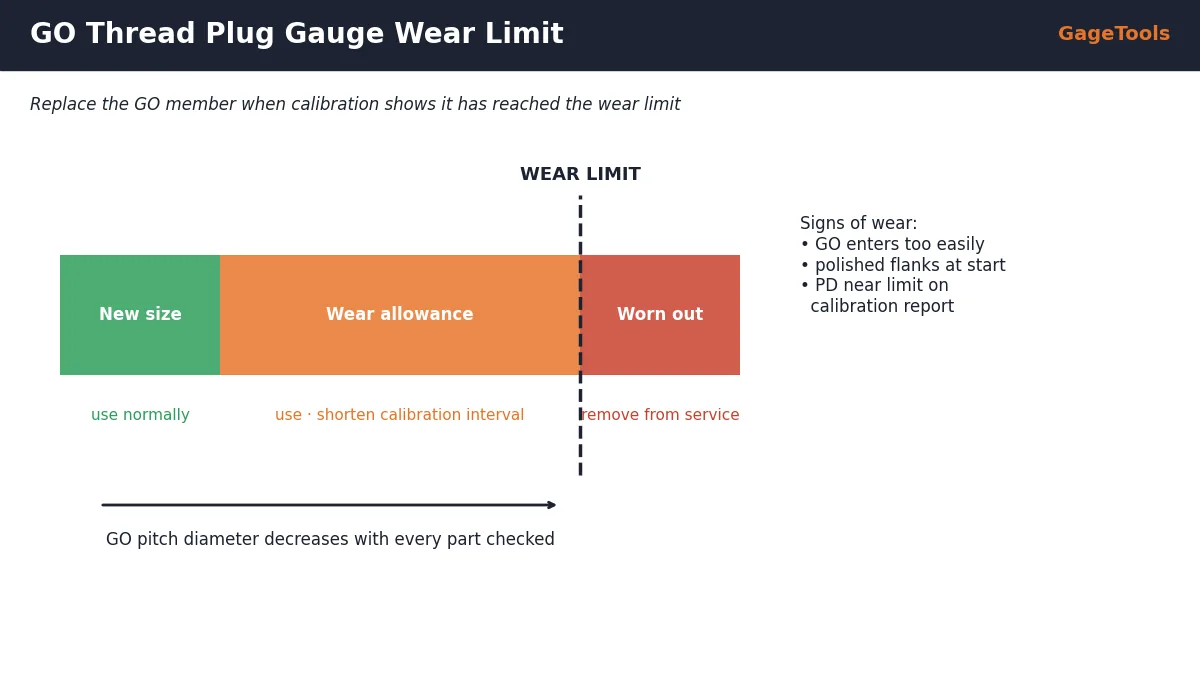
Quick answer: The wear limit is the size a GO thread plug gauge may wear down to before it must be taken out of service. A new GO gauge is made slightly above the minimum pitch diameter of the part; every part it checks rubs a little off. When calibration shows the pitch diameter has reached the wear limit, replace the gauge — continuing to use it lets undersize threads pass.
Need gauges for this? GageTools manufactures GO/NO-GO thread plug gauges and thread ring gauges in Dongguan, China. Standard sizes ship from stock within 72 hours, MOQ is 1 piece, and every RFQ gets a reply within 24 hours — request a quote.
Why GO Gauges Wear Much Faster Than NO-GO Gauges
The GO member screws through the full length of every good part, so it carries nearly all the friction. The NO-GO member only engages a turn or two. In most shops the GO end reaches its wear limit long before the NO-GO end shows measurable wear, which is why many buyers order spare GO members.
New Size, Wear Limit and Reject: How the Zones Work
| Zone (GO plug) | What it means | Action |
|---|---|---|
| Within new-gauge tolerance | Gauge as manufactured | Use normally |
| Between new tolerance and wear limit | Normal, acceptable wear | Use; shorten calibration interval as it approaches the limit |
| Beyond the wear limit | Gauge may accept undersize internal threads | Remove from service and replace |
ISO 1502 (metric) and ASME B1.2 (unified) define the wear allowance for thread gauges. A calibration certificate with measured values shows exactly where your gauge sits between the new size and the wear limit.
Signs a Thread Gauge Is Worn or Damaged
- The GO gauge enters parts noticeably easier than it used to.
- Visible bright or polished flanks near the gauge start.
- Nicks, burrs or corrosion on the thread flanks.
- Calibration reports show pitch diameter moving toward the wear limit.
- Parts that passed the gauge fail at assembly or at the customer.
How to Extend Gauge Life
- Clean parts before gauging — chips and abrasive dust accelerate wear.
- Apply gauges by hand only; never force them.
- Store gauges in their cases, lightly oiled, away from moisture.
- For high-volume lines, ask your supplier about harder gauge materials or surface treatments, and keep a spare GO member on hand.
- Set calibration intervals by usage: high-volume gauges need shorter intervals than occasional-use gauges.
Frequently Asked Questions
Can a worn thread gauge be reworked?
Usually not. Thread gauges are ground to size; once the GO member is worn it is replaced. Many buyers buy a replacement GO member instead of a full set.
How often should thread plug gauges be calibrated?
It depends on usage. Many shops start with 6–12 months and shorten the interval for high-volume gauges once wear data shows how fast the gauge wears.
Do NO-GO gauges have a wear limit?
NO-GO gauges wear very little in normal use, but they are still calibrated. Damage such as nicks is the more common reason to replace them.
Related Buyer Guides
- Thread Gauge Calibration: How Often and What to Check
- How to Read a Thread Gauge Calibration Certificate
- Thread Gauge Material and Hardness
- What Is Pitch Diameter in Thread Gauging?
✓ 20+ years gauge manufacturing
✓ ISO 9001:2015 certified
✓ In-house CNC grinding & inspection
✓ Drawing / RFQ reply within 24h
Replace Worn GO Members or Full Gauge Sets
Send your thread callout, tolerance class and quantity — or just your drawing. Standard sizes ship from stock within 72 hours, custom gauges in 10–15 working days, MOQ 1 piece. Reach us on WhatsApp at +86 173 1689 5054 or [email protected].