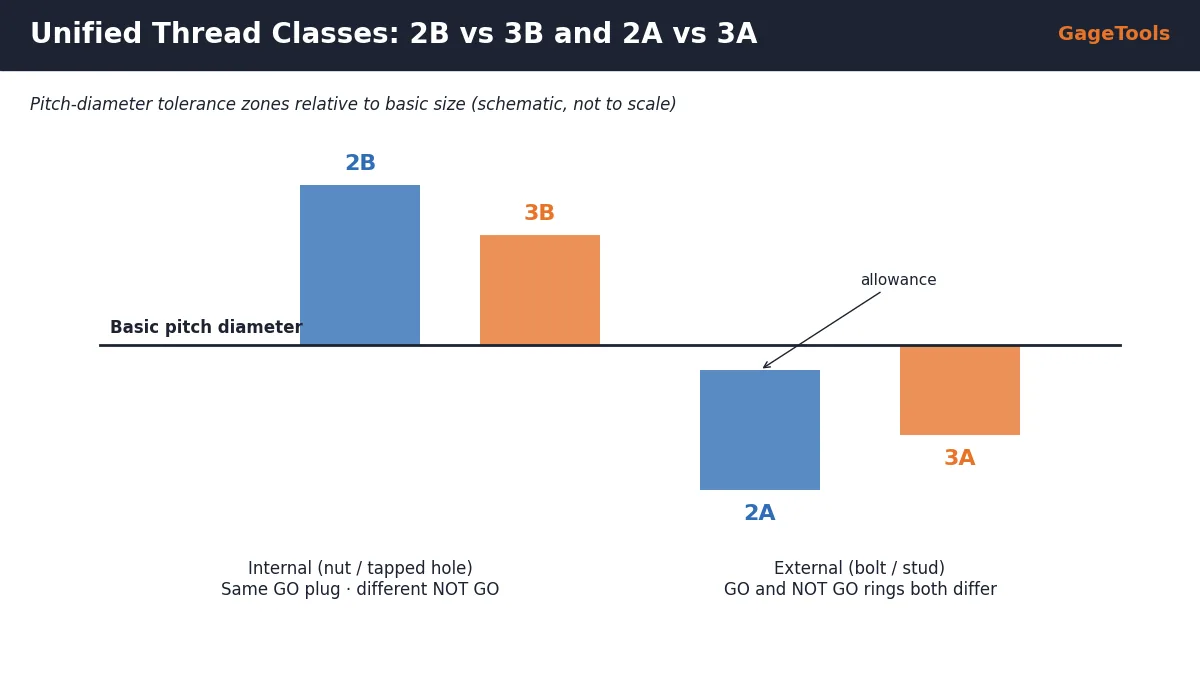
Quick answer: 2B and 3B are tolerance classes for internal unified inch threads (nuts, tapped holes); 2A and 3A are the matching external classes (bolts, studs). Class 2 is the general-purpose standard. Class 3 is tighter and used where precision and strength matter, such as aerospace. For internal threads the GO plug gauge is the same for 2B and 3B, but the NOT GO plug is different. For external threads, both the GO and NOT GO rings change between 2A and 3A.
Need gauges for this? GageTools manufactures GO/NO-GO thread plug gauges and thread ring gauges in Dongguan, China. Standard sizes ship from stock within 72 hours, MOQ is 1 piece, and every RFQ gets a reply within 24 hours — request a quote.
The Three Unified Thread Classes
| Class | Internal / external | Typical use | Allowance |
|---|---|---|---|
| 1A / 1B | Loose fit | Quick assembly, dirty or damaged threads | 1A has an allowance |
| 2A / 2B | Standard fit | Most commercial fasteners | 2A has an allowance (room for plating) |
| 3A / 3B | Close fit | Aerospace, precision and high-strength joints | No allowance |
Class 2 is assumed if a drawing does not state a class — but never guess on a gauge order. Always send the full callout, e.g. 1/4-20 UNC-2B.
Which Gauge Members Change Between Classes
| Thread | GO gauge | NOT GO gauge |
|---|---|---|
| 2B vs 3B (internal) | Same GO plug — minimum pitch diameter is basic for all B classes | Different — 3B has a smaller maximum pitch diameter |
| 2A vs 3A (external) | Different — 2A includes an allowance, 3A does not | Different — tolerance zones differ |
Thread ring gauges for 2A and 3A are set with their own setting plugs, so a ring set for one class cannot be reused for the other.
What About Metric Classes?
Metric threads use a different naming system: internal classes such as 6H (no fundamental deviation) or 6G (with a deviation for coating), and external classes such as 6g or 6h. The idea is the same: the letter sets the position of the tolerance zone and the number sets its width. See our guides on 6g vs 6H and metric tolerance classes.
Common Ordering Mistakes
- Ordering a “1/4-20 plug gauge” without the class — the NOT GO member will be wrong for 3B parts.
- Using 2A ring gauges to check plated parts that were cut to 3A before plating.
- Mixing class-2 and class-3 gauges in the same inspection area without clear marking.
- Assuming a 3B GO plug is “more accurate” — it is the same GO size as 2B; the difference is on the NOT GO side.
Need 2A/2B or 3A/3B gauges? See our GO/NO-GO thread ring gauges for external classes and thread plug gauges for internal classes, made to ASME B1.2.
Frequently Asked Questions
Can a 2B plug gauge check a 3B thread?
Only the GO end. The NOT GO end of a 2B gauge is larger than a 3B limit, so an oversize 3B thread could pass. Use a dedicated 3B NOT GO member.
Will a 3A bolt fit a 2B nut?
Yes. Unified classes are interchangeable for assembly; the class only controls how tight the fit is.
Which class should I choose for a new design?
2A/2B for general industrial use. Choose 3A/3B only when the design needs a close fit, higher fatigue strength or when an aerospace standard requires it.
Related Buyer Guides
- UNC vs UNF vs UNEF: Unified Thread Standards Explained
- What Is a Thread Plug Gauge? Sizes, Standards and How to Order
- Do Thread Ring Gauges Need Setting Plugs?
- Thread Gauges Before or After Plating
✓ 20+ years gauge manufacturing
✓ ISO 9001:2015 certified
✓ In-house CNC grinding & inspection
✓ Drawing / RFQ reply within 24h
Order 2B, 3B, 2A or 3A Thread Gauges
Send your thread callout, tolerance class and quantity — or just your drawing. Standard sizes ship from stock within 72 hours, custom gauges in 10–15 working days, MOQ 1 piece. Reach us on WhatsApp at +86 173 1689 5054 or [email protected].