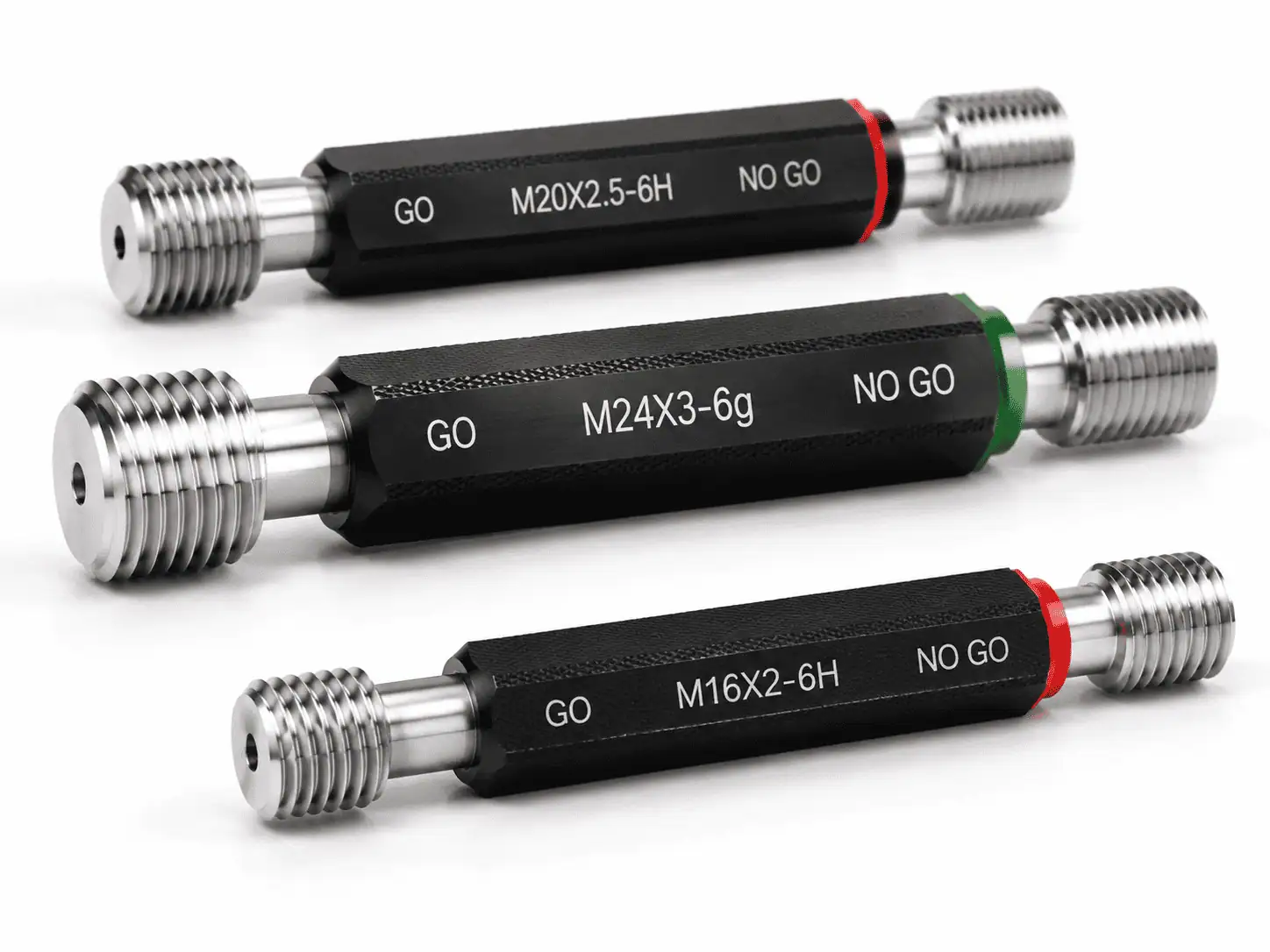
Need gauges for this? GageTools manufactures GO/NO-GO thread plug gauges and thread ring gauges in Dongguan, China. Standard sizes ship from stock within 72 hours, MOQ is 1 piece, and every RFQ gets a reply within 24 hours — request a quote.
Hydraulic Thread Systems and Their Gauges
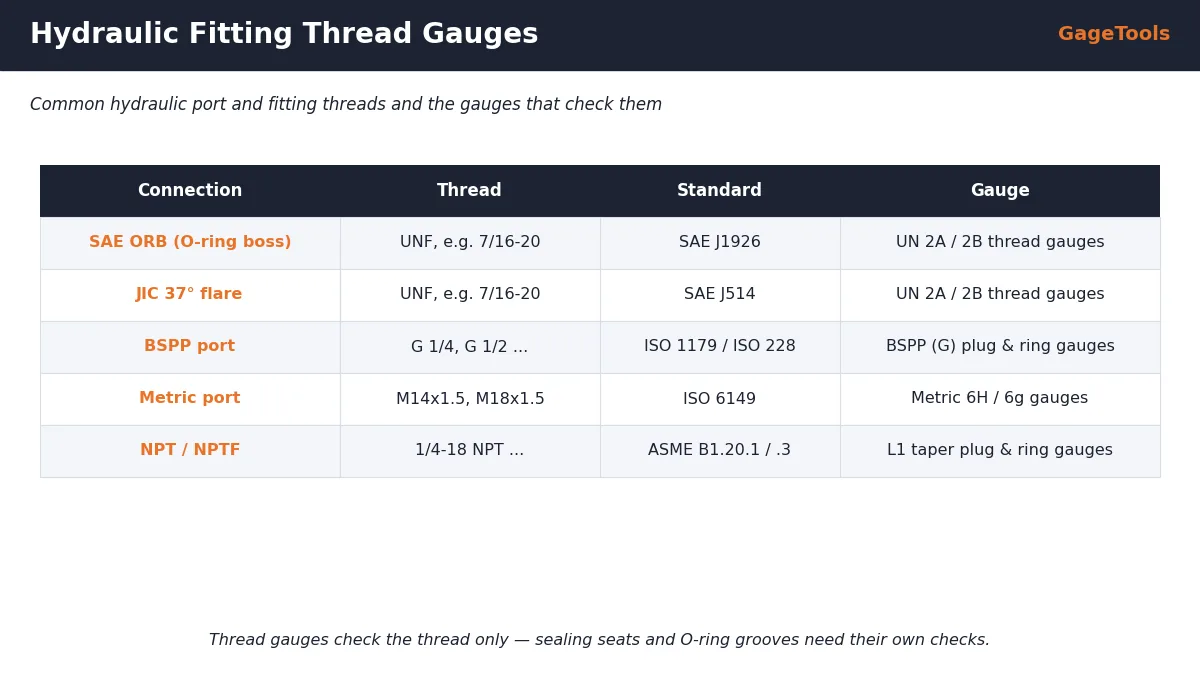
| Connection | Thread | Standard | Gauges |
|---|---|---|---|
| SAE ORB (O-ring boss) | UNF, e.g. 7/16-20 | SAE J1926 | UN 2B plug / 2A ring |
| JIC 37° flare | UNF, e.g. 7/16-20 | SAE J514 | UN 2B plug / 2A ring |
| BSPP port | G 1/4, G 1/2 … | ISO 1179 / ISO 228-1 | BSPP (G) plug / ring |
| Metric port | M14x1.5, M18x1.5 … | ISO 6149 | Metric 6H plug / 6g ring |
| NPT / NPTF | 1/4-18 NPT … | ASME B1.20.1 / B1.20.3 | L1 taper plug / ring |
SAE Dash Sizes and UNF Threads
| Dash size | UNF thread (ORB / JIC) | Nominal tube OD |
|---|---|---|
| -04 | 7/16-20 | 1/4″ |
| -06 | 9/16-18 | 3/8″ |
| -08 | 3/4-16 | 1/2″ |
| -10 | 7/8-14 | 5/8″ |
| -12 | 1 1/16-12 | 3/4″ |
| -16 | 1 5/16-12 | 1″ |
What Thread Gauges Do Not Check
A perfect thread can still leak. Most hydraulic leaks come from the sealing feature, not the thread. Include seat and spot-face checks in your inspection plan.
Gauging Tips for Hydraulic Parts
- Check threads before plating if the drawing gives pre-plate limits.
- Gauge ports to full thread depth — short GO engagement can hide a tight thread near the bottom.
- Keep separate, clearly marked gauges for look-alike sizes (3/4-16 UNF vs M18x1.5).
- Clean ports thoroughly; chips trapped in blind ports damage GO members.
BSPP and Metric Port Sizes
| BSPP port | TPI | Nearest metric port | Pitch |
|---|---|---|---|
| G 1/8 | 28 | M10x1 | 1.0 mm |
| G 1/4 | 19 | M14x1.5 | 1.5 mm |
| G 3/8 | 19 | M18x1.5 | 1.5 mm |
| G 1/2 | 14 | M22x1.5 | 1.5 mm |
| G 3/4 | 14 | M27x2 | 2.0 mm |
| G 1 | 11 | M33x2 | 2.0 mm |
BSPP and metric ports of similar size are not interchangeable. Each needs its own plug gauge, and the port sealing features differ (ISO 1179 vs ISO 6149).
Checking Port Thread Depth
Hydraulic ports are usually blind holes with a specified minimum full-thread depth. A GO plug that stops short of that depth means either the thread is tight near the bottom or the tapping depth is insufficient.
- Mark the minimum full-thread depth on the GO plug, or use a GO plug with a depth step.
- Screw the GO plug in by hand until it stops.
- Check that the mark reaches the port face.
- If it does not, check for chips in the bottom of the port before rejecting.
See our guide to thread gauges for blind holes for depth and clearance details.
Thread Problems That Cause Leaks
| Problem | Typical cause | How gauging helps |
|---|---|---|
| Weeping at ORB port | Damaged spot face, wrong O-ring | Thread gauge passes — check spot face |
| JIC fitting leaks | Damaged flare seat | Thread gauge passes — check seat |
| NPT joint leaks | Taper or size out of tolerance | L1 stand-off out of ±1 turn |
| Fitting galls on assembly | Wrong thread (e.g. UNF in metric port) | Correct gauge rejects the port |
| Port strips under torque | Undersize thread engagement | Minor diameter check needed |
Identifying an Unknown Hydraulic Thread
Hydraulic systems often mix standards, especially on imported machines. Before ordering gauges or fittings, confirm what each port actually is:
- Measure the thread outside diameter (fitting) or inside crest diameter (port).
- Check pitch with metric and inch pitch gauges.
- Check straight vs taper — taper means NPT/NPTF or BSPT.
- Look at the sealing feature: O-ring boss spot face, 37° flare, 24° cone, bonded washer face.
- Match to the table of connection types above.
| Sealing feature seen | Likely connection |
|---|---|
| Flat spot face with O-ring on fitting | SAE ORB, BSPP (ISO 1179-3) or metric (ISO 6149) |
| 37° flare on male fitting | JIC (SAE J514) |
| 24° internal cone | DIN / ISO 8434-1 metric compression |
| Bonded washer on flat face | BSPP or metric with sealing washer |
| Tapered thread, no seal feature | NPT / NPTF or BSPT |
Gauge Sets for Hydraulic Manufacturers
Manifold, valve and cylinder makers often machine dozens of port sizes across several standards. A structured gauge set keeps inspection fast and reliable:
- One GO/NO-GO plug gauge per port thread and class, grouped by standard.
- Clear labels: “SAE ORB -08”, “ISO 6149 M18”, “G 3/8”.
- Depth-marked GO plugs for blind ports.
- Spare GO members for the highest-volume ports.
- Calibration intervals matched to usage.
Hydraulic Port Standards at a Glance
| Standard | Port / fitting type | Thread | Seal |
|---|---|---|---|
| SAE J1926 / ISO 11926 | Straight thread O-ring boss port | UN / UNF | O-ring on fitting |
| SAE J514 | JIC 37° flare fitting | UN / UNF | Metal 37° flare |
| ISO 1179 | BSPP port | G (ISO 228-1) | O-ring or bonded seal |
| ISO 6149 | Metric O-ring port | Metric fine | O-ring, marked port |
| ISO 9974 | Metric port with edge or washer seal | Metric fine | Edge or washer |
| ISO 8434-1 | 24° cone compression fitting | Metric fine | 24° cone + ring |
| ASME B1.20.3 | NPTF dryseal | NPTF taper | Thread interference |
Knowing the port standard tells you the thread system, the class and the sealing feature — everything you need to specify both the thread gauge and any seat or spot-face checks.
Plated and Coated Hydraulic Parts
Hydraulic fittings are often zinc or zinc-nickel plated for corrosion resistance. External UNF threads in class 2A have an allowance that usually accommodates this plating; metric studs are often cut to 6g before plating. Ports in steel manifolds are usually not plated, but aluminium manifolds may be anodised.
- State on the inspection plan whether threads are gauged before or after coating.
- For anodised aluminium ports, check with the drawing whether the thread was cut oversize to allow for the coating.
- Keep separate gauges if both pre- and post-coating inspection are required.
Thread Quality and Assembly Torque
Hydraulic fittings are assembled to specified torques. A tight thread consumes torque in friction, so the fitting may reach its torque value without fully clamping the seal. A loose thread can strip before the target torque is reached. Correct thread size, confirmed with GO/NO-GO gauges, is what makes torque-based assembly reliable.
Repair and Remanufacturing Shops
Hydraulic repair shops rebuild cylinders, pumps and valves from many manufacturers and countries. They often meet every thread system in one week. A compact gauge set covering the common sizes of SAE ORB, BSPP, metric and NPT ports, plus pitch gauges for identification, lets them confirm that repaired or re-tapped ports are correct before reassembly. Re-tapped ports in particular should always be gauged, because hand re-tapping easily produces oversize threads.
Summary
Hydraulic connections use UNF, BSPP, metric fine and NPT threads, each with its own gauges and sealing features. Identify the port standard first, gauge threads to full depth with the correct GO/NO-GO gauges, keep look-alike sizes separated, and check the sealing features separately. With that approach, thread-related leaks and galling become rare.
Key Terms
Quick definitions of the terms used in this guide:
| Term | Meaning |
|---|---|
| ORB | O-ring boss port with straight thread |
| JIC | 37° flare fitting (SAE J514) |
| BSPP | British parallel pipe thread (G) |
| Spot face | Flat sealing surface around a port |
| Dash size | Tube OD in sixteenths of an inch |
| NPTF | Dryseal taper thread |
| ISO 6149 | Metric O-ring port standard |
Practical Tips for Hydraulic Port Gauging
Ports on manifolds and valve bodies are often deep and blind. These habits improve results:
- Blow out and flush ports before gauging.
- Use depth-marked GO plugs to confirm full-thread depth.
- Gauge before painting or coating unless the drawing says otherwise.
- Keep a port map for each manifold showing thread type per port.
- Check re-tapped repair ports every time.
Next Steps
Send your port and fitting list — dash sizes, BSPP sizes, metric port sizes and NPT sizes — and we will quote a complete set of GO/NO-GO plug and ring gauges, with depth-marked GO plugs for blind ports where needed.
Which Gauge Do I Need?
Need Hydraulic Thread Gauges?
Send your port and fitting list (dash sizes or thread callouts). We quote GO/NO-GO plug and ring gauges for every thread system you use.
Related: Pipe thread gauges · BSP gauge guide · Plating and gauging
Frequently Asked Questions
✓ 20+ years gauge manufacturing
✓ ISO 9001:2015 certified
✓ In-house CNC grinding & inspection
✓ Drawing / RFQ reply within 24h
Order Hydraulic Port and Fitting Thread Gauges
GageTools supplies UNF, BSPP, metric fine and NPT/NPTF gauges for hydraulic ports and fittings. ISO/IEC 17025 calibration certificate available on request. Standard sizes ship from stock within 72 hours; custom gauges in 10–15 working days. MOQ 1 piece. WhatsApp for fastest response.
💬 WhatsApp Quote 📐 Send Drawing for Quote