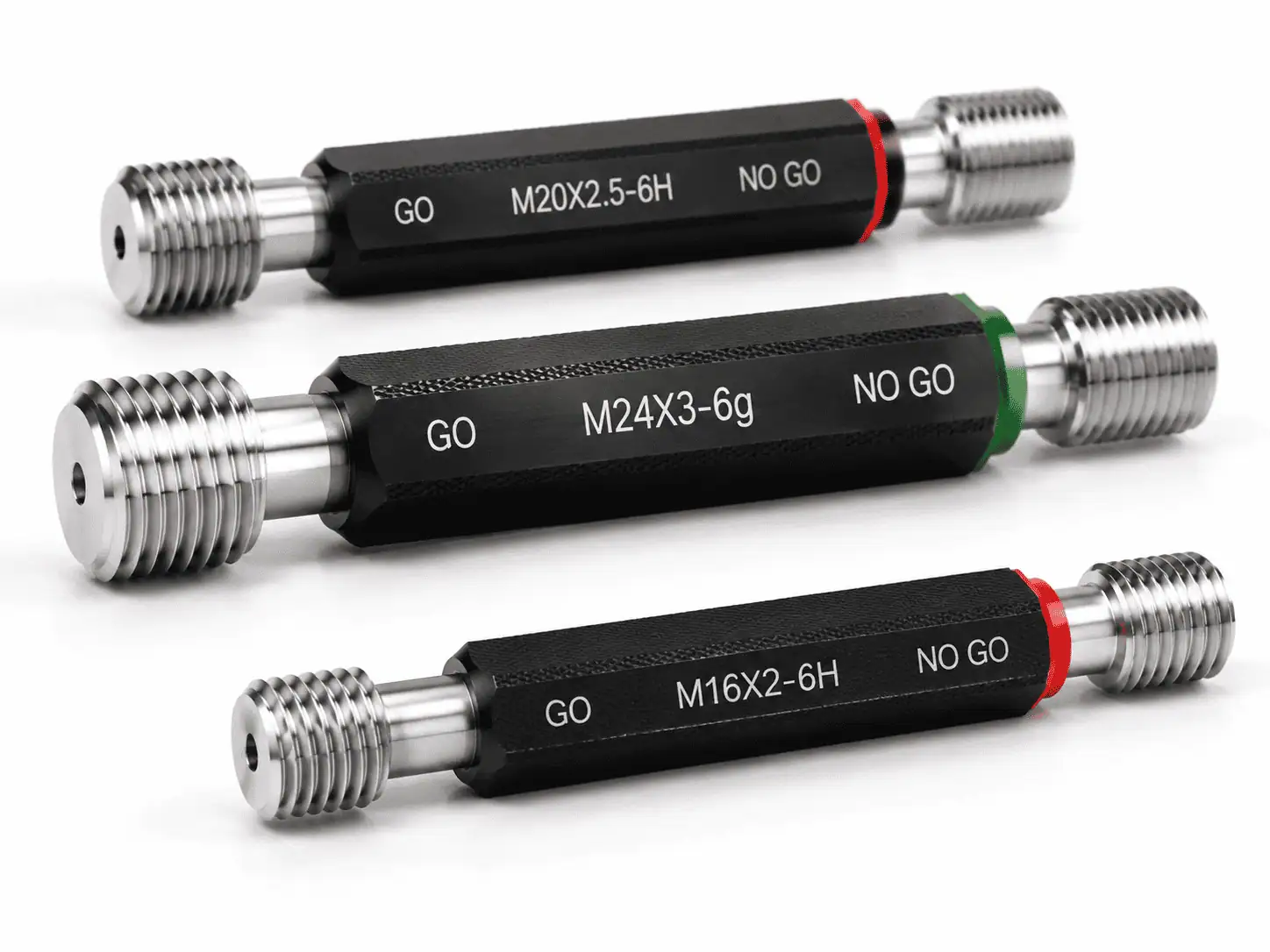
Need gauges for this? GageTools manufactures GO/NO-GO thread plug gauges and thread ring gauges in Dongguan, China. Standard sizes ship from stock within 72 hours, MOQ is 1 piece, and every RFQ gets a reply within 24 hours — request a quote.
Side-by-Side Comparison
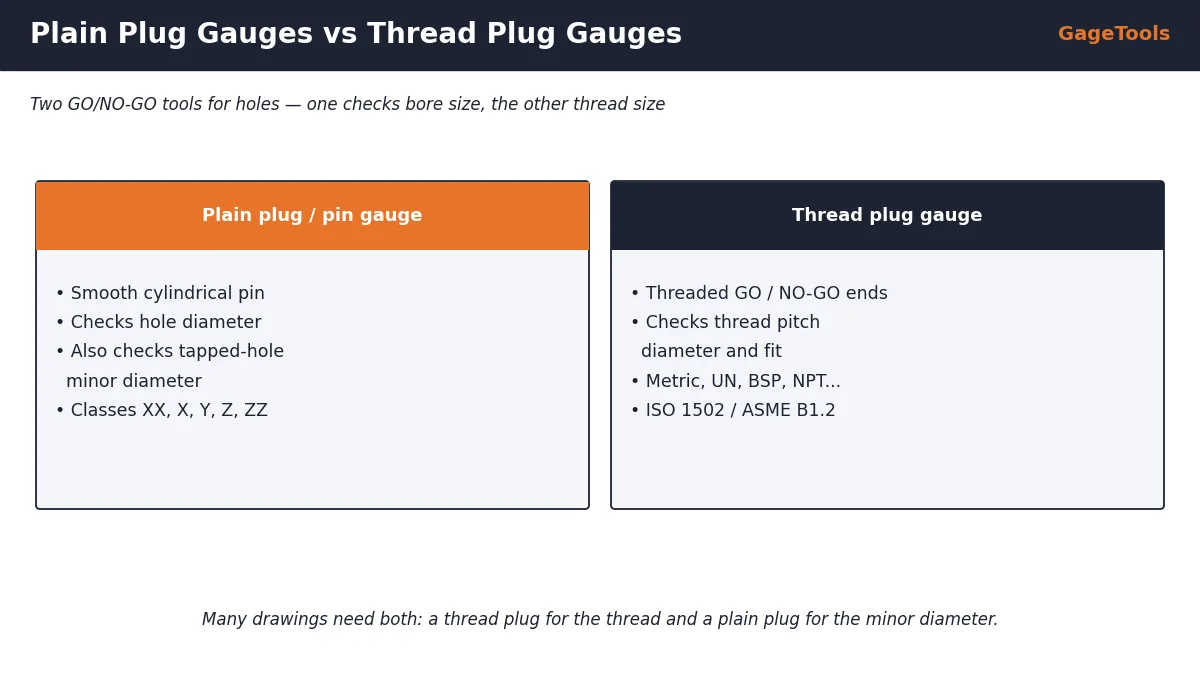
| Plain plug / pin gauge | Thread plug gauge | |
|---|---|---|
| Shape | Smooth cylinder | Threaded GO / NO-GO ends |
| Checks | Hole diameter | Pitch diameter and thread fit |
| Tolerance classes | XX, X, Y, Z, ZZ (ASME B89.1.5) | Per ISO 1502 / ASME B1.2 |
| Typical use | Bores, pin holes, minor diameter | Tapped holes, threaded bores |
| Form | Single pins, sets or GO/NO-GO handles | Double-end or single-end gauges |
Why Tapped Holes Often Need Both
A thread plug gauge checks the pitch diameter and fit, but it does not check the minor diameter of the internal thread. If the tap drill is oversize, the thread can pass the thread plug gauge while having too little thread engagement — and strip under load.
Check the minor diameter on critical tapped holes. Drawings for aerospace, automotive safety and high-load joints often specify minor diameter limits — use a plain GO/NO-GO plug for them.
Plain Plug Gauge Classes
| Class | Relative tolerance | Typical use |
|---|---|---|
| XX | Tightest | Masters, setting gauges |
| X | Very tight | High-precision inspection |
| Y | Tight | General precision inspection |
| Z | Standard | General production |
| ZZ | Widest | Coarse production checks |
A common rule is to choose a class whose gauge tolerance is a small fraction of the part tolerance. The tighter the class, the higher the cost.
Minor Diameter Limits for Common Threads
For 6H internal metric threads the minor diameter tolerance is defined in ISO 965. As a practical guide, the tap drill sizes below produce minor diameters inside the 6H range:
| Thread | Tap drill (mm) | Plain plug purpose |
|---|---|---|
| M6x1 | 5.0 | GO/NO-GO on minor diameter |
| M8x1.25 | 6.8 | GO/NO-GO on minor diameter |
| M10x1.5 | 8.5 | GO/NO-GO on minor diameter |
| M12x1.75 | 10.2 | GO/NO-GO on minor diameter |
| M16x2 | 14.0 | GO/NO-GO on minor diameter |
Take the exact minor diameter limits from the standard or your drawing when ordering plain plug gauges.
Pin Gauge Sets vs GO/NO-GO Plain Plugs
Pin sets are flexible and good for investigation; GO/NO-GO plain plugs are faster and less error-prone for repeated production checks of one hole size.
Common Mistakes
| Mistake | Consequence | How to avoid |
|---|---|---|
| Relying only on the thread plug for critical tapped holes | Oversize tap drill not caught | Add minor-diameter plain plug |
| Using a pin gauge to “check” a thread | False confidence | Use thread plug gauges for threads |
| Forcing pins into tight holes | Damaged pins and parts | Hand pressure only |
| Wrong plain plug class | Gauge error eats part tolerance | Choose class by part tolerance |
Plain Plug Gauges for Non-Threaded Holes
Plain plug gauges are the standard way to check drilled, reamed and bored holes in production. Typical applications include dowel holes, bearing seats, bushing bores and cross-holes.
| Hole type | Typical check | Gauge |
|---|---|---|
| Dowel / pin hole | Diameter within tight limits | GO/NO-GO plain plug |
| Reamed hole | Size and roundness (partly) | Plain plug; CMM for form |
| Tap drill hole | Before tapping | Plain plug |
| Cross hole | Size and position (with fixture) | Plain plug + fixture |
A plain plug checks size, but not roundness or straightness completely. For critical form requirements, add CMM or air gauging.
Ordering Thread and Plain Plugs Together
For a tapped hole that needs both checks, order the gauges together so they match:
- Thread plug gauge: thread size, pitch and class (e.g. M10x1.5-6H).
- Minor-diameter plain plug: GO and NO-GO sizes from the drawing or ISO 965 limits.
- Optional: a depth-marked GO for blind holes.
- Mark both gauges with the same characteristic number from your control plan.
Plain Plug Gauge Tolerance Classes in Numbers
ASME B89.1.5 defines gauge maker’s tolerances for plain plug and ring gauges by class and size. The exact values depend on diameter, but the relationship between classes is roughly:
| Class | Relative tolerance | Typical role |
|---|---|---|
| XX | 1× (tightest) | Master gauges |
| X | About 2× XX | Precision gauges |
| Y | About 3–4× XX | Precision production |
| Z | About 5–6× XX | General production |
| ZZ | About 10× XX | Coarse production |
Use the actual tables from the standard or your supplier’s data when specifying a class.
Materials for Plain Plug Gauges
| Material | Benefit | Typical use |
|---|---|---|
| Hardened tool steel | Economical, good wear | Most production plugs |
| Chrome-plated steel | Corrosion and wear resistance | Humid environments |
| Carbide | Very high wear resistance | High-volume, abrasive materials |
| Ceramic | Wear and corrosion resistance, non-magnetic | Special applications |
For tapped-hole minor diameter checks, hardened steel is usually sufficient unless volumes are very high.
Summary
How to Use a Plain GO/NO-GO Plug
- Clean the hole and the gauge.
- Insert the GO end by hand with light pressure; it should pass through the full depth to be checked.
- Try the NO-GO end; it should not enter (or should not pass beyond a very small start).
- Never twist or force a plain plug — it can seize in a tight hole.
- Record the result and return the gauge to its holder.
Unlike thread gauges, plain plugs are pushed rather than screwed. In a tight hole, a forced plug can jam, so gentle handling matters.
Key Terms
Quick definitions of the terms used in this guide:
| Term | Meaning |
|---|---|
| Plain plug gauge | Smooth GO/NO-GO pin for hole diameter |
| Pin gauge | Single precision pin, often sold in sets |
| Thread plug gauge | Threaded GO/NO-GO gauge for internal threads |
| Minor diameter | Diameter at the crests of an internal thread |
| ASME B89.1.5 | Standard for plain gauge tolerances |
| Class XX–ZZ | Plain gauge tolerance classes, tightest to widest |
Examples: Which Gauges for Which Hole?
| Hole on drawing | Gauges needed |
|---|---|
| Ø8 H7 dowel hole | Plain GO/NO-GO plug Ø8 H7 |
| M8x1.25-6H tapped hole | M8x1.25-6H thread plug |
| M8x1.25-6H, minor Ø controlled | Thread plug + plain plug for minor diameter |
| M8x1.25-6H blind, 12 mm full thread | Thread plug with depth mark |
| Ø6.8 tap drill before tapping | Plain plug Ø6.8 (process check) |
Listing each hole and its gauges in the control plan makes inspection consistent and ordering straightforward.
Practical Tips for Plain and Thread Plug Gauges
Using both gauge types on the same hole works best with a clear routine:
- Check the plain plug on the tap drill hole before tapping when possible.
- Check the thread plug after tapping.
- Mark the plain plug and thread plug with the same characteristic number.
- Store both gauges together at the station.
- Never force either gauge into a tight hole.
When a Plain Plug Is Not Enough
Plain plugs confirm that a hole is within its size limits where the gauge enters, but they cannot measure roundness, straightness, position or surface finish. For holes with tight form or position tolerances, combine plain plug gauging with CMM measurement, air gauging or dedicated position gauges, as your drawing and customer require.
Next Steps
Send the hole and thread specifications from your drawing — thread callout, class, minor diameter limits if controlled, and depth for blind holes. We will quote matched thread plug and plain plug gauges, marked with your characteristic numbers if required.
Ordering Tips
- Thread plug: thread size, pitch and class
- Plain plug: diameter, tolerance and gauge class
- Quantity and certificate requirement
Need Thread or Plain Plug Gauges?
Send the hole and thread specifications. We quote thread plug gauges and plain plug gauges together.
Related: Thread plug gauges · Blind hole gauging · GO/NO-GO buying guide
Frequently Asked Questions
✓ 20+ years gauge manufacturing
✓ ISO 9001:2015 certified
✓ In-house CNC grinding & inspection
✓ Drawing / RFQ reply within 24h
Order Thread Plug and Plain Plug Gauges
GageTools supplies GO/NO-GO thread plug gauges, plain plug gauges and pin gauges for hole and thread inspection. ISO/IEC 17025 calibration certificate available on request. Standard sizes ship from stock within 72 hours; custom gauges in 10–15 working days. MOQ 1 piece. WhatsApp for fastest response.
💬 WhatsApp Quote 📐 Send Drawing for Quote