
Need gauges for this? GageTools manufactures GO/NO-GO thread plug gauges and thread ring gauges in Dongguan, China. Standard sizes ship from stock within 72 hours, MOQ is 1 piece, and every RFQ gets a reply within 24 hours — request a quote.
API Thread Types You Will Meet
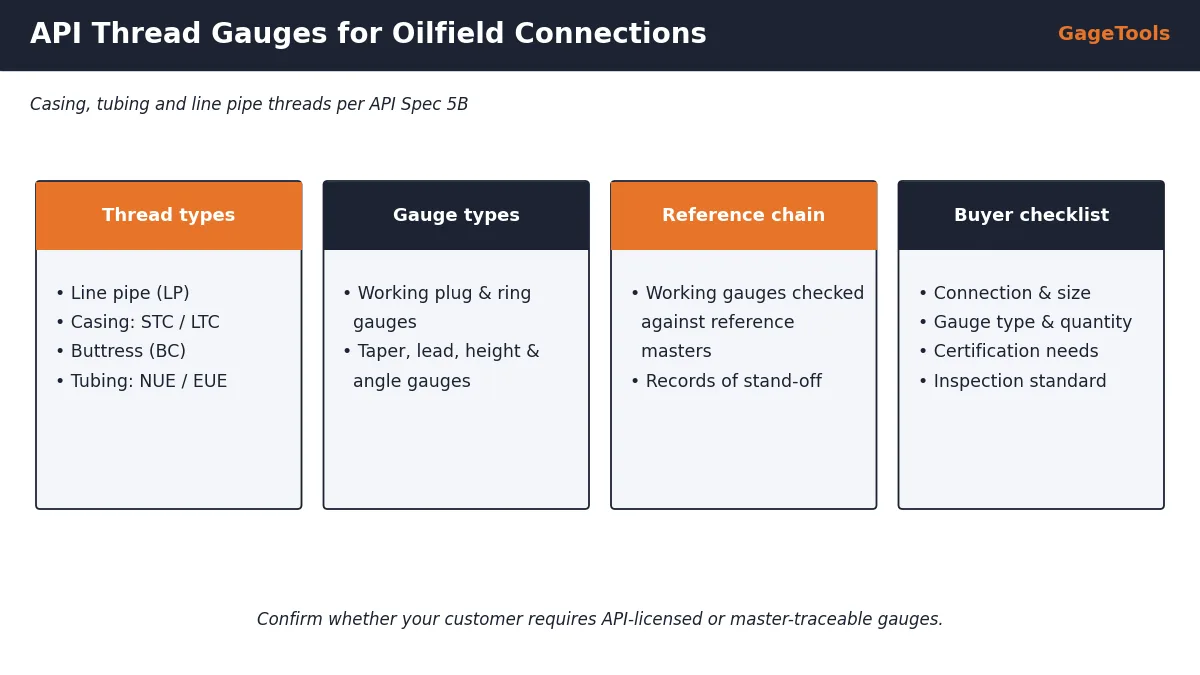
| Connection | Abbreviation | Typical use |
|---|---|---|
| Line pipe | LP | Pipelines and general piping |
| Short round thread casing | STC | Well casing |
| Long round thread casing | LTC | Well casing, higher load |
| Buttress thread casing | BC | High-load casing strings |
| Non-upset tubing | NUE | Production tubing |
| External-upset tubing | EUE | Production tubing, stronger joint |
Gauges Used on API Threads
- Checking stand-off at the gauging plane
- Pipe ends (ring gauge)
- Couplings and boxes (plug gauge)
- Daily production and incoming inspection
Working gauges wear with use and are periodically compared with reference masters so their stand-off values stay known.
- Taper per inch or per foot
- Lead (pitch accuracy)
- Thread height (depth)
- Flank angle
Stand-off alone cannot show whether taper or lead is wrong. Element gauges catch these errors before they cause leaks or galling.
The Reference Chain: Why Masters Matter
API gauging relies on a chain: reference master gauges define the size, working gauges are checked against the masters, and parts are checked with the working gauges. A break anywhere in that chain means part acceptance can no longer be trusted.
API licensing is a specific program. Not every gauge made to API dimensions is an API-licensed gauge. If your customer requires licensed gauges or specific traceability, state it in your RFQ so the quotation covers the right product.
What Is Inspected on an API Thread
API threads are inspected on several parameters, not just size. Each parameter has its own gauge or method:
| Parameter | What it controls | Typical gauge / method |
|---|---|---|
| Stand-off | Overall size at the gauging plane | Working plug / ring gauge |
| Taper | Change in diameter along the thread | Taper gauge |
| Lead | Pitch accuracy along the thread | Lead gauge |
| Thread height | Depth of thread form | Height gauge |
| Thread form / angle | Flank angles, crest and root | Profile / optical check |
| Length and chamfer | Thread length, bevel | Measuring tools per specification |
A thread that passes stand-off but has taper or lead errors can gall on make-up or leak under pressure. That is why oilfield inspection plans combine ring and plug gauges with element gauges.
Setting Up a Gauge Program for API Threads
- List every connection, size and grade your plant threads or inspects.
- Define which parameters are checked at each station (machining, final inspection, incoming).
- Assign working gauges to stations and element gauges to inspection.
- Define how working gauges are verified against reference masters, and how often.
- Keep records of stand-off values over time to spot wear trends.
- Train inspectors on hand-tight make-up and reading stand-off consistently.
- Qualified calibration lab
- Controlled storage
- Minimal use
Reference masters should only be used to verify working gauges, never on production parts, so they stay stable for years.
Field Conditions and Gauge Care
Oilfield gauges are often used in yards and pipe mills rather than clean labs. Sand, scale, dope and temperature swings all affect results.
- Clean thread compound and debris from both part and gauge before gauging.
- Let gauges and pipe reach similar temperatures; large steel parts in the sun expand noticeably.
- Protect gauges from impact — a dented ring face changes stand-off readings.
- Store gauges in cases, lightly oiled, and inspect for damage before each shift.
Why Stand-Off Matters for Make-Up
On a tapered oilfield connection, the stand-off measured with the working gauge tells you where the pipe and coupling will meet when made up. If stand-off is outside its limits, the connection may make up too far (over-stressing the coupling) or not far enough (leaving too little engagement to seal and carry load).
Stand-off is therefore both a size check and a predictor of how the joint will behave in the field. That is why working gauges must themselves be verified regularly: a worn gauge shifts every stand-off reading and moves the whole production process off target without anyone noticing.
| Stand-off result | Likely field effect |
|---|---|
| Within limits | Normal make-up and sealing |
| Too much (part undersize) | Joint makes up too far; possible over-stress |
| Too little (part oversize) | Insufficient make-up; sealing and strength risk |
What to Ask a Gauge Supplier
Clear answers to these questions before ordering avoid surprises at the customer’s audit.
Buttress vs Round Threads
API casing is supplied with either round threads (STC/LTC) or buttress threads (BC). They behave differently and need different gauges.
| Feature | Round thread (STC / LTC) | Buttress (BC) |
|---|---|---|
| Thread form | Symmetric, rounded crests and roots | Asymmetric: steep load flank, sloping stab flank |
| Load capacity | Good | Higher axial load capacity |
| Sealing | Relies on thread compound in the helical gap | Relies on thread compound; more gaps |
| Gauges | Round-thread working gauges | Buttress working gauges |
| Typical use | Standard casing strings | Deeper wells, heavier loads |
Because the flank shapes are different, a round-thread gauge cannot be used on buttress threads, even at the same pipe size.
Documentation Oilfield Customers Expect
- Gauge identification with connection, size and serial number
- Calibration or verification record against reference masters
- Stand-off values recorded at each verification
- Certificate of conformity for new gauges
- Traceability statement for measuring equipment
Some operators also request inspection reports for the threads themselves. Clarify whether you need gauge documentation only, or product inspection documentation as well.
Storing and Transporting API Gauges
API ring and plug gauges are heavy and expensive. Protect them in fitted, lockable cases; keep them lightly oiled; and never transport them loose on a truck bed. A dropped ring gauge can be damaged in ways that are not visible but change stand-off readings. After any impact, verify the gauge before use.
Training Inspectors on API Gauging
API thread inspection results depend heavily on technique. Pipe mills and service companies usually train and qualify inspectors before they are allowed to accept threads.
- How to clean threads and gauges properly in field conditions.
- How to apply ring and plug gauges hand-tight without cocking them on the thread.
- How to read and record stand-off consistently.
- How to use taper, lead and height gauges, including zero-setting.
- When to reject, when to re-inspect and when to escalate.
Periodic comparison between inspectors on the same pipes — similar to an attribute study — shows whether technique is consistent across shifts and sites.
Key Terms
Quick definitions of the terms used in this guide:
| Term | Meaning |
|---|---|
| API Spec 5B | API specification for casing, tubing and line pipe threads and gauging |
| Working gauge | Gauge used on production threads |
| Reference master | Gauge used to verify working gauges |
| Stand-off | Gauge position relative to the part at hand-tight |
| Taper | Change in diameter per unit length |
| Lead | Axial advance per thread; accuracy along the thread |
| Thread height | Depth of the thread form |
| STC / LTC | Short / long round thread casing |
| BC | Buttress thread casing |
| EUE / NUE | External-upset / non-upset tubing |
| Make-up | Screwing the connection together to specified position or torque |
Summary
API thread gauging combines working ring and plug gauges for stand-off with element gauges for taper, lead and height, all traceable to reference masters. Because stand-off predicts how a connection makes up in the field, both the gauges and the inspectors’ technique must be controlled. Confirm licensing, documentation and connection details before ordering, and protect heavy gauges carefully in storage and transport.
What to Specify When Ordering
- Connection type and size (e.g. 2 7/8″ EUE tubing, 9 5/8″ BC casing)
- Which gauges: working ring/plug, element gauges, or both
- Whether API-licensed or master-traceable gauges are required
- Quantity and the inspection standard your customer uses
- Certificate and record requirements
Need API Thread Gauges?
Tell us the connection, size, gauge types and the documentation your customer requires. We review the specification before quoting.
Related: Pipe thread gauges · Traceability · Calibration guide
Frequently Asked Questions
✓ 20+ years gauge manufacturing
✓ ISO 9001:2015 certified
✓ In-house CNC grinding & inspection
✓ Drawing / RFQ reply within 24h
Request API Thread Gauge Pricing
GageTools supplies thread gauges for oilfield and pipe threads, with documentation to match your customer’s requirements. ISO/IEC 17025 calibration certificate available on request. Standard sizes ship from stock within 72 hours; custom gauges in 10–15 working days. MOQ 1 piece. WhatsApp for fastest response.
💬 WhatsApp Quote 📐 Send Drawing for Quote