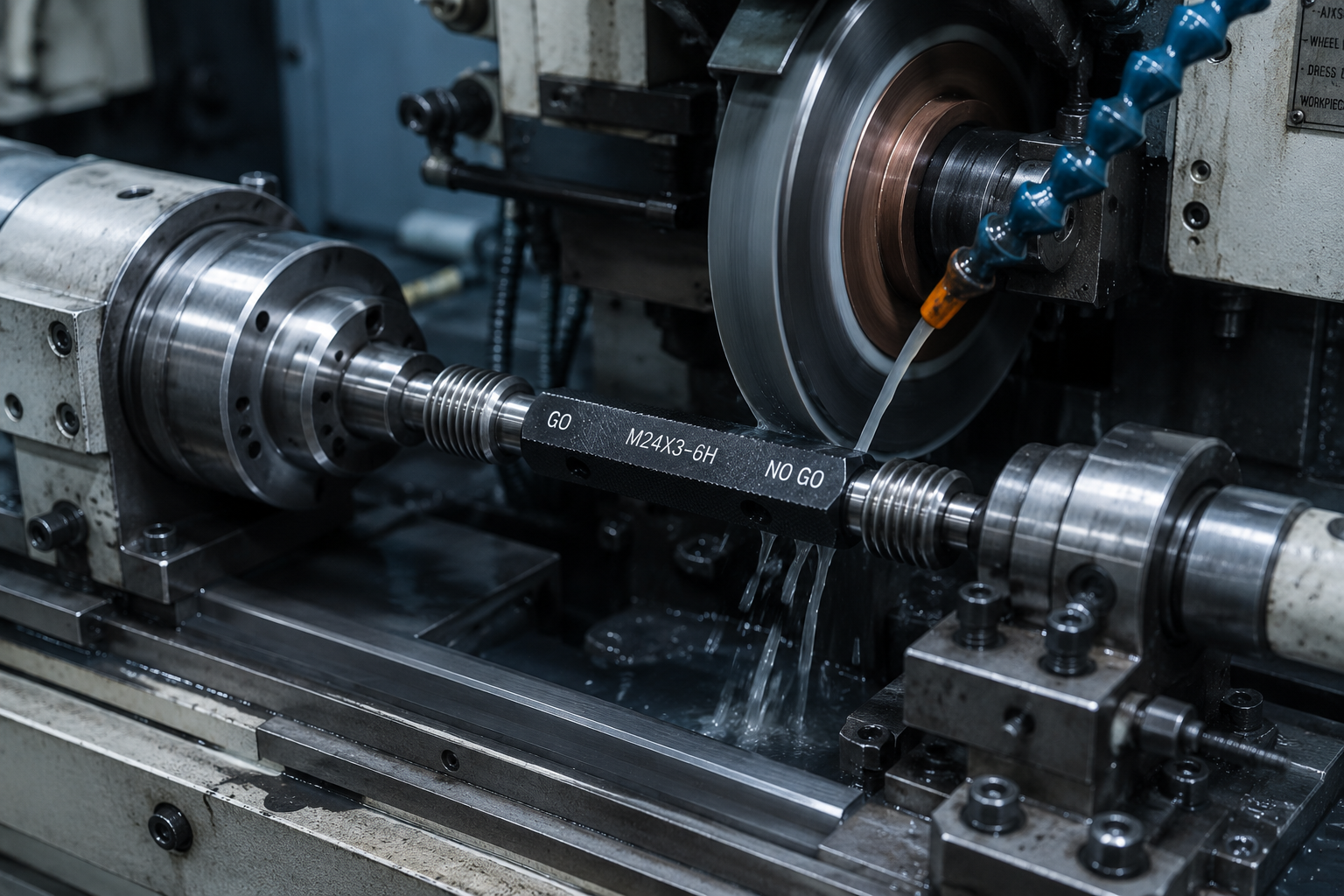
Choosing the wrong thread gauge supplier costs more than the gauge itself — rejected parts, failed audits, and production shutdowns all trace back to inaccurate tooling. This guide gives you eight specific questions to ask any supplier before placing an order, plus the answers a qualified supplier should be able to give without hesitation.
ISO 9001 certification means the supplier’s quality management system has been independently audited and found to meet the international standard for consistent production quality. It is the minimum acceptable baseline for any gauge supplier you are seriously considering.
The key word is show. Any supplier can claim ISO 9001. A qualified supplier will send you the certificate within minutes — with the accreditation body name, certificate number, scope of certification, and expiry date clearly shown. Verify the certificate is current through the accreditation body’s online registry before proceeding.
Watch out for: “We follow ISO 9001 procedures” without a certificate number. Following procedures is not the same as being certified. Only an independently audited and issued certificate is acceptable.
This is the single most important question on this list. A calibration certificate is not a label or a sticker — it is a document from an accredited laboratory showing the actual measured pitch diameter, major diameter, minor diameter, pitch, and thread angle of your specific gauge, compared against the nominal values and tolerance limits.
There are two types of documents suppliers provide. Only one is acceptable for production inspection:
- Shows actual measured values for each dimension
- Issued by ISO/IEC 17025 accredited lab
- NIST-traceable measurement chain
- Signed by technician and approver
- Measurement uncertainty stated
- Says only “conforms to specification”
- No actual measured values shown
- Not issued by accredited laboratory
- Not acceptable for ISO 9001 audits
- Provides no evidence of actual dimensions
Thread gauges require CNC thread grinding to tolerances of ±0.001mm. A supplier who subcontracts grinding has no direct control over the most critical production step. This means longer lead times, higher risk of dimensional variation between batches, and limited ability to resolve quality issues quickly.
An in-house manufacturer controls every step from raw material to final calibration — giving you consistent quality, faster delivery, and direct accountability when something goes wrong.
Useful follow-up: Ask for a factory photo showing the grinding equipment. A genuine manufacturer can send this within minutes. A trader will hesitate or send a stock image.
For most B2B buyers, evaluating a sample before placing a production order is standard practice — especially for gauges that will be used in ongoing production inspection. The sample lead time tells you a great deal about the supplier’s production capacity and order management.
A supplier with genuine in-house grinding capacity can typically deliver a standard metric or UN thread gauge sample within 3 to 5 working days. A lead time of 3 to 4 weeks for a sample usually indicates the supplier is a trader placing your order with a third-party manufacturer.
Standard catalogue gauges cover most applications. But in precision engineering, aerospace, oil and gas, and medical device manufacturing, non-standard thread forms are common — custom pitches, special tolerance classes, multi-start threads, or threads to proprietary drawing dimensions.
A manufacturer with genuine CNC grinding capability can produce custom gauges from a drawing or dimensional specification. A trader cannot — they will either decline or place the order with a manufacturer who may not have the required precision.
Test this claim: Send a non-standard thread drawing and ask for a quotation with lead time. A genuine manufacturer will respond with a technical quotation within 24 hours. A trader may take days or come back with vague pricing.
Thread gauges are not consumables — a single gauge can last years in production use. Most buyers need one or two gauges per thread size, not hundreds. A supplier with a high MOQ (minimum order quantity) is either a trader with high per-unit sourcing costs, or a manufacturer optimized for high-volume commodity production rather than precision custom tooling.
For gauge procurement, MOQ 1 is the standard expectation from a qualified manufacturer. Higher MOQs are a signal to investigate further.
Global supply chains require gauges for multiple thread standards — a buyer in Germany needs DIN 13 metric gauges, an automotive supplier in the USA needs ASME B1.1 UN gauges, a hydraulics company in the UK needs ISO 228 BSP gauges. A supplier limited to one or two standards will become a bottleneck as your sourcing needs expand.
| Standard | Thread Type | Gauge Standard | Typical Region |
|---|---|---|---|
| ISO 261 / DIN 13 | Metric M1–M100 | ISO 1502 | Global |
| ANSI/ASME B1.1 | UNC / UNF / UNEF | ASME B1.2 | USA / Canada |
| BS EN ISO 228 | BSPP (G thread) | ISO 228-2 | UK / EU / AUS |
| ISO 7 | BSPT (R / Rc / Rp) | ISO 7-2 | UK / EU / Asia |
| ANSI B2.1 | NPT / NPTF | ANSI B2.1 | USA / Canada |
| ASME B1.5 | ACME / Stub ACME | ASME B1.5 / B1.8 | USA / Canada |
| DIN 103 / ISO 2903 | Trapezoidal (Tr) | DIN 103 | Europe / Global |
Even with rigorous in-house quality control, a gauge can occasionally arrive outside specification due to handling damage, shipping conditions, or measurement variation. How a supplier responds to this situation tells you more about their reliability than their brochure ever will.
A qualified supplier will have a clear, documented policy — and will not require lengthy negotiation to resolve a legitimate quality issue. Ask this question directly and listen carefully to the answer.
Vague answers are a red flag. “We will handle it case by case” means there is no policy — and no guarantee of resolution. A supplier confident in their quality control will have a specific, committed answer.
Need gauges for this? GageTools manufactures GO/NO-GO thread plug gauges and thread ring gauges in Dongguan, China. Standard sizes ship from stock within 72 hours, MOQ is 1 piece, and every RFQ gets a reply within 24 hours — request a quote.
Supplier Evaluation Scorecard
Use this table to compare suppliers side by side before placing your order. A qualified supplier should be able to answer Yes to all eight criteria.
Red Flags — Walk Away From Any Supplier Who Says These Things
- “We follow ISO 9001 procedures” (no certificate shown)
- “Certificate included” but no actual measured values on the document
- “Sample lead time is 3–4 weeks” for a standard metric gauge
- “MOQ is 50 pieces minimum” for thread gauges
- “We will handle quality issues case by case”
- Unable to confirm which tolerance class the gauge is made to
- Cannot send factory photos of grinding equipment within 24 hours
- Price significantly below market without explanation
On unusually low pricing: Thread gauge grinding to ±0.001mm requires premium tool steel, precision CNC grinding machines, and calibrated measurement equipment. A gauge priced 60–70% below market rate has almost certainly compromised on one or more of these inputs — typically material hardness, grinding tolerance, or calibration accuracy. The gauge may pass initial visual inspection but will wear rapidly and produce false acceptance results within weeks of production use.
Frequently Asked Questions
How many suppliers should I qualify before placing an order?
For production-critical gauges, qualify at least two suppliers using the eight questions above. This gives you a backup source if lead times change, and gives you a baseline for comparing quality and pricing. For non-critical gauges, one qualified supplier is sufficient.
Is a factory audit necessary before placing a first order?
A full factory audit is standard practice for large-volume or safety-critical applications. For initial orders, requesting verifiable certificates, sample gauges with calibration documentation, and factory photos of grinding equipment is usually sufficient to assess supplier capability. A qualified supplier will welcome this due diligence and respond promptly to all documentation requests.
Can I trust a calibration certificate from a Chinese manufacturer?
Yes — provided the certificate is issued by a laboratory accredited by CNAS (China National Accreditation Service for Conformity Assessment), which is a signatory to the ILAC Mutual Recognition Arrangement. CNAS-accredited calibration is internationally recognized and accepted by ISO 9001 auditors, IATF 16949 auditors, and AS9100 auditors worldwide. Always verify the CNAS accreditation number through the CNAS public registry at cnas.org.cn before accepting the certificate.
Should I ask for a sample before placing a bulk order?
Always, if the application is production-critical. A sample with its calibration certificate gives you direct evidence of the supplier’s actual dimensional capability — not just their claimed capability. Compare the actual measured values on the certificate against the nominal values and tolerance limits. The closer the actual values are to nominal (rather than to the tolerance limit), the higher the supplier’s manufacturing precision.
Ready to Qualify GageTools?
Send us your thread specification and we will respond with pricing, lead time, sample availability, and our ISO 9001:2015 and ISO/IEC 17025 certificates — within 24 hours. MOQ 1 piece. Calibration certificate available on request.
Send RFQ by Email → 💬 WhatsAppRelated Buyer Guides
- Thread Gauge Manufacturer vs Trader: What’s the Difference and Why It Matters
- How to Compare Thread Gauge Manufacturer Quotes
- Custom Thread Gauge Sampling: Process, Cost and Timeline Before You Order in Bulk
✓ 20+ years gauge manufacturing
✓ ISO 9001:2015 certified
✓ In-house CNC grinding & inspection
✓ Drawing / RFQ reply within 24h
Have a drawing or thread callout ready? Request a thread gauge quote and our engineering team will review your specification.
Pingback: Thread Gauge Manufacturer vs Trader: Buyer Guide
Pingback: How to Compare Thread Gauge Manufacturer Quotes - GageTools