Most thread gauge buyers never find out whether they are buying from a manufacturer or a trader — until something goes wrong. A wrong-sized batch, a three-week delay on a replacement, a calibration certificate that cannot be verified. This guide explains the difference, how to tell them apart in under five minutes, and why it matters for your quality system and procurement cost.
Need gauges for this? GageTools manufactures GO/NO-GO thread plug gauges and thread ring gauges in Dongguan, China. Standard sizes ship from stock within 72 hours, MOQ is 1 piece, and every RFQ gets a reply within 24 hours — request a quote.
The Core Difference
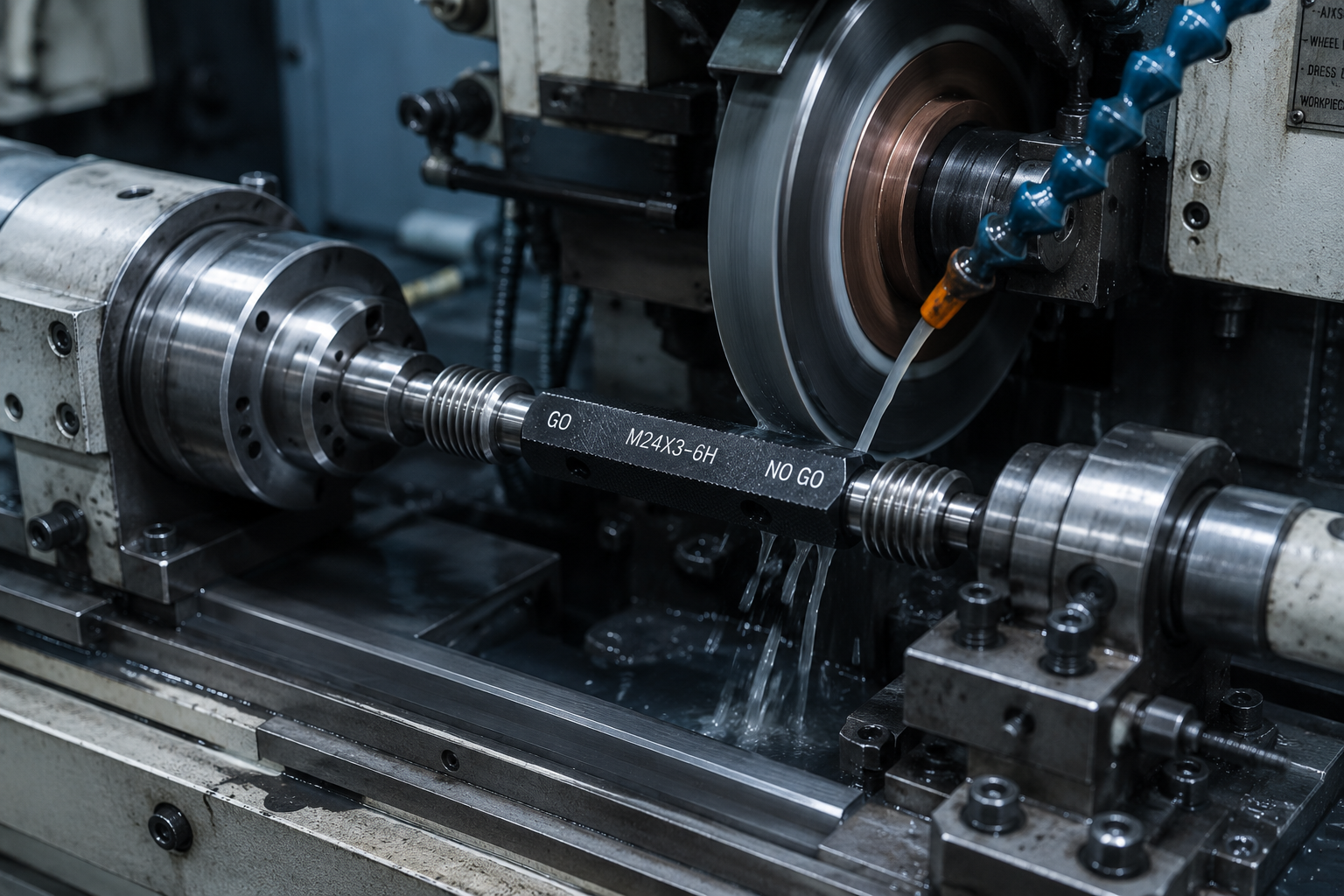
A thread gauge manufacturer owns the production equipment — CNC grinding machines, lapping equipment, CMM measurement systems, and a calibration laboratory. They grind every thread gauge on their own machines, inspect every gauge in their own lab, and issue calibration certificates from their own accredited facility.
A trader (also called a reseller, distributor, or sourcing agent) does not own any production equipment. They receive your order, place it with one or more manufacturers, mark up the price, and forward the gauge to you — often with a rebranded certificate or packaging. Some traders are transparent about this; many are not.
Important: Traders are not always a bad choice — for standard off-the-shelf gauges where speed and local stock matter, a reputable trader with transparent sourcing can be a valid option. The problem is when a trader presents themselves as a manufacturer, or when the application requires direct manufacturing accountability — custom gauges, calibration traceability, or rapid quality resolution.
How to Tell a Manufacturer from a Trader in 5 Minutes
Ask these three questions. A manufacturer can answer all three immediately and with specifics. A trader will hesitate, give vague answers, or need to “check with the factory.”
How Manufacturer vs Trader Affects Your Quality System
Every gauge is produced and calibrated under one roof. The calibration certificate references the manufacturer’s own accredited lab — with a verifiable accreditation number, actual measured values, and a documented measurement uncertainty. This certificate is accepted by ISO 9001, IATF 16949, and AS9100 auditors without question.
- Certificate issued by accredited in-house lab
- Accreditation number verifiable online
- Actual measured values shown for every dimension
- Full traceability chain documented
- Quality disputes resolved directly — no middleman
The trader receives the gauge and certificate from the manufacturer, then may rebrand the certificate with their own company name — removing the original lab’s accreditation details. This creates a traceability gap: your quality system holds a certificate from a company that has no calibration lab, with no verifiable accreditation number.
- Certificate may show trader name, not accredited lab
- No accreditation number to verify
- Audit risk: certificate may not satisfy ISO 9001 clause 7.1.5
- Quality disputes require trader to contact manufacturer
- Resolution time 2–4× longer than direct manufacturer
Audit risk: If your quality auditor asks for calibration traceability documentation and the certificate shows a company name that has no ISO/IEC 17025 accreditation on record, you have a nonconformance. This is a real and common finding in IATF 16949 and AS9100 audits. Always verify the certificate issuer’s accreditation before accepting gauges for production use.
Lead Time: Why It Is So Different
Lead time is where the manufacturer vs trader difference is most visible in day-to-day procurement. The table below shows typical timelines for the same order placed with each type of supplier.
| Order Type | From Manufacturer | From Trader |
|---|---|---|
| Standard metric plug gauge sample | 72 hours | 2–3 weeks |
| Standard metric ring gauge sample | 72 hours | 2–3 weeks |
| Custom non-standard gauge | 5–10 working days | 4–6 weeks |
| Replacement for out-of-spec gauge | 72–96 hours | 2–4 weeks |
| Urgent production order (10 pcs) | 3–5 working days | 3–5 weeks |
| Recalibration and return | 5–7 working days | 4–8 weeks |
The trader’s lead time is longer because every order goes through two additional steps — placing the order with the manufacturer, and waiting for the manufacturer to complete production before the trader can ship to you. In urgent situations, this difference can halt a production line.
Price: What You Are Actually Paying For
You pay the factory price directly. The manufacturer’s margin covers production cost, quality control, calibration, and their profit. No additional layer.
Example: M12×1.75 6H plug gauge = $X (factory price)
You pay the factory price plus the trader’s margin — typically 20–40% above manufacturer price. The trader adds no manufacturing value; the margin covers their sourcing, handling, and profit.
Example: M12×1.75 6H plug gauge = $X × 1.3 (factory price + 30% trader margin)
For a single gauge, the price difference may seem small. For an annual procurement of 200–500 gauges across multiple thread standards, a 30% margin difference represents a significant cost. Direct manufacturer sourcing consistently returns 20–40% lower unit cost for equivalent quality.
Custom and Non-Standard Gauges: Manufacturer Only
For standard catalogue gauges — common metric sizes like M6, M8, M10, M12 in 6H/6g — a trader can source from stock and deliver without major issues. The gap between manufacturer and trader becomes critical when you need a non-standard gauge.
| Custom Requirement | Manufacturer | Trader |
|---|---|---|
| Non-standard pitch (e.g. M18×2.0) | Made to drawing in 5–10 days | Must find a manufacturer — 4–6 weeks |
| Special tolerance class (e.g. 4H) | Ground to spec directly | Limited manufacturers can do this |
| Proprietary thread form from DXF | Engineers review and quote | Cannot handle — no engineering team |
| Multi-start thread gauge | Feasibility confirmed in 24h | Likely to decline or delay |
| Customer-branded gauge (OEM) | NDA + custom marking available | Must negotiate with manufacturer |
| Urgently needed replacement gauge | Priority production possible | Cannot prioritize — no control |
Real Procurement Scenarios
5-Minute Supplier Verification Checklist
Before placing any thread gauge order, run through these checks. They take less than five minutes and eliminate the most common sourcing mistakes.
- Ask for factory photos of CNC grinding machines — real photos, not stock images
- Ask for the ISO/IEC 17025 accreditation number — verify on CNAS / UKAS / A2LA registry
- Ask for a sample calibration certificate — confirm it shows actual measured values, not just “conforms”
- Ask the lead time for a non-standard gauge (e.g. M22×1.5 6H) — a manufacturer answers in 24h
- Ask for the ISO 9001 certificate number — verify it is current and covers thread gauge manufacturing
- Ask what happens if a gauge arrives out of specification — listen for a specific, committed answer
- Check if the company name on the calibration certificate matches the company you are ordering from
Frequently Asked Questions
Is it always better to buy directly from a manufacturer?
For production-critical gauges, custom or non-standard gauges, and any application requiring verified calibration traceability — yes. For standard off-the-shelf gauges where you need fast local delivery and a reputable trader carries certified stock, a trader can be a valid choice, provided you verify the calibration traceability back to the original accredited lab.
How do I know if a Chinese supplier is a manufacturer or trader?
Ask for the ISO/IEC 17025 accreditation number of their calibration lab and verify it on the CNAS website (cnas.org.cn). Ask for photos of their thread grinding machines. Ask for a quotation on a non-standard gauge with a 48-hour response requirement. A genuine manufacturer passes all three tests easily. A trader fails at least two of them.
Can a trader provide a valid calibration certificate?
Only if the certificate shows the original accredited manufacturer’s lab name and accreditation number — not the trader’s name. A certificate rebranded with the trader’s name, with no verifiable accreditation number, is not a valid calibration certificate for ISO 9001 or IATF 16949 purposes.
Does buying from a manufacturer guarantee better quality?
Not automatically — but it does give you direct accountability and faster resolution when quality issues arise. A manufacturer controls every step of production and can investigate and resolve a dimensional issue in hours. A trader must contact the manufacturer, which adds days or weeks to resolution time. For quality-critical applications, direct accountability is essential.
What if I need gauges from multiple thread standards?
A manufacturer with full in-house capability can supply gauges for Metric, UN, BSP, NPT, ACME, and Trapezoidal threads from a single source — with consistent certification and a single point of accountability. A trader may source from different manufacturers for different standards, resulting in inconsistent certificate formats and multiple accountability chains.
Buying Direct from the Manufacturer
GageTools manufactures thread gauges in-house — CNC grinding, lapping, and ISO/IEC 17025 calibration all on one site. A full calibration certificate showing actual measured values is available on request. MOQ 1 piece. Sample in 72 hours.
Send RFQ by Email → 💬 WhatsAppRelated Buyer Guides
- How to Choose a Thread Gauge Supplier: 8 Questions to Ask Before You Order
- How to Choose a Thread Gauge Manufacturer in China
- How to Compare Thread Gauge Manufacturer Quotes
✓ 20+ years gauge manufacturing
✓ ISO 9001:2015 certified
✓ In-house CNC grinding & inspection
✓ Drawing / RFQ reply within 24h
Have a drawing or thread callout ready? Request a thread gauge quote and our engineering team will review your specification.
Pingback: How to Choose a Thread Gauge Supplier
Pingback: How to Compare Thread Gauge Manufacturer Quotes - GageTools