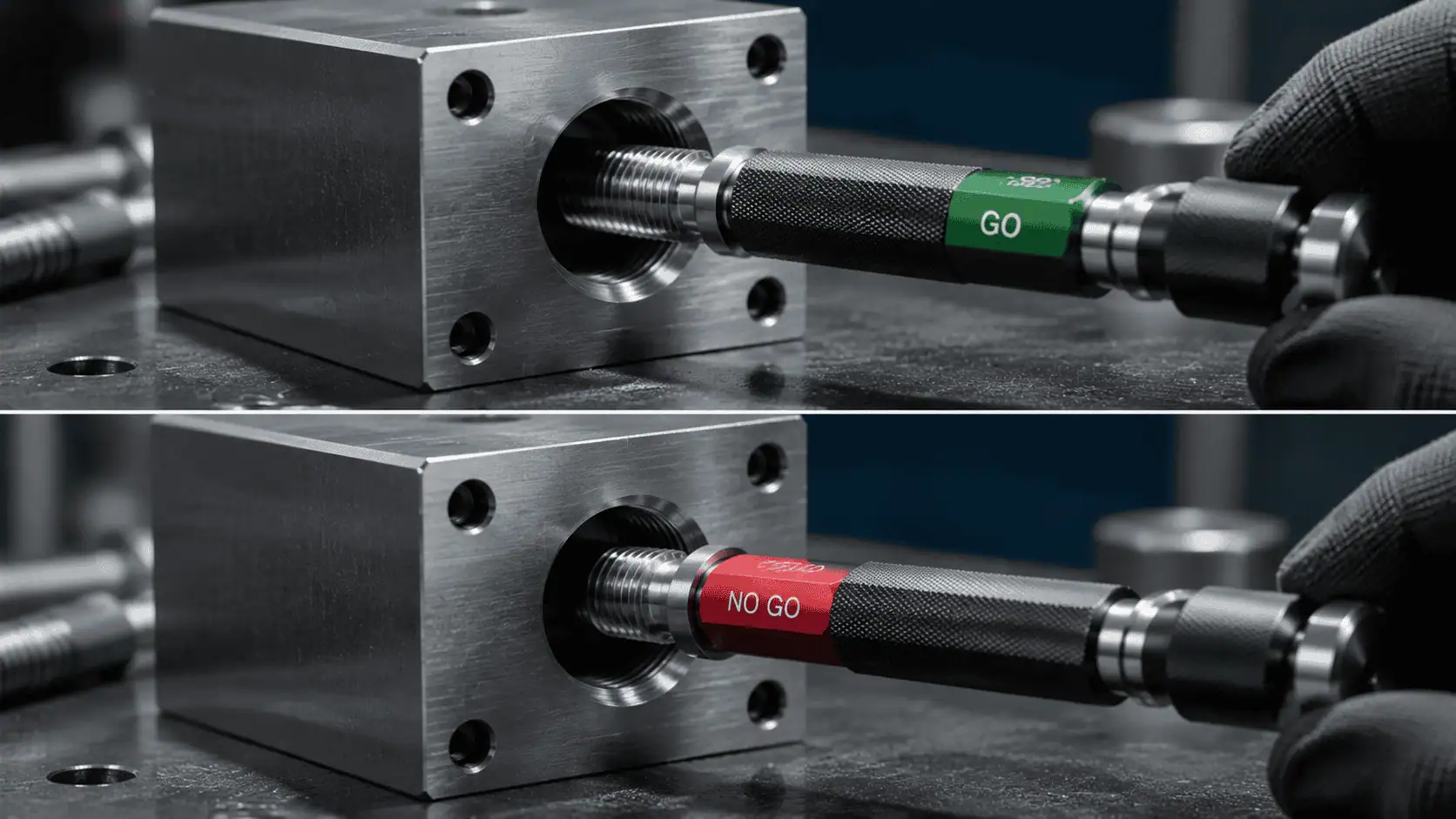
Need gauges for this? GageTools manufactures GO/NO-GO thread plug gauges and thread ring gauges in Dongguan, China. Standard sizes ship from stock within 72 hours, MOQ is 1 piece, and every RFQ gets a reply within 24 hours — request a quote.
How to Read a Thread Plug Gauge Result
A GO/NO-GO thread plug gauge gives two answers. The GO plug, with a full thread form, asks: will a correct screw assemble into this hole? The NO-GO plug, short and truncated, asks: is the pitch diameter larger than the maximum allowed? Each failure points to a different family of causes.
Read the result carefully, not just “pass/fail”. Where does the GO plug stop — at the first thread, halfway, or near the bottom? Does the NO-GO enter one turn, three turns or all the way? Is the problem on every part or every fifth part? These details narrow the cause quickly.
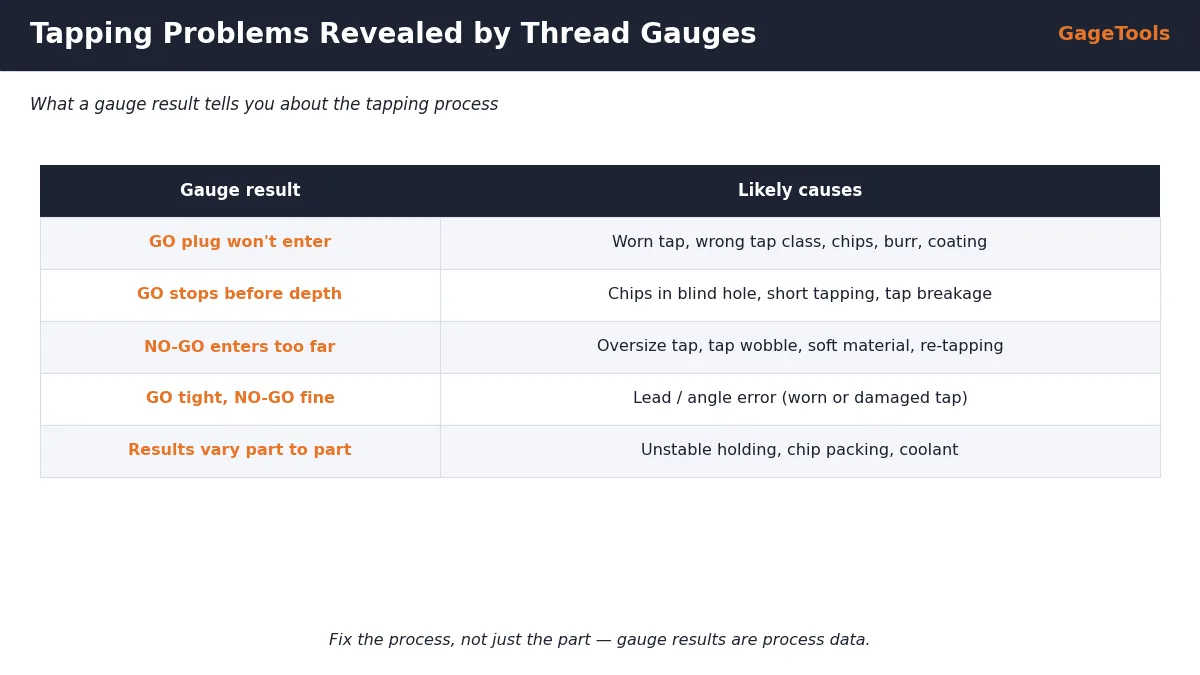
Troubleshooting Table: Gauge Result, Cause, Fix
Use this table as a first diagnosis. In most cases more than one cause is possible, so check the simplest (cleanliness and gauge condition) first.
| Gauge symptom | Likely causes | Fixes |
|---|---|---|
| GO will not enter at all | Wrong tap size or class; hole undersize; tap worn; chips packed at entry | Confirm tap marking vs drawing; replace tap; clean hole |
| GO enters a few turns, then stops | Chips packed in the thread; torn flanks; lead error from axial force | Improve chip evacuation; use floating or synchronised holder |
| GO tight near bottom of blind hole | Chip packing at bottom; tap not reaching depth; incomplete threads | Increase drill depth; peck; check depth setting |
| GO stops at the first thread | Burr or raised material at hole mouth; no countersink | Chamfer/countersink; deburr before gauging |
| NO-GO enters beyond limit | Tap class too large; tap oversize from regrind; soft material | Select smaller tap class; check tap PD; adjust speeds |
| NO-GO enters only at mouth | Bell-mouth from misalignment or tap wobble | Check spindle alignment; use rigid or synchronised tapping |
| NO-GO enters on some parts only | Tap run-out; holder wear; varying material | Check tap and holder run-out; material certificates |
| Results drift over the run | Tap wear | Track results; set a tap-change interval |
| Both plugs pass, screw still tight | Coating applied after gauging; damaged thread in handling | Gauge after coating; protect threads |
Never “fix” the problem by forcing the gauge. A GO plug driven in with a wrench or a NO-GO judged with extra effort gives a false result and wears or damages the gauge. Hand pressure only.
When the GO Plug Won’t Enter
A GO plug failure is the more urgent of the two, because it means a mating screw may not assemble. Work through the causes in this order:
- Check the gauge. Is it the right size, pitch and class? Is it clean, undamaged and within its calibration date?
- Clean the hole. Blow out chips and coolant, especially in blind holes. Re-check.
- Look at the hole mouth. A burr or raised lip stops the GO plug at the first thread. Countersinking the hole before tapping prevents it.
- Check the tap. Compare the tap marking with the drawing class. Inspect for worn or chipped teeth.
- Check the material. Stainless steel, titanium and some plastics spring back and close the hole after tapping. An oversize tap class may be needed.
- Check the machine. Axial force on a floating holder, or a feed that does not match the pitch, can distort the lead so the full-form GO plug binds.
A worn GO gauge will pass holes that are too small, not reject good ones — so a sudden GO rejection is rarely the gauge. For how gauge wear is judged, see thread plug gauge wear limits.
When the NO-GO Plug Enters
The NO-GO plug may start to engage on a good hole, but it must stop within the permitted turns: no more than two under ISO 1502 for metric threads, and no more than three complete turns under ASME B1.2 for unified threads. If it goes further, the pitch diameter is oversize.
Oversize holes come from tools and set-up rather than from the gauge. A tap that is one class too large for the material, a reground tap with poor pitch diameter control, a tap that runs out in the holder, or a spindle that is not aligned with the hole all enlarge the hole. Soft and gummy materials such as some aluminium alloys and copper also tend to tap oversize.
| Check | What you look for | Typical fix |
|---|---|---|
| Tap class | Class larger than needed for material | Step down one class (e.g. ISO 3 to ISO 2) |
| Tap run-out | Wobble when rotated in holder | Replace collet/holder; check tap shank |
| Spindle alignment | Tap not concentric with drilled hole | Re-align; tap in same set-up as drilling |
| Cutting speed / coolant | Built-up edge on tap teeth | Adjust speed; improve lubrication |
| Regrind quality | Uneven teeth, altered geometry | Use qualified regrinding or new taps |
Read more about why the NO-GO limit exists in the two-turn rule for NO-GO gauges.
Bell-Mouth: Oversize at the Entry Only
A bell-mouthed hole is oversize at the entry and correct further down. It is caused by the tap entering off-centre or at an angle, or by a floating holder that lets the tap wander before the thread is established. The NO-GO plug often enters the first one or two threads and then stops; the GO plug usually passes.
Because the NO-GO plug may stop within its permitted turns, a bell-mouthed hole can be accepted by a strict reading of the gauge rule and still give poor engagement at the top of the thread — exactly where the load is highest in many joints. If you see NO-GO entry close to the limit on many parts, investigate even though they pass.
- Drill and tap in the same set-up where possible
- Check spindle-to-hole alignment
- Use a holder suited to the machine (rigid or synchronised)
- Countersink the hole to guide the tap start
- Check tap run-out in the holder
NO-GO entry concentrated at the mouth, with a normal GO result, is the typical pattern. Record the number of NO-GO turns during first-off inspection so drift is visible.
Tap Wear: Using the Gauges to Time Tap Changes
A cutting tap wears mainly on its chamfer and the first full teeth. As it wears, the holes it produces generally get smaller, until the GO plug starts to feel tight and finally fails. Holes can also become rough, with torn flanks that the GO plug detects as tightness.
Rather than waiting for a GO failure, use the gauges as a trend signal. Check the GO plug feel and NO-GO turns at fixed intervals, record them, and change taps when the GO plug starts to tighten. This is cheaper than sorting a batch of undersize holes afterwards.
| Stage | GO plug | NO-GO plug | Action |
|---|---|---|---|
| New tap | Free | Starts, stops early | Record baseline |
| Normal wear | Free | Stops earlier | Continue |
| Advanced wear | Slightly tight | Barely engages | Plan tap change |
| Worn out | Fails | Does not engage | Change tap; check last parts |
Chips, Blind Holes and Torn Threads
Chips cause more tapped-hole rejects than almost anything else. In blind holes, chips packed at the bottom stop the tap early or tear the last threads; the GO plug then stops short of the required depth. In through holes, chips wrapped around the tap can tear flanks along the length.
- Drill deeper than the thread depth to leave room for chips in blind holes.
- Use spiral-flute taps in blind holes to lift chips out; spiral-point taps in through holes to push them ahead.
- Use through-coolant or air blast where available.
- Consider form tapping for ductile materials — no chips at all.
- Blow out holes before gauging, so chips do not give a false GO failure.
Make sure the GO plug length matches the required thread depth. Our guide to thread gauges for blind holes explains the options.
Quick Selector: What Is My Gauge Telling Me?
What to Send When Ordering Replacement Gauges
If troubleshooting shows that a gauge is worn, damaged or the wrong class, replace it before resuming production. To quote, please send:
- Thread callout and class (e.g.
M8x1.25-6H,1/4-28 UNF-2B) - GO and NO-GO members, or double-end plug
- Required thread depth, especially for blind holes
- Quantity; spare GO members for high-volume lines
- Certificate requirement (ISO/IEC 17025 calibration certificate on request)
Standard sizes ship from stock within 72 hours. See our GO/NO-GO thread gauges and thread plug gauge range.
Need Thread Plug Gauges for Production Tapping?
Send the thread callout, class, depth and quantity. We reply with price and lead time within 24 hours; stock sizes ship within 72 hours.
Related: Thread plug gauges · Inspection procedure · Plug gauge wear limits
Frequently Asked Questions
✓ 20+ years gauge manufacturing
✓ ISO 9001:2015 certified
✓ In-house CNC grinding & inspection
✓ Drawing / RFQ reply within 24h
Order GO/NO-GO Thread Plug Gauges
GageTools supplies thread plug gauges for metric, unified, pipe and special threads, with spare GO members for high-volume tapping lines. ISO/IEC 17025 calibration certificate available on request. Standard sizes ship from stock within 72 hours; custom gauges in 10–15 working days. MOQ 1 piece. WhatsApp for fastest response.
💬 WhatsApp Quote 📐 Send Drawing for QuoteNeed These Gauges? Get a Quote
Send your thread size or drawing, gauge type and quantity. MOQ is 1 piece; standard catalogue sizes in stock ship within 72 hours. Prefer chat? WhatsApp us.