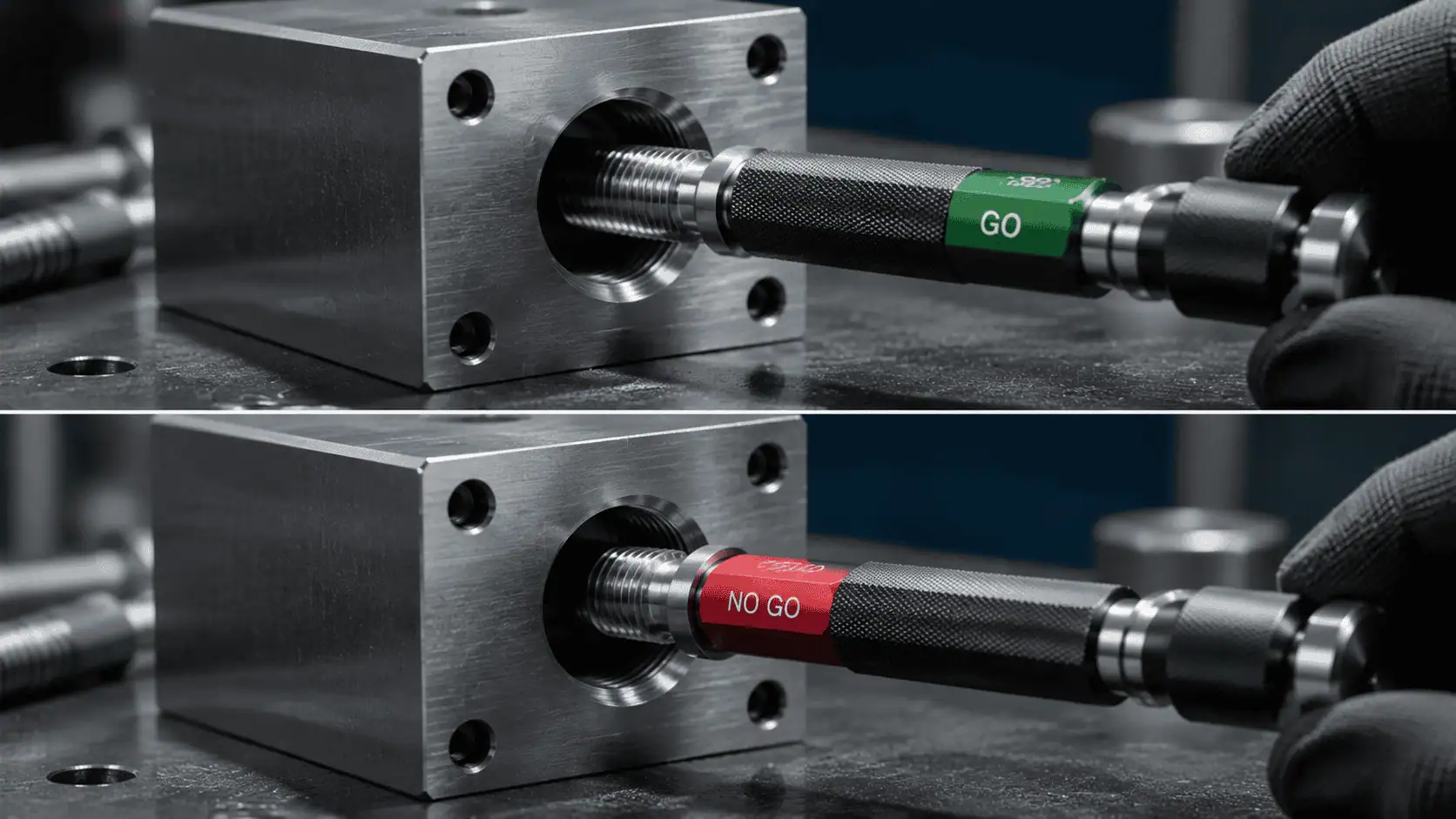
Need gauges for this? GageTools manufactures GO/NO-GO thread plug gauges and thread ring gauges in Dongguan, China. Standard sizes ship from stock within 72 hours, MOQ is 1 piece, and every RFQ gets a reply within 24 hours — request a quote.
Side-by-Side Comparison
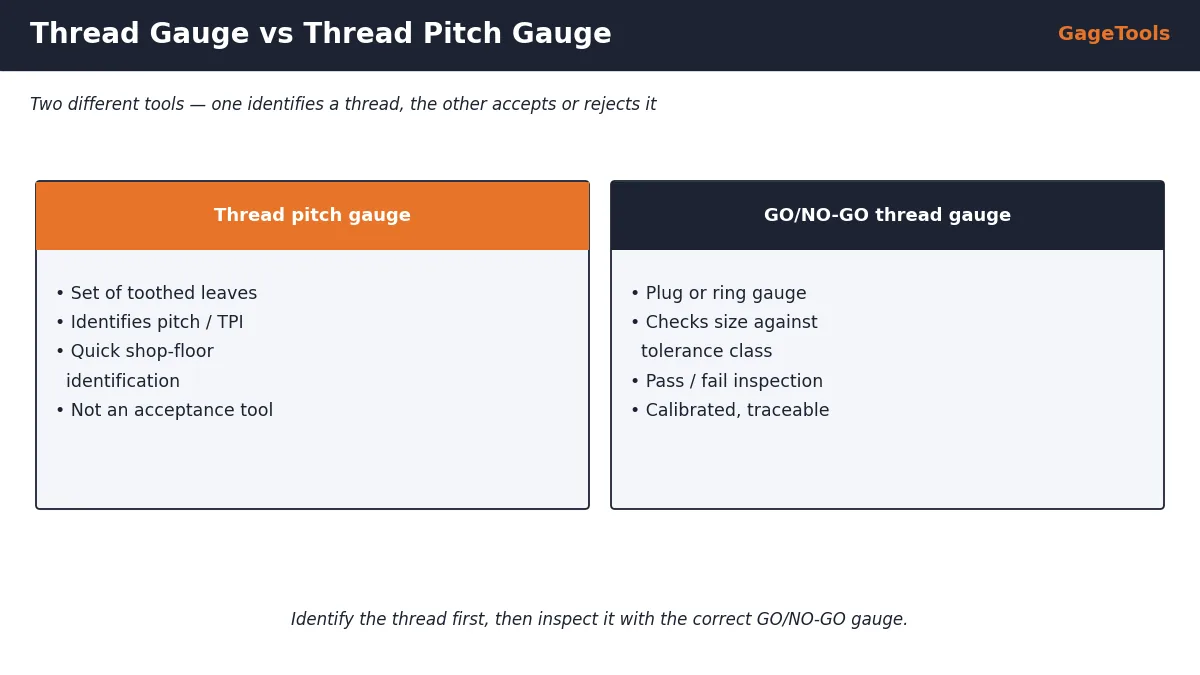
| Thread pitch gauge | GO/NO-GO thread gauge | |
|---|---|---|
| Purpose | Identify pitch / TPI | Accept or reject a thread |
| Form | Set of toothed leaves | Plug or ring gauge |
| Checks diameter? | No | Yes — pitch diameter and fit |
| Accuracy | Rough identification | Made to gauge tolerances |
| Calibration | Rarely | Scheduled, with records |
| Used for | Maintenance, repair, sorting | Production and incoming inspection |
What a Thread Pitch Gauge Is Good For
- Identifying a replacement bolt, nut or fitting
- Sorting mixed fasteners in maintenance
- Telling metric from inch threads
- First step before ordering the correct GO/NO-GO gauge
A pitch gauge is not an inspection tool. It cannot tell whether a thread is oversize or undersize, so it cannot be used to accept production parts.
When You Need a GO/NO-GO Thread Gauge
Using Both Tools Together
- Measure the diameter with calipers.
- Identify the pitch or TPI with a thread pitch gauge.
- Match the size to a standard (M, UNC/UNF, BSP, NPT…).
- Find the tolerance class on the drawing (e.g. 6H, 2B).
- Order and use the matching GO/NO-GO gauge for inspection.
How to Use a Thread Pitch Gauge Correctly
- Clean the thread so the leaves can sit in the grooves.
- Try a leaf that looks close, holding it parallel to the thread axis.
- Look against the light: a correct leaf shows no gaps along several teeth.
- Try the neighbouring pitches to confirm — near sizes can look similar over a short length.
- Check with both metric and inch sets if you are unsure of the system.
- Record the result, then measure the diameter to complete the identification.
Other Thread Tools and What They Do
| Tool | Measures / checks | Typical use |
|---|---|---|
| Thread pitch gauge | Pitch / TPI | Identification |
| GO/NO-GO plug gauge | Internal thread acceptance | Production inspection |
| GO/NO-GO ring gauge | External thread acceptance | Production inspection |
| Thread micrometer | Pitch diameter (external) | Measurement, set-up |
| Three-wire method | Pitch diameter (external) | Lab measurement |
| Optical comparator | Form, angle, root radius | Lab and first-article checks |
In a typical shop, pitch gauges live in the maintenance toolbox, GO/NO-GO gauges at the machines and inspection benches, and thread micrometers or wire sets in the quality lab.
Cost and Accuracy Compared
Which Should You Buy First?
If you are setting up a new inspection area, the order of purchase depends on what you do:
| Your situation | Buy first | Why |
|---|---|---|
| Production of threaded parts | GO/NO-GO gauges for each thread | Needed to accept parts |
| Maintenance and repair | Pitch gauge sets (metric + inch) | Identify replacement parts |
| Incoming inspection of purchased parts | GO/NO-GO gauges for critical threads | Verify supplier quality |
| Quality lab | Thread micrometer / wires + master gauges | Measure and resolve disputes |
Most production shops need both tools: a pitch gauge set in every maintenance toolbox, and calibrated GO/NO-GO gauges at every thread-producing operation.
Common Misuses
- Using a pitch gauge to “approve” production parts — it cannot detect size errors.
- Using a GO/NO-GO gauge to identify an unknown thread by trial and error — risks damaging the gauge and the part.
- Using an uncalibrated GO/NO-GO gauge because “it still fits” — wear is invisible.
- Borrowing a gauge of a similar size or different class — the result is meaningless.
Right tool, right job. Identify with a pitch gauge; accept with a calibrated GO/NO-GO gauge; resolve disputes by measurement.
Choosing a Pitch Gauge Set
| Set type | Leaves cover | Best for |
|---|---|---|
| Metric 60° | e.g. 0.25–6.0 mm pitch | Metric fasteners and parts |
| Inch 60° | e.g. 4–80 TPI | UNC, UNF, NPT |
| Whitworth 55° | e.g. 4–62 TPI | BSW, BSF, BSP |
| Combination | Metric + inch | General maintenance toolboxes |
A combination set covers most general needs. Workshops that see British equipment should add a 55° set so Whitworth and BSP threads can be told apart from Unified.
Measuring Pitch Diameter When You Need a Number
Sometimes a decision is not enough — for example, when settling a dispute or setting up a process. Then pitch diameter is measured:
| Method | For | Notes |
|---|---|---|
| Thread micrometer | External threads | Fast shop-floor measurement with suitable anvils |
| Three-wire method | External threads | Accurate; used in calibration labs |
| Thread measuring machine | Plugs, rings, parts | Lab measurement of gauges |
| Optical comparator | Form and angle | Visual check of profile |
These methods complement GO/NO-GO gauges; they do not replace them for routine production inspection.
Summary
Three Everyday Scenarios
- Calipers
- Thread pitch gauge
The fitter measures 9.9 mm diameter and finds a 1.5 mm pitch: M10x1.5. A standard M10 bolt is fitted. No GO/NO-GO gauge is needed because no part is being accepted for production.
- M10x1.5-6H GO/NO-GO plug gauge
- Calibration records
Every batch of tapped holes is checked with a calibrated plug gauge. A pitch gauge would be useless here, because it cannot detect an oversize or undersize thread.
- Thread micrometer or three-wire set
- Gauge certificates
The customer’s gauge rejects parts that the supplier’s gauge accepts. The lab measures pitch diameter on sample parts and compares both gauges’ certificates to find the cause.
Key Terms
Quick definitions of the terms used in this guide:
| Term | Meaning |
|---|---|
| Thread pitch gauge | Set of toothed leaves used to identify pitch or TPI |
| Pitch | Distance between adjacent threads (mm) |
| TPI | Threads per inch (inch threads) |
| GO/NO-GO gauge | Fixed-limit gauge that accepts or rejects a thread |
| Pitch diameter | Diameter where thread and groove widths are equal |
| Thread micrometer | Micrometer with anvils for measuring external pitch diameter |
| Three-wire method | Pitch diameter measurement over precision wires |
| Calibration | Comparison of a gauge with a traceable reference |
Mistakes Buyers Make When Ordering
| Mistake | Result | Better approach |
|---|---|---|
| Ordering a “thread gauge” without saying plug or ring | Wrong gauge type delivered | State internal (plug) or external (ring) |
| Leaving out the class | Default class may not match drawing | Copy the class from the drawing |
| Leaving out pitch on metric fine | Coarse gauge supplied | Always write pitch, e.g. M12x1.5 |
| Buying a pitch gauge for inspection | Cannot accept or reject parts | Buy GO/NO-GO gauges for inspection |
A complete thread callout — size, pitch or TPI, class and internal/external — avoids nearly all of these problems.
Practical Tips for Using Both Tools
A few simple habits prevent most thread inspection problems:
- Keep pitch gauges in maintenance toolboxes, not at inspection stations.
- Keep GO/NO-GO gauges at the point of use, in holders, with calibration labels visible.
- Identify an unknown thread fully before choosing a GO/NO-GO gauge.
- Never use a pitch gauge result to accept production parts.
- When gauges disagree, measure rather than swap gauges.
Buying Both at Once
New workshops often buy a combined starter kit: a metric and inch pitch gauge set for identification, plus GO/NO-GO plug and ring gauges for the threads they actually produce. Send your list of production threads and we will quote the GO/NO-GO gauges; pitch gauge sets are widely available from tool suppliers.
Next Steps
Once you have identified a thread with a pitch gauge and calipers, send us the full callout — size, pitch or TPI, class, and internal or external. We will quote the matching GO/NO-GO plug or ring gauge, with a certificate on request. If the thread does not match any standard, a sample part or drawing is enough for us to design a custom gauge.
Need the Right GO/NO-GO Gauge?
Send the thread you identified — or a sample part — and we will quote the correct GO/NO-GO plug or ring gauge.
Related: GO/NO-GO principle · What is a thread gauge? · GO/NO-GO thread gauges
Frequently Asked Questions
✓ 20+ years gauge manufacturing
✓ ISO 9001:2015 certified
✓ In-house CNC grinding & inspection
✓ Drawing / RFQ reply within 24h
Get the Right GO/NO-GO Gauge for Your Thread
GageTools supplies GO/NO-GO thread plug and ring gauges for metric, UN, BSP, NPT, ACME and special threads. ISO/IEC 17025 calibration certificate available on request. Standard sizes ship from stock within 72 hours; custom gauges in 10–15 working days. MOQ 1 piece. WhatsApp for fastest response.
💬 WhatsApp Quote 📐 Send Drawing for Quote