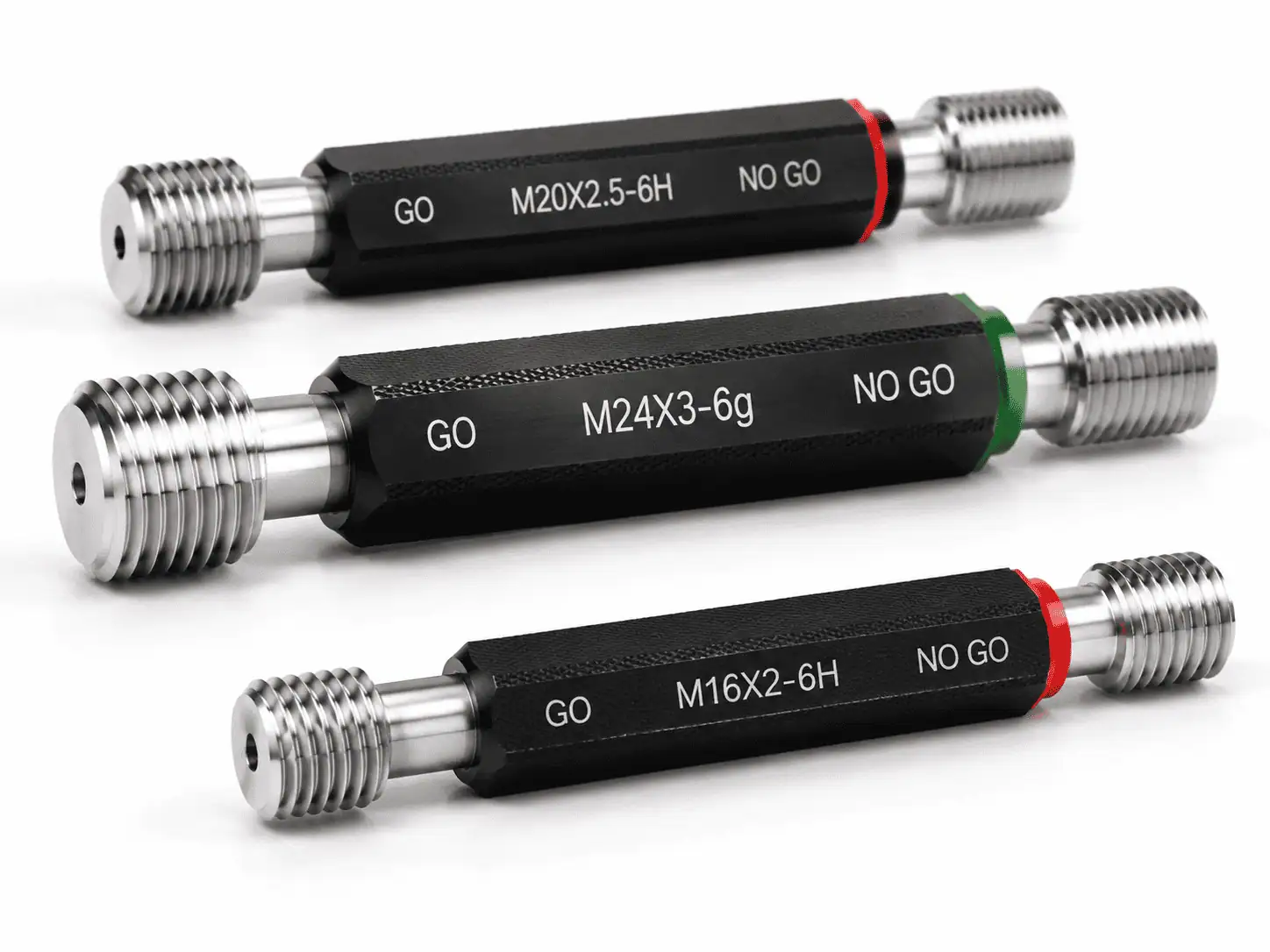
The Main Plug Gauge Designs
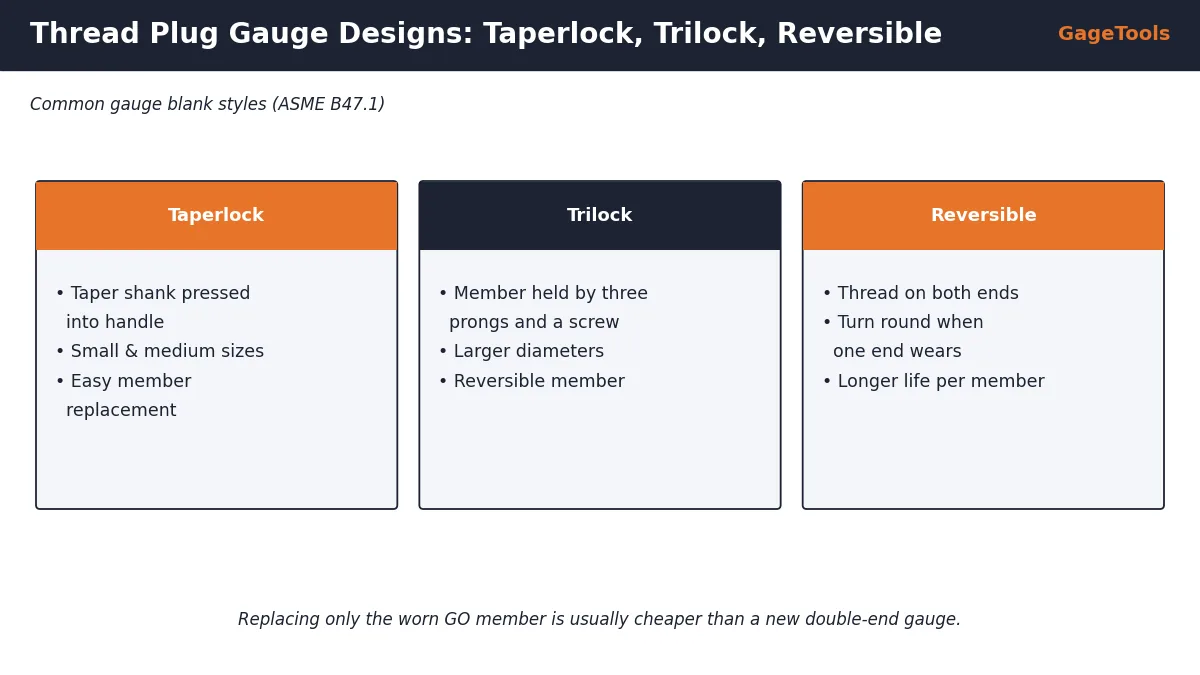
- Small and medium diameters
- Double-end GO/NO-GO gauges
- High-volume production
The member is held securely by the taper and can be knocked out and replaced when it wears, while the handle is reused.
- Larger diameters
- Heavier gauges
- Reversible members
The member can be turned round when the leading threads wear, giving a second working end before replacement.
- High-wear GO members
- Large sizes where members are costly
Two working ends per member means longer life in heavy use and fewer replacements.
Design Comparison
| Design | How the member is held | Typical size range | Main benefit |
|---|---|---|---|
| Taperlock | Taper shank pressed into handle | Small to medium | Simple, secure, easy replacement |
| Trilock | Three prongs + through screw | Larger diameters | Member can be reversed |
| Reversible | Thread on both ends of member | Various | Two working ends |
| One-piece | Member and handle combined | Small special gauges | Compact |
How Design Choice Lowers Gauge Cost
The GO member wears much faster than the NO-GO member because it screws through every good part. With replaceable-member designs you can:
- Replace only the worn GO member and keep the handle and NO-GO member
- Keep spare GO members on the shelf for high-volume lines
- Reverse trilock members to use the second end before buying new
Match the design and size range. A replacement member must fit the handle design and size range you already have. If unsure, send a photo of the existing gauge with the RFQ.
Handle Materials and Identification
Handles are more than a grip. They carry the size and class marking, protect the gauging member and help operators pick the right gauge quickly.
| Handle feature | Why it matters |
|---|---|
| Size and class engraved | Correct gauge selection and traceability |
| Serial number | Links gauge to calibration record |
| Colour coding (e.g. red on NO-GO) | Prevents using the wrong end |
| Knurled or ribbed grip | Consistent hand pressure, less slipping |
| Lightweight material for small sizes | Reduces over-torque on fine threads |
How to Replace a Worn Member
- Confirm the handle design and size range from the marking or a photo.
- Order the replacement member with the same thread, class and design.
- For taperlock designs, remove the old member with the correct knock-out method; never clamp the gauging thread in a vice.
- Fit the new member, checking that it seats fully.
- Mark or record the new member’s ID and calibrate before use.
Calibrate after replacement. A new member must be verified and recorded before it goes back into production, even if it came with a certificate.
Single-End vs Double-End Plug Gauges
For large diameters, separate single-end GO and NO-GO gauges are easier to handle and cheaper to replace individually.
Gauge Member Materials and Finishes
Gauge members are made from hardened, stabilised steels so they keep their size and resist wear. Some applications benefit from harder surfaces:
| Option | Benefit | Typical use |
|---|---|---|
| Hardened tool steel | Standard, good wear resistance | Most thread plug gauges |
| Chrome plating | Extra wear and corrosion resistance | Humid environments, frequent handling |
| Carbide | Much higher wear resistance | Very high-volume GO members |
Harder materials cost more up front but can reduce replacement frequency on high-volume lines. See our guide to thread gauge material and hardness.
Stocking Spare Members
A worn GO member discovered during calibration can stop a production line if no replacement is available. Keeping spares avoids that:
- Identify gauges on high-volume or critical lines.
- Keep at least one calibrated spare GO member for each of those sizes.
- Rotate spares into use so they are calibrated and ready.
- Reorder a new spare whenever one is put into service.
Typical Size Ranges by Design
Exact ranges depend on the manufacturer and the gauge blank standard, but as a general guide:
| Design | Typical diameter range | Notes |
|---|---|---|
| Taperlock | Small to about 1.5 in / 38 mm | Most common for production plug gauges |
| Trilock | About 1.5 in / 38 mm and above | Heavier members, reversible |
| Special / one-piece | Very small or special sizes | Designed per application |
If you are replacing members, always confirm the size range from the existing handle marking or a photo.
Ergonomics and Inspection Speed
On a busy inspection station, gauge design affects both speed and accuracy. Operators checking hundreds of tapped holes a day benefit from:
- Double-end gauges for small sizes, so one tool does both checks.
- Knurled handles that give a consistent, light grip.
- Single-end gauges for large sizes, so each member is easier to handle.
- Clear colour codes on NO-GO ends.
- Gauge holders at the workstation so gauges are not dropped or mixed.
Small changes like these reduce operator fatigue and the variation that shows up in attribute gauge studies.
Can a Damaged Member Be Repaired?
Minor nicks on the first thread of a GO member can sometimes be dressed by a qualified gauge lab, followed by calibration. Deeper damage, wear beyond the limit, or any damage on the NO-GO member normally means replacement. Never try to repair gauging threads on the shop floor with files or stones — it changes the size and invalidates the gauge.
What About Ring Gauge Designs?
Ring gauges have their own design variations, mainly solid versus adjustable. Adjustable rings use a slotted body with adjusting and locking screws and are set with setting plugs; solid rings are one piece. Ring gauges do not have handles, so identification relies on marking on the ring face and, often, a coloured band or groove on NO-GO rings. See thread ring gauges for the range.
Choosing a Design for a New Inspection Station
Keeping one design family across a station makes spare parts, storage and operator training simpler.
Summary
Taperlock, trilock and reversible designs are different ways of holding the gauging member in its handle. Taperlock suits small and medium sizes, trilock with reversible members suits large sizes, and both allow worn members to be replaced without buying a complete gauge. Knowing your design makes ordering replacement members fast and cost-effective, and keeping calibrated spare GO members on busy lines avoids production stoppages.
Key Terms
Quick definitions of the terms used in this guide:
| Term | Meaning |
|---|---|
| Taperlock | Member with taper shank pressed into handle |
| Trilock | Member held by three prongs and a screw |
| Reversible member | Member with thread on both ends |
| Gauge blank | Standardised gauge body before threading (ASME B47.1) |
| Double-end | GO and NO-GO on one handle |
| Single-end | One member per handle |
| Member | The threaded gauging part of a plug gauge |
Practical Tip: Mark Member Change Dates
When you replace a GO member, record the date and the parts count if you track it. Over time this shows how long members last on each line, which makes it easy to plan spares and set sensible calibration intervals.
Next Steps
To replace members or order new plug gauges, send the thread size and class, the design (taperlock, trilock or reversible) and which members you need. A photo of your existing gauge with its markings is often the quickest way to confirm compatibility.
What to Tell Us When Ordering
- Thread size and class
- Design: taperlock, trilock or reversible
- GO member, NO-GO member or complete gauge
- Quantity and certificate requirement
Need Plug Gauges or Replacement Members?
Send the thread callout, design and which members you need. A photo helps if you are not sure of the design.
Related: Thread plug gauges · Wear limits · Replacing a gauge without a drawing
Frequently Asked Questions
✓ 20+ years gauge manufacturing
✓ ISO 9001:2015 certified
✓ In-house CNC grinding & inspection
✓ Drawing / RFQ reply within 24h
Order Thread Plug Gauges and Replacement Members
GageTools supplies complete thread plug gauges and replacement GO and NO-GO members in taperlock, trilock and reversible designs. ISO/IEC 17025 calibration certificate available on request. Standard sizes ship from stock within 72 hours; custom gauges in 10–15 working days. MOQ 1 piece. WhatsApp for fastest response.
💬 WhatsApp Quote 📐 Send Drawing for Quote