
Need gauges for this? GageTools manufactures GO/NO-GO thread plug gauges and thread ring gauges in Dongguan, China. Standard sizes ship from stock within 72 hours, MOQ is 1 piece, and every RFQ gets a reply within 24 hours — request a quote.
Why Gauge Training Matters
A GO/NO-GO thread gauge looks simple: screw it in, see if it goes. That simplicity is exactly why training is often skipped. Yet many gauge disputes, premature gauge wear and escaped defects trace back to how the gauge was used, not to the gauge itself.
Common symptoms of untrained use include GO gauges forced with a wrench, NO-GO results counted loosely, dirty parts rejected as oversize, and worn gauges kept in service because “they still feel fine”. Each of these either passes bad parts or rejects good ones.
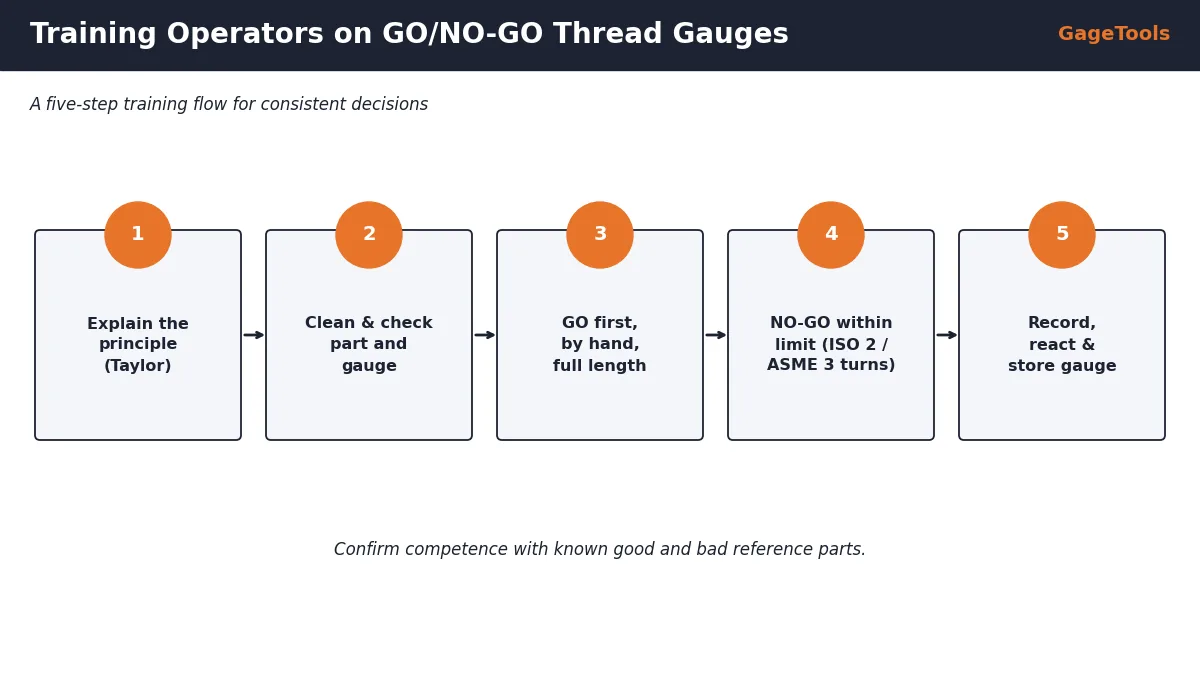
A short, structured training session, followed by a practical check, removes most of these problems. The rest of this article is a training plan you can adapt to your plant. It applies to machine operators who check their own parts, to final inspectors and to receiving inspection staff checking purchased threaded parts, because all of them make the same accept or reject decision with the same gauges.
Teach the Principle Before the Procedure
Operators who understand why the GO and NO-GO gauges differ make better decisions when something unusual happens. The key ideas fit on one page:
This is Taylor’s principle: the GO gauge checks all features of the thread together, and the NO-GO gauge checks one feature, the pitch diameter, on its own. For trainers who want more background, see Taylor’s principle and GO/NO-GO thread gauge principle and use.
Also teach how to read the gauge marking: thread size, pitch or TPI, class, GO or NO-GO, and the gauge ID. An operator should be able to confirm, from the marking alone, that the gauge matches the drawing callout.
The Standard Gauging Sequence
Teach one sequence and use it everywhere. Post it at inspection points and at machines where threads are checked.
- Check the gauge: correct size and class, calibration label in date, no visible damage.
- Clean the part and the gauge: remove chips, coolant, burrs and dirt.
- Check GO first: it must enter or run on by hand over the full thread length or required depth.
- Check NO-GO: it must not enter more than the permitted turns.
- Decide and record: accept or reject, record the result as your procedure requires.
- Return the gauge: clean, protect and store it in its place.
For a complete inspection procedure, including sampling and records, see our step-by-step thread gauge inspection procedure.
Teaching Hand Force and Turn Counting
The two skills that vary most between operators are how hard they turn the gauge and how they count NO-GO turns. Both must be demonstrated, not just described.
| Skill | Correct practice | Common error |
|---|---|---|
| Hand force | Fingertip or light hand force only | Using a wrench, pliers or two hands to force the gauge |
| GO engagement | Full length or required depth, smoothly | Stopping halfway and calling it good |
| Counting NO-GO turns | Count full turns from first engagement | Counting partial turns or the chamfer |
| ISO metric NO-GO | Not more than 2 turns (ISO 1502) | Applying the inch rule |
| Unified NOT GO | Not more than 3 complete turns (ASME B1.2) | Applying the metric rule |
| Short threads | NO-GO must not pass through completely | Rejecting because it engaged at all |
A good exercise is to let each trainee gauge the same set of parts and compare results. Differences in force and counting show up immediately and can be corrected on the spot. See the two-turn rule for the reasoning behind the NO-GO limits.
Never allow tools to turn a thread gauge. A wrench can force a GO gauge onto an oversize part, making a reject look like an accept, and it damages the gauge flanks at the same time.
Common Operator Errors and Their Effects
| Error | What happens | Training point |
|---|---|---|
| Skipping the GO check | Oversize parts accepted | GO first, every time |
| Gauging dirty or wet parts | Good parts rejected | Clean before gauging |
| Using the wrong class gauge | Wrong accept or reject | Compare marking with drawing |
| Gauging hot parts | Results change as parts cool | Gauge at a stable temperature |
| Using a dropped gauge | Unknown gauge condition | Report drops; quarantine the gauge |
| Mixing GO and NO-GO rings | Reversed decisions | Recognise markings and colour codes |
Include these errors in the training material with short examples from your own plant. Real cases are remembered much better than general rules.
Handling, Cleaning and Storage
Operators handle gauges more than anyone else, so they have the biggest influence on gauge life. Training should cover:
- Holding plugs by the handle, not the gauging member
- Wiping gauges clean before and after use
- Applying a light protective film if the gauge will be stored for a while
- Storing gauges in their cases or designated places, never loose in drawers or on machines
- Keeping gauges away from coolant spray, chips and magnetic chucks
- Reporting any drop, impact or rough feel immediately
Our guide to thread gauge storage and handling gives more detail you can use in training material.
What to Do When a Part Fails
Operators must know what a gauge failure means and what they are allowed to do next. Define the reaction plan in advance and include it in training.
Operators should never “re-work” a thread to make it pass without authorisation, and never adjust an adjustable ring gauge on the shop floor.
Checking Competence
Training is complete only when the operator shows the skill. A simple practical assessment works well:
- Prepare a set of reference parts: some known good, some oversize, some undersize, confirmed by measurement.
- Mark them with hidden codes so the trainee does not know which is which.
- Ask the trainee to gauge each part, following the standard sequence.
- Compare the results with the known condition and discuss any disagreement.
- Record the result and the date in the training record.
Repeat the assessment at a set interval and whenever something changes: a new gauge type, a new thread standard, a new product family, or after a quality problem linked to gauging. Customers working to IATF 16949 or similar systems often expect to see these training records during audits.
What to Send When Ordering Gauges for Training and Production
Some plants keep a dedicated set of gauges for training so production gauges are not worn by practice. When ordering, include:
- Thread callouts and classes for production and training sets (e.g. M8x1.25-6H, 3/8-16 UNC-2A)
- Plug, ring or both, with quantities
- Marking or colour-code requirements for GO and NO-GO members
- Whether training gauges need separate IDs
- Certificate requirement (ISO/IEC 17025 available on request)
Browse our thread plug gauges and ring gauges, or send the list; we reply within 24 hours.
Need Gauges for Production and Training?
Send your thread callouts, classes and quantities, and tell us about any marking or colour-code needs. We confirm the specification and reply within 24 hours.
Related: GO/NO-GO thread gauges · What is a GO gauge · Inspection procedure
Frequently Asked Questions
✓ 20+ years gauge manufacturing
✓ ISO 9001:2015 certified
✓ In-house CNC grinding & inspection
✓ Drawing / RFQ reply within 24h
Equip Your Operators With the Right Gauges
GageTools supplies clearly marked GO/NO-GO thread plug and ring gauges for metric, unified and pipe threads, for production lines and training sets. ISO/IEC 17025 calibration certificate available on request. Standard sizes ship from stock within 72 hours; custom gauges in 10–15 working days. MOQ 1 piece. WhatsApp for fastest response.
💬 WhatsApp Quote 📐 Send Drawing for QuoteNeed These Gauges? Get a Quote
Send your thread size or drawing, gauge type and quantity. MOQ is 1 piece; standard catalogue sizes in stock ship within 72 hours. Prefer chat? WhatsApp us.