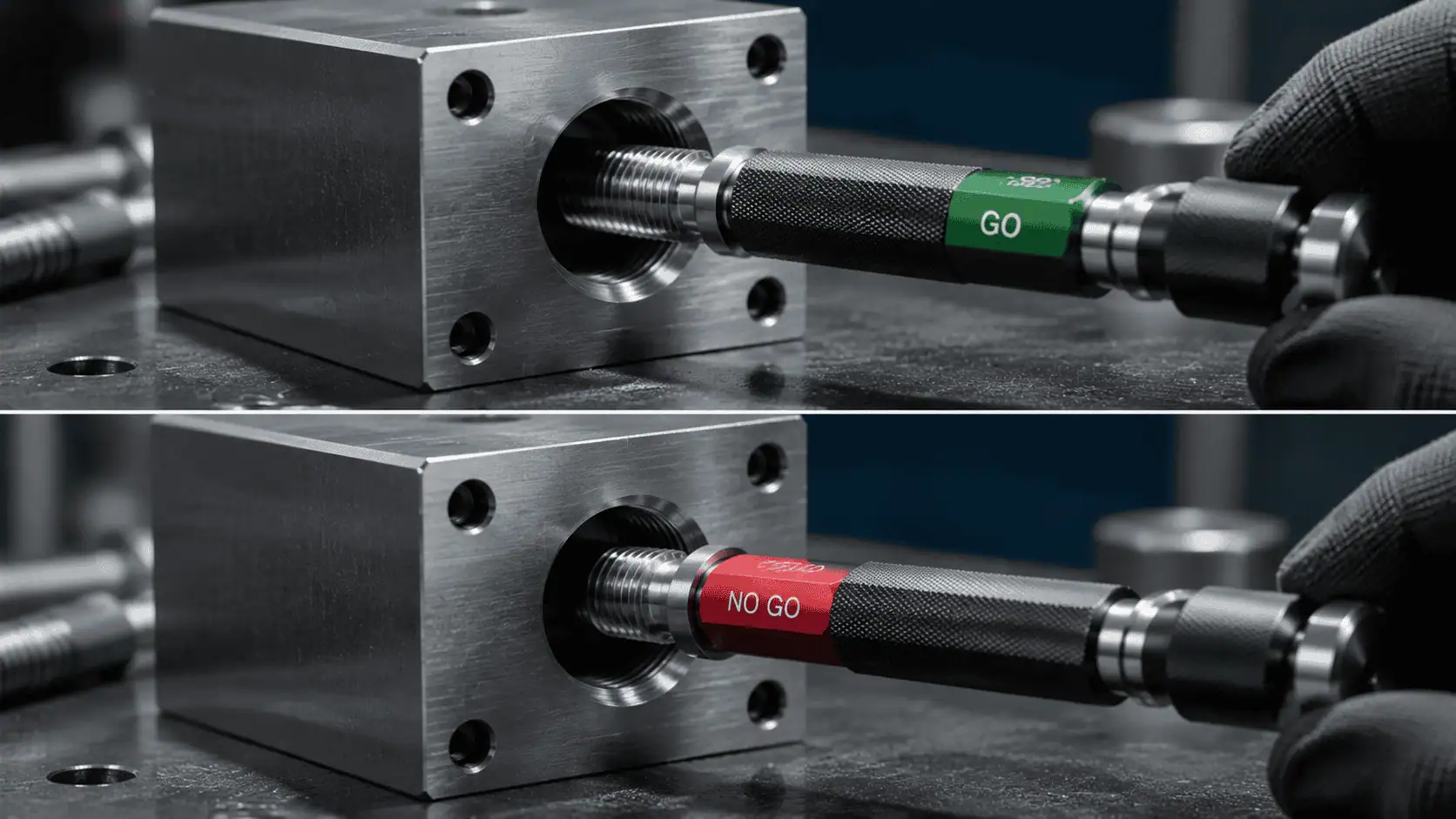
Need gauges for this? GageTools manufactures GO/NO-GO thread plug gauges and thread ring gauges in Dongguan, China. Standard sizes ship from stock within 72 hours, MOQ is 1 piece, and every RFQ gets a reply within 24 hours — request a quote.
What Total Cost of Ownership Means for a Thread Gauge
Purchasing departments are measured on price, so thread gauges are often bought from the lowest quotation. Yet a gauge is not a consumable part that is used once. It is a measuring instrument that makes thousands of decisions over months or years, and each decision has consequences for scrap, rework, customer complaints and audits.
Total cost of ownership (TCO) looks at the whole life of the gauge. It asks how long the gauge will stay within tolerance, how much it costs to keep it calibrated and documented, what happens when it is unavailable and how reliable its decisions are. When these costs are added up, the purchase price is often a minor share.
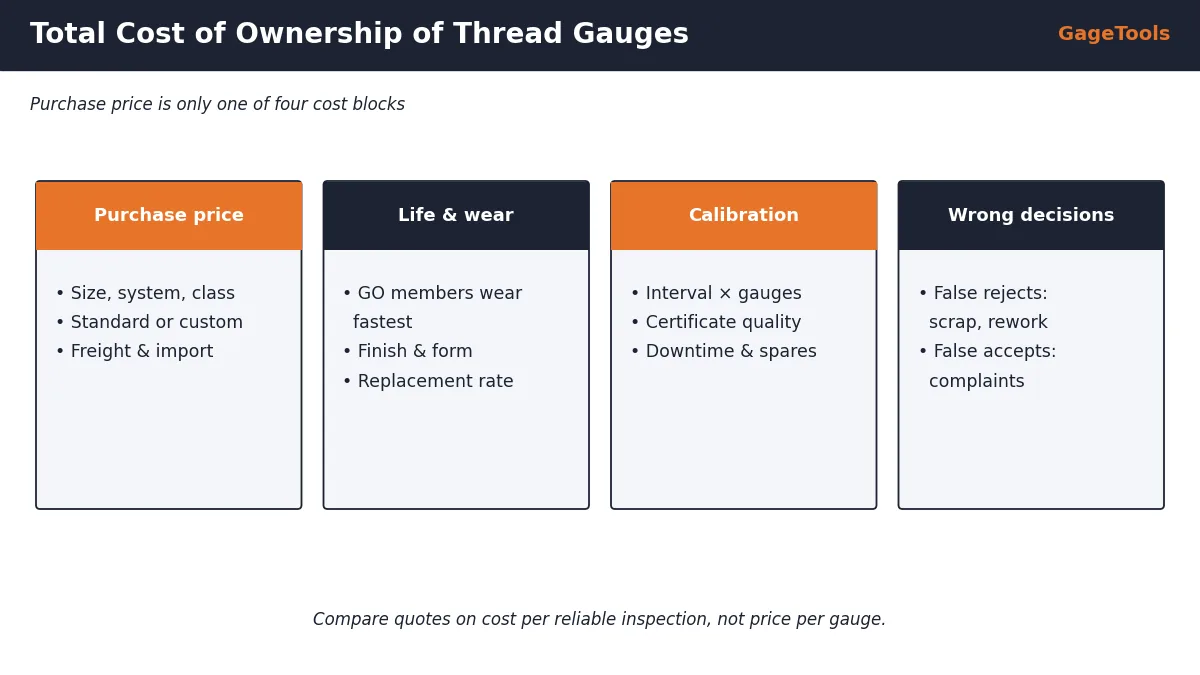
The Cost Elements Over a Gauge’s Life
The table lists the main cost elements. Some are visible on invoices; others are hidden in production and quality budgets.
| Cost element | Visible or hidden | What drives it |
|---|---|---|
| Purchase price | Visible | Size, thread system, class, standard or custom |
| Freight and import | Visible | Order size, consolidation, shipping method |
| Incoming verification | Hidden | Documentation quality, need to re-check gauges |
| Calibration | Visible | Number of gauges, interval, in-house or lab |
| Replacement when worn | Visible | Wear resistance, finish, usage |
| Downtime waiting for a gauge | Hidden | Lead time, spares, supplier response |
| False rejects | Hidden | Gauge size and form accuracy |
| False accepts | Hidden, often largest | Gauge accuracy, wear, wrong class |
| Disputes with customers | Hidden | Traceability and certificate quality |
Hidden costs are hard to estimate, which is exactly why they are ignored. But a single customer complaint caused by a false accept can cost more than the entire gauge budget for a year.
Why the Cheapest Gauge Can Cost More
A gauge is cheap for a reason. The savings usually come from steps that are invisible when the gauge is new but matter throughout its life.
- Faster wear: rough flanks and inconsistent hardness wear quickly, so the GO member reaches its wear limit sooner and must be replaced more often.
- Unreliable decisions: form or lead errors in a GO gauge change the functional size it checks, even if the pitch diameter looks right.
- Documentation gaps: a certificate without measured values forces you to pay for an independent calibration before first use.
- Supplier friction: if the gauge was bought through a trader, questions about design and limits may take days to answer.
For more on what quality looks like, see what makes a high-quality thread gauge.
A Simple Cost-per-Inspection Example
Consider two GO thread plug gauges for the same high-volume thread. The figures below are illustrative only, in arbitrary cost units, to show the method rather than real prices.
| Item | Gauge A (lowest price) | Gauge B (higher price) |
|---|---|---|
| Purchase price | 60 units | 100 units |
| Inspections before wear limit (example) | 20,000 | 50,000 |
| Gauges needed for 100,000 inspections | 5 | 2 |
| Purchase cost for 100,000 inspections | 300 units | 200 units |
| Extra incoming calibration | Needed on every gauge | Certificate accepted |
| Replacements and paperwork | 5 changeovers | 2 changeovers |
In this example the lower-priced gauge costs more over the same number of inspections even before hidden costs are counted. The exact figures in your plant will differ, but the method holds: divide total cost by the number of reliable inspections the gauge delivers.
Hidden costs widen the gap further. Each changeover means a new gauge to register, calibrate and issue, and each early replacement is a moment when the station may be without a gauge. If the lower-priced gauge also triggers one disputed lot a year, the comparison is no longer close.
Do not use gauge life figures from a sales brochure. Gauge life depends heavily on your material, cleanliness, operator technique and thread class. Use your own calibration history to estimate how many inspections each gauge really delivers.
Calibration and Documentation Over the Gauge’s Life
Every thread gauge in use must be calibrated at intervals, so calibration is a recurring cost that often exceeds the purchase price over a few years. Two things drive it: the number of gauges you hold and how often each must be checked.
Gauges that wear quickly need shorter intervals, which multiplies calibration cost. Gauges delivered with a certificate showing measured values can often go straight into service after a receiving check, while gauges with no usable documentation must be calibrated before first use. Clear serial numbers and consistent marking also save time in the calibration lab, because every result can be matched to the right record without investigation.
Our thread gauge calibration guide explains how intervals are set and what is checked.
The Biggest Hidden Cost: Wrong Decisions
A thread gauge exists to make correct accept and reject decisions. When it gets them wrong, the cost appears somewhere else in the business.
- GO plug oversize or with form error
- GO ring undersize
- Wrong class or wrong plating condition
- Burred or dirty gauge
Scrap or rework of good parts, lost machine time, and engineering time spent investigating a process that is actually fine.
- GO plug worn undersize
- NO-GO member worn or wrong limit
- Gauge past calibration date
- Wrong class used
Assembly failures, customer complaints, sorting at the customer, possible recalls and damage to the supplier relationship.
Both errors are more likely with gauges whose size, form and wear history are uncertain. A certificate with measured values and a good calibration record reduces that uncertainty. Our guide to thread plug gauge wear limits explains how wear is controlled.
Downtime, Lead Time and Supplier Response
When a GO plug fails calibration on a busy line, the question is how long until a replacement arrives. A gauge that costs less but takes weeks to replace can stop production or force operators to share gauges between machines.
- Keep calibrated spare GO members for high-volume threads.
- Choose suppliers that hold standard sizes in stock; ours ship from stock within 72 hours.
- For custom gauges, keep the approved drawing so a repeat order starts immediately; custom lead time is 10–15 working days.
- Value fast answers: we reply to RFQs within 24 hours.
How to Compare Quotes on Total Cost
A fair comparison checks that each quote is for the same gauge, then adds the costs that the quote does not show. Our article on comparing thread gauge manufacturer quotes covers the specification side in detail.
- Confirm the specification is identical: designation, class, gauge standard, members, condition.
- Check what documentation is included: measured values, serial numbers, ISO/IEC 17025 option.
- Ask about manufacturing: is the supplier the maker or a trader?
- Estimate life: use your own calibration history where possible.
- Add calibration, freight and downtime risk.
- Compare cost per reliable inspection, not price per gauge.
What to Send When Ordering for Lowest Total Cost
To get a quotation that can be compared on total cost, send:
- Full thread designation, class and gauge standard
- Gauge members required (GO, NO-GO, setting plugs)
- Annual usage estimate or number of inspection points
- Documentation needed: certificate type (ISO/IEC 17025 available on request), serial numbers
- Spares you want to hold
- Drawings for any special threads
See our GO/NO-GO thread gauges range, or send your requirement for a like-for-like quote.
Compare Thread Gauges on Total Cost
Send your specification, usage and documentation needs. We quote gauges with measured-value certificates on request and a clear lead time for stock and custom items.
Related: How to compare gauge quotes · Manufacturer vs trader · Thread gauge price guide
Frequently Asked Questions
✓ 20+ years gauge manufacturing
✓ ISO 9001:2015 certified
✓ In-house CNC grinding & inspection
✓ Drawing / RFQ reply within 24h
Thread Gauges Built for Long, Reliable Service
GageTools manufactures GO/NO-GO thread plug and ring gauges with individual serial numbers and measured-value documentation. ISO/IEC 17025 calibration certificate available on request. Standard sizes ship from stock within 72 hours; custom gauges in 10–15 working days. MOQ 1 piece. WhatsApp for fastest response.
💬 WhatsApp Quote 📐 Send Drawing for Quote