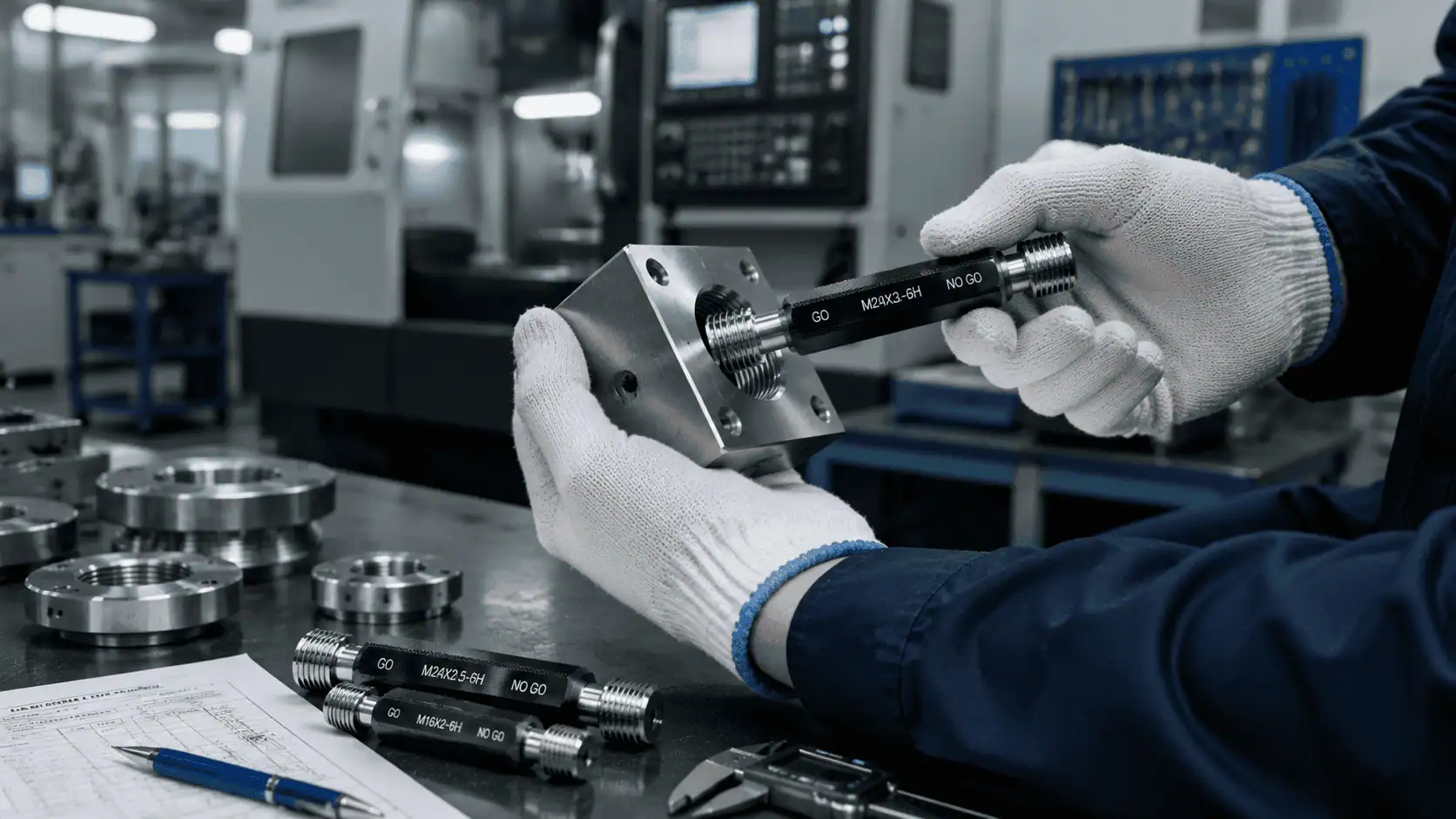
Need gauges for this? GageTools manufactures GO/NO-GO thread plug gauges and thread ring gauges in Dongguan, China. Standard sizes ship from stock within 72 hours, MOQ is 1 piece, and every RFQ gets a reply within 24 hours — request a quote.
What Is a UNS Thread?
ASME B1.1 defines the Unified inch screw thread system. Most parts use one of its standard series: coarse (UNC), fine (UNF), extra-fine (UNEF) or the constant-pitch series such as 8-UN, 12-UN and 16-UN. Each has preferred combinations of diameter and threads per inch, and the tolerance limits for each size and class can be taken from published tables.
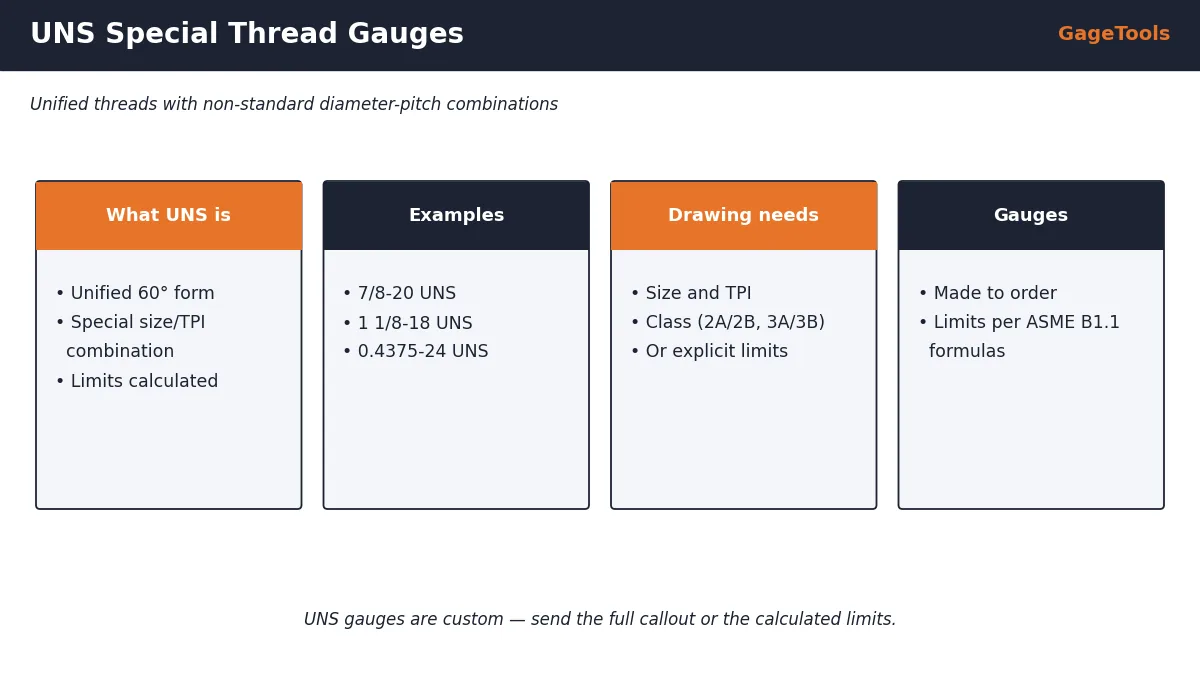
A UNS thread keeps the same 60° Unified form but departs from those standard combinations. The designer might choose a diameter between two standard sizes, a pitch that is not listed for that diameter, or a length of engagement long enough that the standard tolerances no longer suit. The thread is still Unified; it is simply “special”.
If you are not sure which series your drawing uses, our overview of UNC, UNF and UNEF thread standards explains the standard series first.
When Are Special Threads Used?
Special threads are never chosen for fun. They add cost to tooling and gauging, so there is usually a clear engineering reason behind them:
- Space constraints — a thin-walled part needs a finer pitch than the standard series allows at that diameter.
- Legacy designs — an older product used a size that is no longer standard, and spare parts must still fit.
- Instrument and optical parts — fine pitches on small or odd diameters for adjustment and focusing.
- Long engagement — a nut or sleeve engages far more than the standard assumes, so tolerances are recalculated.
- Proprietary interfaces — a special size helps prevent assembly with standard hardware.
- Repair and oversize threads — a slightly larger diameter to recover a damaged tapped hole.
The same logic exists in metric drawings, where a non-preferred diameter and pitch combination such as a special fine pitch is called out with its own tolerance limits. Everything in this article applies to special metric threads as well, with ISO 965 as the reference in place of ASME B1.1.
How to Call Out a UNS Thread on a Drawing
A UNS callout looks like a standard Unified callout with “UNS” as the series, for example 0.625-24 UNS-2A or 1.125-10 UNS-3B. On its own, however, that designation is not enough to make a gauge, because there is no published limit table for that combination.
- Nominal diameter and threads per inch
- Series (UNS) and class (1A/2A/3A or 1B/2B/3B)
- Hand (RH or LH)
- Limits of size: major, pitch and minor diameter
- Length of engagement if it is not standard
ASME B1.1 gives the formulas to calculate tolerances for special threads, and good drawing practice is to write the calculated limits next to the callout. Without them, two suppliers can calculate slightly different sizes and argue about which gauge is right.
| Callout element | Example | What it controls |
|---|---|---|
| Diameter and pitch | 0.625-24 | Basic size and thread geometry |
| Series | UNS | Tells the reader the size is special |
| Class | 2A / 2B | Tolerance and allowance |
| Pitch diameter limits | Max / min values | GO and NO-GO gauge sizes |
| Major / minor limits | Max / min values | Crest and root clearance |
| Length of engagement | e.g. 1.5 × diameter | Basis for calculated tolerances |
“UNS” without limits of size is incomplete. If the drawing only shows the designation, the gauge maker must calculate the limits, and the result must be approved by the customer before manufacture. Ask the design owner to add the limits to the drawing whenever possible.
How a Custom UNS Gauge Is Designed
A UNS gauge follows the same rules as any Unified gauge under ASME B1.2: full-form GO members at the maximum-material limit and truncated NO-GO members that check pitch diameter at the least-material limit. The difference is that every size must be derived from the drawing rather than read from a table.
- Drawing review. We read the callout, class and any stated limits of size.
- Limit check. If limits are shown, we check them for consistency with the class and pitch. If they are missing, we calculate them and send them to you.
- Gauge design. We define GO and NO-GO pitch diameters, gauge lengths, truncation and markings.
- Customer confirmation. You approve the gauge sizes before any cutting starts.
- Manufacture and inspection. The gauges are made, measured and marked with the full special designation.
This is the same process we use for all custom thread gauges made from drawings. Its value is that disagreements are settled on paper, before a gauge exists.
UN, UNS, UNR and UNJ: Keeping the Letters Straight
Several Unified designations look alike but mean different things for gauging:
| Designation | Meaning | Gauging note |
|---|---|---|
| UNC / UNF / UNEF | Standard graded-pitch series | Limits from standard tables |
| UN | Standard constant-pitch series (e.g. 8-UN, 12-UN) | Limits from standard tables |
| UNS | Special combination of diameter, pitch or engagement | Limits from drawing or calculation |
| UNR | External thread with mandatory rounded root | Same GO/NO-GO sizes as UN; root checked separately |
| UNJ | Controlled root radius with modified internal minor diameter | Separate standard; see aerospace gauging |
If your special thread is also UNJ, the gauging rules change significantly. See our guide to MJ and UNJ aerospace thread gauges before placing an order.
Cost and Lead Time for Special Thread Gauges
Special thread gauges cost more than stock sizes because each one needs its own design and set-up. The main drivers are:
Ordering both the GO/NO-GO plug and the ring gauge together, and ordering spares at the same time, spreads the set-up cost across more pieces. Because the MOQ is one piece, you can still start with a single gauge if you only need to prove the process first.
Common Mistakes with UNS Gauges
| Mistake | Consequence | How to avoid |
|---|---|---|
| Ordering from the designation alone | Limits guessed or disputed | Put limits of size on the drawing |
| Using the nearest standard gauge | Wrong accept/reject decisions | Order a gauge for the actual special size |
| Ignoring long engagement | Tolerance not suited to the joint | State length of engagement |
| Not approving calculated limits | Customer rejects parts later | Confirm limits in writing before manufacture |
What to Send When Ordering UNS Thread Gauges
- The part drawing or a clear sketch of the thread
- Full designation with class and hand
- Limits of size, if known
- Length of engagement if non-standard
- Plug, ring or both, and quantity
- Certificate requirement (ISO/IEC 17025 calibration certificate available on request)
We reply to RFQs within 24 hours. If anything is unclear, we will ask before quoting rather than make assumptions about a special size.
Need a UNS or Special Thread Gauge?
Send the drawing with the thread callout, class and any limits of size. We confirm the gauge design with you and reply with price and lead time within 24 hours.
Related: Custom thread gauges from drawing · How to order custom thread gauges · Replacing a gauge without a drawing
Frequently Asked Questions
✓ 20+ years gauge manufacturing
✓ ISO 9001:2015 certified
✓ In-house CNC grinding & inspection
✓ Drawing / RFQ reply within 24h
Order UNS and Special Thread Gauges
GageTools designs and makes GO/NO-GO plug and ring gauges for UNS, special metric and other non-standard threads from your drawing, with limits confirmed before manufacture. ISO/IEC 17025 calibration certificate available on request. Standard sizes ship from stock within 72 hours; custom gauges in 10–15 working days. MOQ 1 piece. WhatsApp for fastest response.
💬 WhatsApp Quote 📐 Send Drawing for Quote