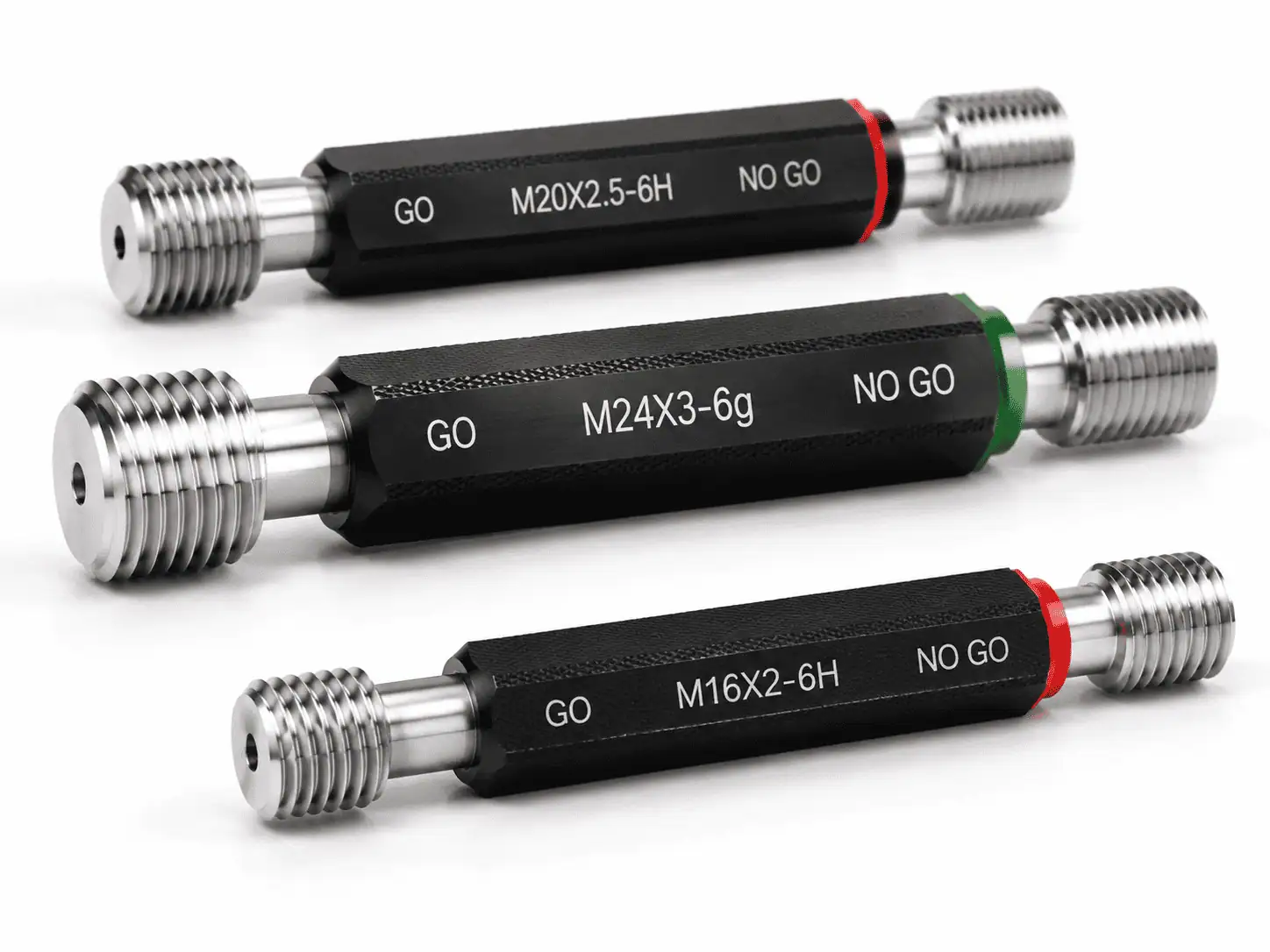
PG Thread Size Chart
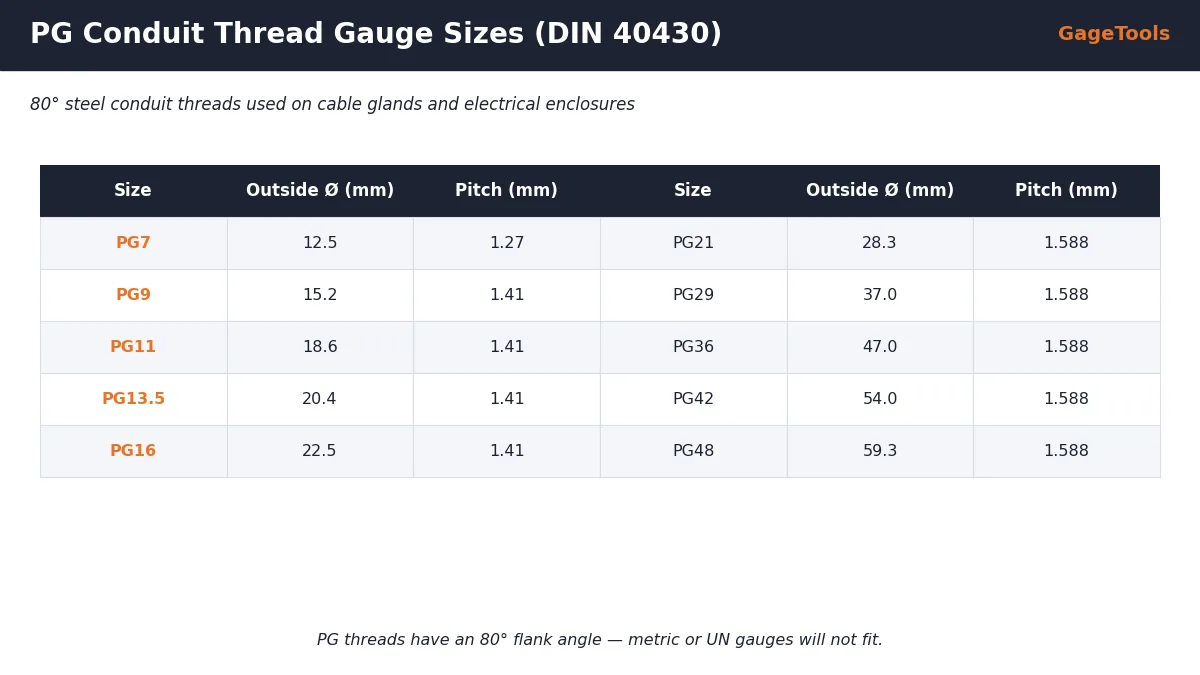
| Size | Outside Ø (mm) | Pitch (mm) | Threads per inch |
|---|---|---|---|
| PG7 | 12.5 | 1.27 | 20 |
| PG9 | 15.2 | 1.41 | 18 |
| PG11 | 18.6 | 1.41 | 18 |
| PG13.5 | 20.4 | 1.41 | 18 |
| PG16 | 22.5 | 1.41 | 18 |
| PG21 | 28.3 | 1.588 | 16 |
| PG29 | 37.0 | 1.588 | 16 |
| PG36 | 47.0 | 1.588 | 16 |
| PG42 | 54.0 | 1.588 | 16 |
| PG48 | 59.3 | 1.588 | 16 |
Why PG Threads Need Their Own Gauges
The shallow 80° profile suits thin-wall conduit and sheet-metal enclosures, where a deep 60° thread would weaken the wall. Because the angle and pitch differ from ISO metric, only PG gauges can judge a PG thread.
PG vs Metric Cable Gland Threads
Many new enclosures use metric cable gland threads such as M20x1.5 (EN 60423), but PG threads remain common on existing equipment and replacement parts. Make sure you know which system the drawing uses before ordering gauges.
| Approximate size | PG thread | Common metric gland thread |
|---|---|---|
| Small | PG7 / PG9 | M12x1.5 / M16x1.5 |
| Medium | PG11 / PG13.5 | M20x1.5 |
| Large | PG16 / PG21 | M25x1.5 / M32x1.5 |
Not interchangeable. A PG13.5 gland will not properly fit an M20x1.5 hole, and gauges for one system cannot check the other.
Where PG Threads Are Used
- Cable glands on electrical enclosures, control cabinets and junction boxes
- Lighting fittings and luminaire housings
- Sensor and connector housings in automation equipment
- Replacement and maintenance parts for machinery built to older German standards
In many industries PG threads are gradually being replaced by metric M-threads, but equipment built over several decades still uses PG, and spare parts must match.
Inspecting PG Threads in Thin Walls
PG threads are often cut or formed in thin sheet metal, die-cast housings or plastic mouldings. That creates some specific gauging challenges:
| Challenge | Effect | Recommendation |
|---|---|---|
| Very short thread length | Few threads for the gauge to engage | Check GO engagement over the full available length |
| Thin sheet walls | Walls can deflect under gauge pressure | Apply very light hand force |
| Plastic housings | Threads can deform or be cut by a steel gauge | Gauge gently; consider moulding-specific checks |
| Burrs from punching/tapping | False rejects | Deburr before gauging |
Converting from PG to Metric Glands
If you are updating an enclosure design from PG to metric glands, the hole size and thread change, and so do your gauges. Plan the change so that production and inspection move together:
- Update drawings with the metric thread (e.g. M20x1.5-6H).
- Order metric plug gauges before the first production run.
- Keep PG gauges for spare-part production of older designs.
- Label both gauge sets clearly to avoid mix-ups.
How PG Cable Glands Seal
A cable gland seals in two places: around the cable (with a seal insert compressed by the gland nut) and at the enclosure wall (with a sealing washer or O-ring under the gland body). The PG thread holds the gland in the wall and provides the clamping force for the wall seal.
If the enclosure thread is oversize, the gland may not clamp properly and the enclosure’s protection rating can be compromised. If it is undersize, the gland may not screw in fully. Gauging the enclosure hole with a PG plug gauge protects both assembly and sealing.
| Thread condition | Effect on gland |
|---|---|
| Correct (passes GO, stops NO-GO) | Proper clamping and sealing |
| Oversize | Loose fit, weak clamping, sealing risk |
| Undersize | Gland will not seat fully |
| Damaged / burred | Cross-threading, damaged seals |
Through-Holes with Locknuts
Not every PG gland is screwed into a tapped hole. On thin enclosures, the gland often passes through a clearance hole and is held by a PG locknut. In that case the thread to inspect is on the gland body and locknut, not in the enclosure. Use PG ring gauges on the gland bodies and PG plug gauges on the locknuts if your process requires it.
The 80° Thread Form in Detail
PG threads were designed for thin steel conduit, where a normal 60° thread would cut too deeply into the wall. The 80° included angle gives a very shallow thread depth — roughly half that of a metric thread of similar pitch — with flat crests and roots.
Because the thread is so shallow, small errors in diameter have a large effect on engagement. Accurate PG gauges are therefore important even though the application looks “simple”.
Threads and Enclosure Protection Ratings
Enclosures are rated for dust and water ingress (IP ratings). The gland thread itself does not seal, but it must hold the gland firmly against its sealing washer. Oversize or damaged threads can reduce clamping force and compromise the rating.
- Gauge every tapped enclosure hole during production.
- Check that the gland screws in fully and seats on its washer.
- Replace damaged threads rather than over-tightening glands.
- For moulded housings, include thread checks in first-article inspection of each new mould.
Which PG Size for Which Cable?
| PG size | Typical cable diameter range (approx.) |
|---|---|
| PG7 | 3–6.5 mm |
| PG9 | 4–8 mm |
| PG11 | 5–10 mm |
| PG13.5 | 6–12 mm |
| PG16 | 10–14 mm |
| PG21 | 13–18 mm |
| PG29 | 18–25 mm |
Cable ranges vary by gland manufacturer and seal insert; the table is a rough guide only. The thread gauge depends only on the PG size, not on the cable.
PG Threads in Moulded Plastic Housings
Many modern enclosures are injection-moulded, and the PG thread is moulded directly into the housing. Moulded threads bring their own issues:
| Issue | Cause | Check |
|---|---|---|
| Oversize thread | Mould wear, material shrinkage | PG plug gauge; monitor per mould cavity |
| Undersize thread | Shrinkage, flash | PG plug gauge |
| Flash in thread | Mould parting line | Visual + gauge |
| Distortion | Uneven cooling | Gauge at several positions |
Gauge first-article parts from every cavity of a new mould, and repeat periodically as the mould wears. Plastic threads can also relax over time, so gauge at a consistent time after moulding.
Summary
PG threads remain common on cable glands, enclosures and connectors built to older German standards. Their shallow 80° form needs dedicated PG plug and ring gauges; metric or UN gauges cannot be substituted. Know which system your enclosure uses, gauge thin-wall and moulded threads gently, and keep PG and metric gland gauges clearly separated.
Key Terms
Quick definitions of the terms used in this guide:
| Term | Meaning |
|---|---|
| PG | Panzergewinde — German steel conduit thread |
| DIN 40430 | Standard defining PG threads |
| 80° thread | Shallow flank angle used on PG threads |
| Cable gland | Fitting that secures and seals a cable at an enclosure |
| Locknut | Nut that holds a gland in a clearance hole |
| EN 60423 | Standard for metric conduit and gland threads |
| IP rating | Enclosure protection against dust and water |
PG or Metric: Quick Selector
Practical Tip: Check Glands on Assembly
After gauging the enclosure hole, fit one gland per batch and tighten it to the manufacturer’s torque. If it seats fully and the sealing washer compresses evenly, the thread and the gland are working together as intended.
Next Steps
Send your list of PG sizes and whether you need plug gauges for enclosure holes, ring gauges for gland bodies, or both. If you are also moving to metric glands, include the metric sizes so both gauge sets can be quoted together, clearly labelled to avoid mix-ups.
Ordering PG Thread Gauges
- PG size, e.g.
PG13.5 - Plug and/or ring, GO/NO-GO pair or GO only
- Quantity and certificate requirement
Need PG Thread Gauges?
Send the PG sizes and quantities. PG gauges are usually made to order; we confirm lead time with the quotation.
Related: Thread plug gauges · Thread ring gauges · Metric thread gauges
Frequently Asked Questions
✓ 20+ years gauge manufacturing
✓ ISO 9001:2015 certified
✓ In-house CNC grinding & inspection
✓ Drawing / RFQ reply within 24h
Order PG Conduit Thread Gauges
GageTools makes GO/NO-GO plug and ring gauges for PG and other special thread forms to your specification. ISO/IEC 17025 calibration certificate available on request. Standard sizes ship from stock within 72 hours; custom gauges in 10–15 working days. MOQ 1 piece. WhatsApp for fastest response.
💬 WhatsApp Quote 📐 Send Drawing for Quote