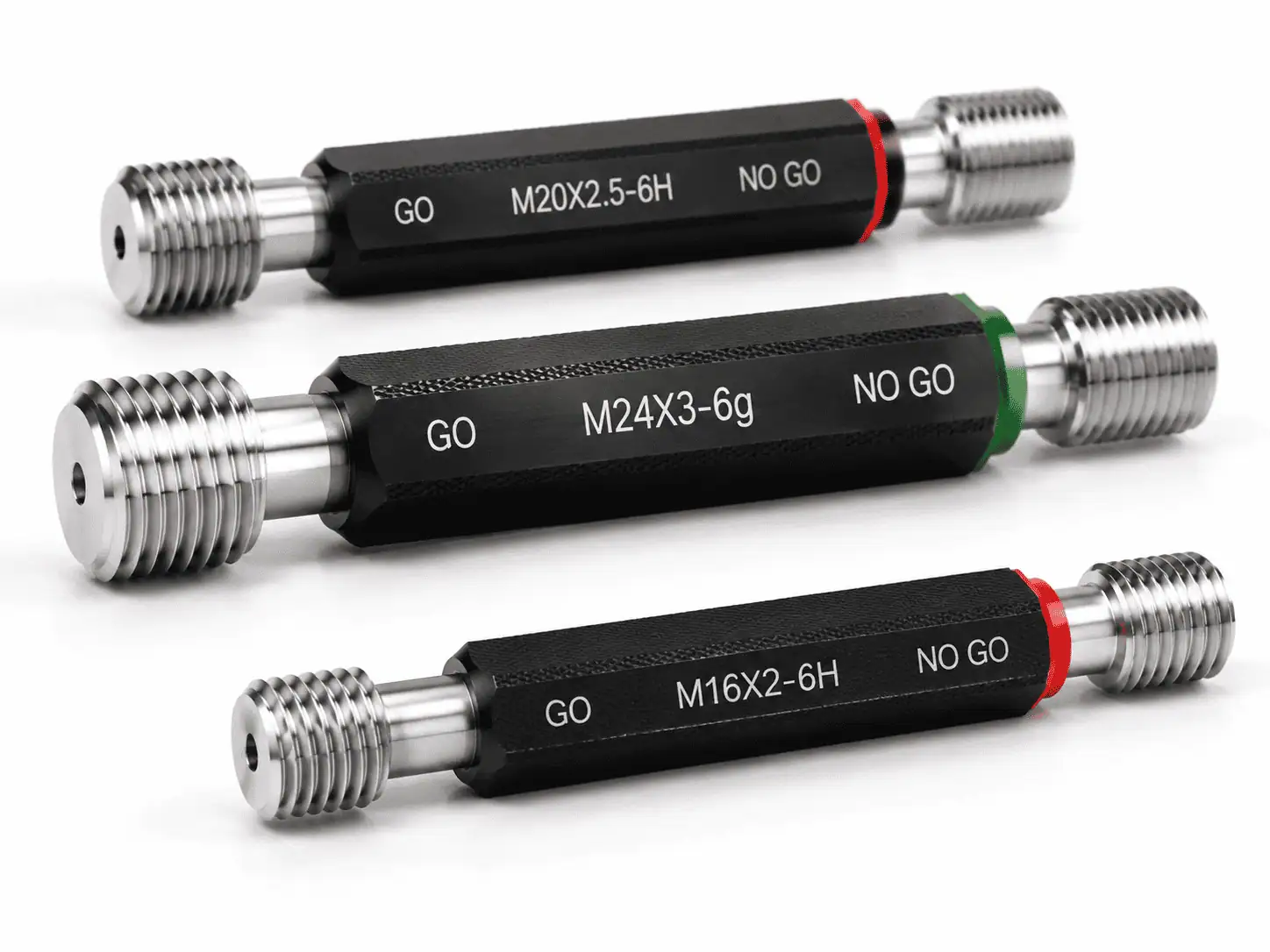
Need gauges for this? GageTools manufactures GO/NO-GO thread plug gauges and thread ring gauges in Dongguan, China. Standard sizes ship from stock within 72 hours, MOQ is 1 piece, and every RFQ gets a reply within 24 hours — request a quote.
Why Deep Threads Are Hard to Gauge
A standard thread plug gauge assumes the thread starts near an accessible face. Many real parts are different: a port thread at the bottom of a counterbore, a thread inside a hydraulic manifold cavity, an internal thread beyond a larger clearance bore, or a thread at the far end of a long housing. A standard handle may not reach, or it may reach but at an angle.
The risks are practical. The inspector cannot see the thread start, so the gauge may enter at an angle and cross-thread. A long, heavy assembly makes it hard to feel light resistance, so a tight GO or a slightly entering NO-GO can be misjudged. And if the gauge reaches the thread but not its full length, the check is incomplete.
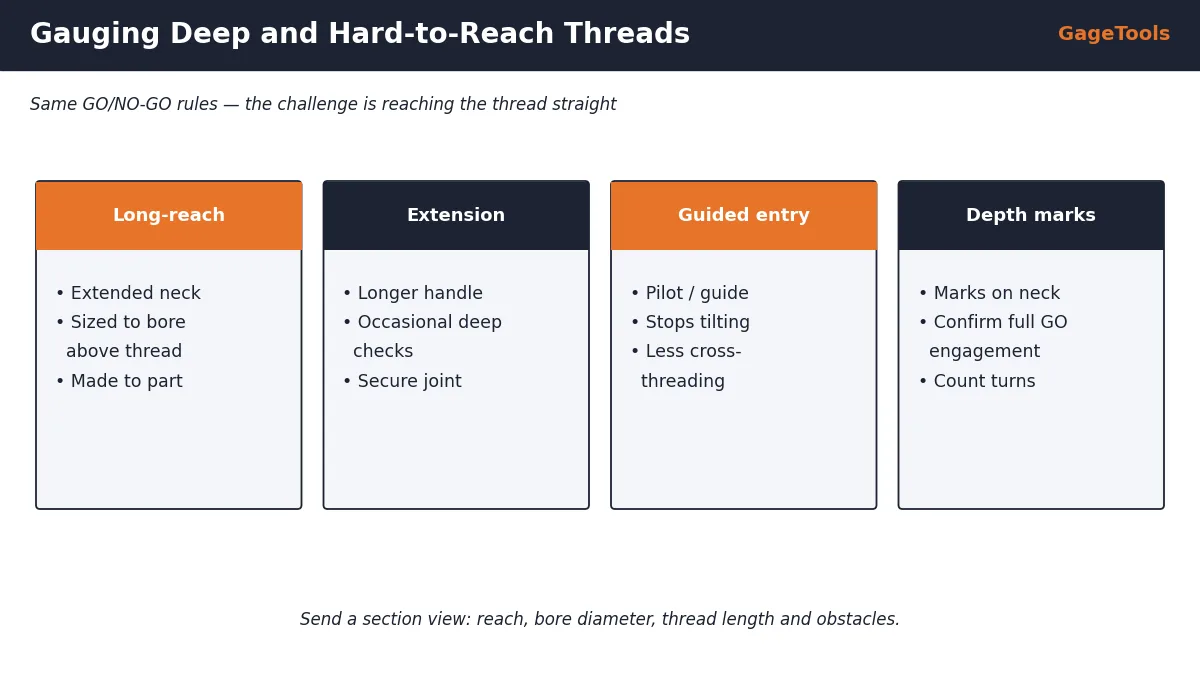
Four Ways to Reach a Deep Thread
- Threads at the bottom of counterbores
- Moderate depths with a clear bore above
- Regular production checks
The neck must be smaller than the bore above the thread, but stiff enough not to flex. Its length is made to suit your part.
- Occasional deep checks
- Several thread sizes at similar depth
- Reducing the number of special gauges
Joints add length and weight; the connection must stay secure and concentric so the member does not wobble.
- Blind starts the inspector cannot see
- Threads beyond a precise bore
- Reducing cross-threading risk
The guide must be designed to your bore size with clearance; if it is too tight it becomes a gauge of the bore, not a guide.
- Confirming full thread length
- Visual check that the gauge is fully engaged
- Training new inspectors
Marks are only as good as the reference face they are read against; define that face on the inspection plan.
The GO/NO-GO Rules Do Not Change
A long reach changes how you get to the thread, not how you judge it. The GO member must enter by hand over the full specified thread length. The NO-GO member must not enter beyond the permitted engagement: not more than two turns under ISO 1502 for metric threads and not more than three complete turns under ASME B1.2 for unified threads, unless your drawing says otherwise. For background, see the two-turn rule for NO-GO gauges.
Counting turns on a long gauge is harder. The handle is far from the thread, and feel is reduced. Add a reference mark on the handle so turns can be counted from outside, and turn slowly with light fingertip force.
If the thread is blind as well as deep, the GO gauge must also confirm thread depth. Our article on thread gauges for blind holes covers depth and clearance in detail.
Design Details That Decide Whether the Gauge Works
| Detail | Why it matters | What we need from you |
|---|---|---|
| Reach (face to thread start) | Sets neck or handle length | Dimension from drawing |
| Bore above thread | Limits neck diameter | Minimum bore diameter |
| Thread length to check | Sets member length and marks | Full thread length |
| Obstacles, cross holes, steps | Neck may catch or snag | Section view or photo |
| Weight and balance | Affects feel and turn counting | Typical part orientation |
| Guide requirement | Prevents tilt at entry | Bore tolerance if guiding |
Most of this information is on the part drawing. A section view through the thread and bore usually answers every question at once. We confirm the gauge design with you before quoting, so neck diameter, reach and guide are agreed up front.
Typical Applications
Standard thread sizes and classes still apply; only the access is special. For the gauge members themselves, see our thread plug gauges and, for metric ranges, our metric thread gauges.
Technique for Deep Thread Inspection
- Clean the bore and thread. Deep cavities trap chips and coolant; blow out and inspect with a light.
- Align before engaging. Hold the gauge on the bore axis and let the guide or neck centre it.
- Start by hand, gently. Turn backwards until you feel the thread start drop in, then turn forward.
- Count turns from outside using the handle mark.
- Check full engagement of the GO member using depth marks.
- Withdraw straight. Do not lever the gauge sideways against the bore.
If results vary between inspectors, run a short comparison on the same parts. Technique differences show up quickly on deep threads.
Handling and Calibrating Long-Reach Gauges
Long-reach gauges are more exposed to damage than standard plugs. The extra length acts as a lever, so a drop or a sideways knock can bend the neck or damage the first threads of the member. A bent neck may not be obvious by eye, but it makes the member enter at an angle and gives false tight readings.
- Store long gauges flat in a fitted case, not standing in a drawer or hanging by the handle.
- Check straightness and the condition of the first threads before each shift of use.
- Calibrate the gauging member on the same schedule as your other plug gauges, and after any drop.
- If the member is replaceable, spare members can be kept for the most-used sizes.
Wear on the GO member follows the same pattern as any plug gauge, so the same limits apply. Deep-thread gauges are often used on expensive parts such as manifolds and valve bodies, where a wrong accept costs far more than a spare gauge. Treat them as critical gauges in your calibration system and give them their own ID, like any other gauge.
When a Gauge Is Not Enough
Some threads are too deep, too small or too obstructed for a practical plug gauge. In those cases, quality teams sometimes combine methods: gauging a representative feature on a sectioned sample part during approval, gauging the thread before a later assembly or welding operation closes access, or changing the process sequence so threads are checked while still accessible.
What to Send When Ordering Deep Hole Thread Gauges
- Thread callout with class (e.g. M16x1.5-6H, 1/2-20 UNF-2B)
- Drawing or section view showing reach, bore diameter and thread length
- GO, NO-GO or both; quantity
- Whether you need a guide, depth marks or an extension handle
- Thread hand (left-hand threads need dedicated gauges)
- Certificate requirement (ISO/IEC 17025 calibration certificate available on request)
Long-reach gauges are made to order, typically in 10–15 working days. We make custom thread gauges from drawing with MOQ 1 piece.
Need a Gauge for a Deep Thread?
Send the part drawing or a section view and the thread callout. We confirm the gauge design and reply with price and lead time within 24 hours.
Related: Blind hole thread gauges · Custom gauges from drawing · Thread plug gauges
Frequently Asked Questions
✓ 20+ years gauge manufacturing
✓ ISO 9001:2015 certified
✓ In-house CNC grinding & inspection
✓ Drawing / RFQ reply within 24h
Long-Reach Thread Gauges Made to Your Part
GageTools makes long-reach and extension-handle thread plug gauges for deep and hard-to-reach internal threads, designed from your drawing. ISO/IEC 17025 calibration certificate available on request. Standard sizes ship from stock within 72 hours; custom gauges in 10–15 working days. MOQ 1 piece. WhatsApp for fastest response.
💬 WhatsApp Quote 📐 Send Drawing for QuoteNeed These Gauges? Get a Quote
Send your thread size or drawing, gauge type and quantity. MOQ is 1 piece; standard catalogue sizes in stock ship within 72 hours. Prefer chat? WhatsApp us.