
Need gauges for this? GageTools manufactures GO/NO-GO thread plug gauges and thread ring gauges in Dongguan, China. Standard sizes ship from stock within 72 hours, MOQ is 1 piece, and every RFQ gets a reply within 24 hours — request a quote.
Why Consolidate Thread Gauge Purchases
Many plants buy thread gauges one at a time, whenever a gauge wears out or a new part appears. The result is dozens of small orders a year, several suppliers, certificates in different formats and freight costs that are larger than the gauges themselves. Consolidating purchases into planned orders fixes most of this.
- One supplier evaluation: the gauge maker is approved once, and every gauge comes from the same quality system.
- Consistent documentation: certificates, serial numbers and marking follow one format, which makes the gauge register easier to maintain.
- Lower freight and handling: one shipment, one customs entry, one receiving inspection.
- Better planning: replacement gauges arrive before the old ones reach their wear limit.
The challenge is that a typical mixed order combines threads that are gauged in completely different ways. Metric and unified threads use GO/NO-GO turn rules; taper pipe threads use stand-off against an L1 gauge; straight pipe threads such as G (BSPP) look like parallel threads but have their own standard. A consolidated order only works if every line is unambiguous.
The Consolidation Process at a Glance
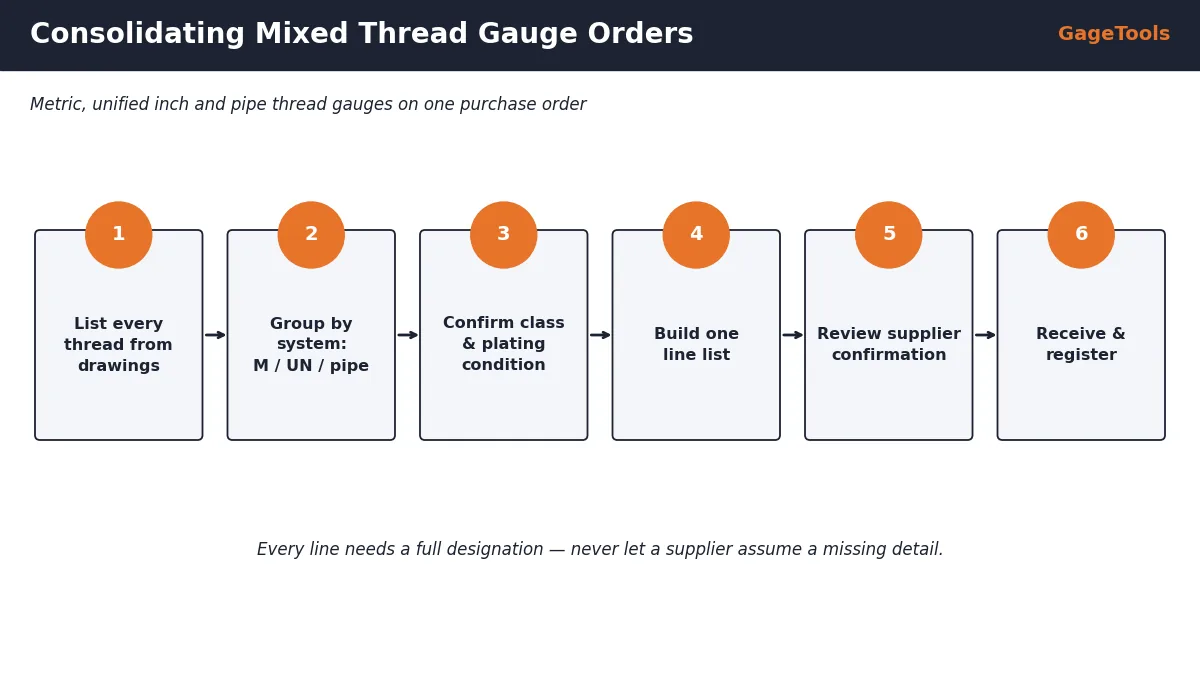
The process has six steps. First, list every thread you need to inspect, using the part drawings rather than memory. Second, group the threads by system: ISO metric, unified inch, taper pipe, parallel pipe and special threads. Third, confirm class and gauging condition for each line. Fourth, build a single line list. Fifth, review the supplier’s confirmation line by line. Sixth, receive and register the gauges as one delivery.
Doing the work in this order means errors are caught while they are still on a spreadsheet, not when the wrong gauge arrives at the inspection bench.
How the Thread Systems Differ in One Order
The table below summarises what changes from one system to the next. It is the reason each group needs its own check before the order is placed.
| Thread system | Example designation | Gauge standard | How parts are accepted |
|---|---|---|---|
| ISO metric | M10x1.5-6H / M10x1.5-6g | ISO 1502 | GO runs through; NO-GO max 2 turns |
| Unified inch | 1/2-13 UNC-2B / 2A | ASME B1.2 | GO runs through; NOT GO max 3 complete turns |
| NPT taper pipe | 1/2-14 NPT | ASME B1.20.1 | Stand-off within ±1 turn of L1 gauge |
| BSPT taper pipe | R 1/2 / Rc 1/2 | ISO 7 | Stand-off against the gauge reference |
| BSPP parallel pipe | G 1/2 A / G 1/2 | ISO 228 | GO/NO-GO for parallel pipe thread |
| Trapezoidal / Acme | Tr20x4-7H / 1-5 ACME-2G | Standard or customer specification | GO/NO-GO, class-dependent |
Unified inch ring gauges are often adjustable and set with setting plugs, so decide for each inch ring line whether setting plugs are part of the order. For taper pipe threads, decide whether you need plug, ring or both, and whether the drawing calls for NPT or NPTF. Our comparison of NPT, NPTF, BSPP and BSPT gauges helps avoid mixing these up.
Building a Clean Line List
The line list is the heart of a consolidated order. Use one row per gauge member or per set, and never abbreviate the designation. A good line list can be read by someone who has never seen your parts and still produce the correct gauges.
| Line | Designation | Gauge type | Condition | Qty | Certificate |
|---|---|---|---|---|---|
| 1 | M8x1.25-6H | GO/NO-GO plug set | Finished thread | 3 | ISO/IEC 17025 |
| 2 | M12x1.75-6g | GO/NO-GO ring set | Before plating | 2 | ISO/IEC 17025 |
| 3 | 3/8-16 UNC-2B | GO/NOT GO plug set | Finished thread | 2 | Standard |
| 4 | 3/4-10 UNC-2A | GO/NOT GO ring set + setting plugs | Finished thread | 1 | ISO/IEC 17025 |
| 5 | 1/2-14 NPT | L1 plug gauge | Finished thread | 2 | Standard |
| 6 | G 3/4 | GO/NO-GO plug set | Finished thread | 1 | Standard |
Add your internal part number or gauge ID to each line if you want it marked on the gauge. Keep a column for comments such as “left-hand”, “blind hole, full thread depth 22 mm” or “replace worn GO member only”.
Designation Errors That Appear in Mixed Orders
When metric, inch and pipe threads sit on the same list, similar-looking designations are easily confused. These are the errors we see most often:
| Error | Why it happens | How to avoid it |
|---|---|---|
| 1/2 NPT read as 1/2-13 UNC | Both start with “1/2” | Always write the TPI and series in full |
| G 1/2 treated as R 1/2 | Both are 55° BSP threads | Write parallel (G) or taper (R/Rc) explicitly |
| M12 without pitch | Coarse pitch assumed | Always write the pitch, even for coarse threads |
| UNC instead of UNF | Same diameter in both series | Copy TPI from the drawing, not from memory |
| Class missing | Default class assumed | Write 6H/6g, 2B/2A or 3B/3A on every line |
| Plug vs ring confused | Internal vs external not stated | Name the part feature: tapped hole or stud |
Never let a supplier “assume” a missing detail on a mixed order. On a single-gauge order a missing class is quickly queried. On a sixty-line order, one unqueried assumption can slip through. Every line must be complete before the order is released.
For unified threads, the UNC, UNF and UNEF guide is useful when checking TPI against diameter.
Planning Lead Times for Stock and Custom Lines
A consolidated order usually contains both standard sizes and special gauges. Standard sizes ship from stock within 72 hours; custom gauges made to drawing take 10–15 working days. Decide in advance whether you want everything in one shipment or the stock lines sent first.
If some gauges are urgent, mark those lines clearly. Our page on custom thread gauge lead time explains what drives the time for special gauges.
Certificates, Marking and Packing
A consolidated order is the right moment to standardise documentation. Ask for one certificate per gauge member, each referencing the serial number engraved on that member. If you need ISO/IEC 17025 certificates for some lines only, mark those lines; it keeps cost under control without weakening critical inspection.
Agree the certificate format before the order is placed. If your gauge register expects the serial number, measured values and the calibration date in a particular layout, send an example. Certificates that match your records can be filed in minutes; certificates in an unexpected format often sit in a pile until someone has time to re-type them.
- Marking: designation, class, GO/NO-GO and serial number on every member; add your gauge ID if you supply the format.
- Packing: each set in its own labelled box, grouped by thread system, so receiving can check against the line list.
- Packing list: should follow your PO line numbers, not the supplier’s internal numbering.
- Setting plugs: packed and labelled with the ring set they belong to.
When the shipment arrives, check each line against the PO before any gauge is issued to production.
Which Consolidation Approach Suits You?
Consolidation is a planning tool, not a rule. If a production line is stopped for one gauge, order that gauge separately.
What to Send When Ordering a Mixed Thread Gauge Order
To get an accurate quotation for a consolidated order in one pass, send:
- A line list with full designation, class and hand for every thread
- Gauge type per line: plug, ring, GO, NO-GO, L1, setting plugs
- Gauging condition per line (before or after plating)
- Part drawings for any special or non-standard thread
- Quantities, required delivery date and whether split shipment is acceptable
- Marking format and certificate requirement per line
We review the full list and reply within 24 hours, flagging any line that needs clarification. Browse metric thread gauges and GO/NO-GO thread gauges for standard ranges.
Consolidating Your Thread Gauge Purchasing?
Send your full line list with designations, classes, gauge types and quantities. We check every line, flag anything unclear and quote stock and custom items together.
Related: GO/NO-GO thread gauges · Bulk thread gauges for OEM buyers · Pipe thread gauge comparison
Frequently Asked Questions
✓ 20+ years gauge manufacturing
✓ ISO 9001:2015 certified
✓ In-house CNC grinding & inspection
✓ Drawing / RFQ reply within 24h
One Supplier for Metric, Inch and Pipe Thread Gauges
GageTools supplies GO/NO-GO plug and ring gauges for metric and unified threads, taper and parallel pipe thread gauges, and custom gauges from drawings on one order. ISO/IEC 17025 calibration certificate available on request. Standard sizes ship from stock within 72 hours; custom gauges in 10–15 working days. MOQ 1 piece. WhatsApp for fastest response.
💬 WhatsApp Quote 📐 Send Drawing for Quote