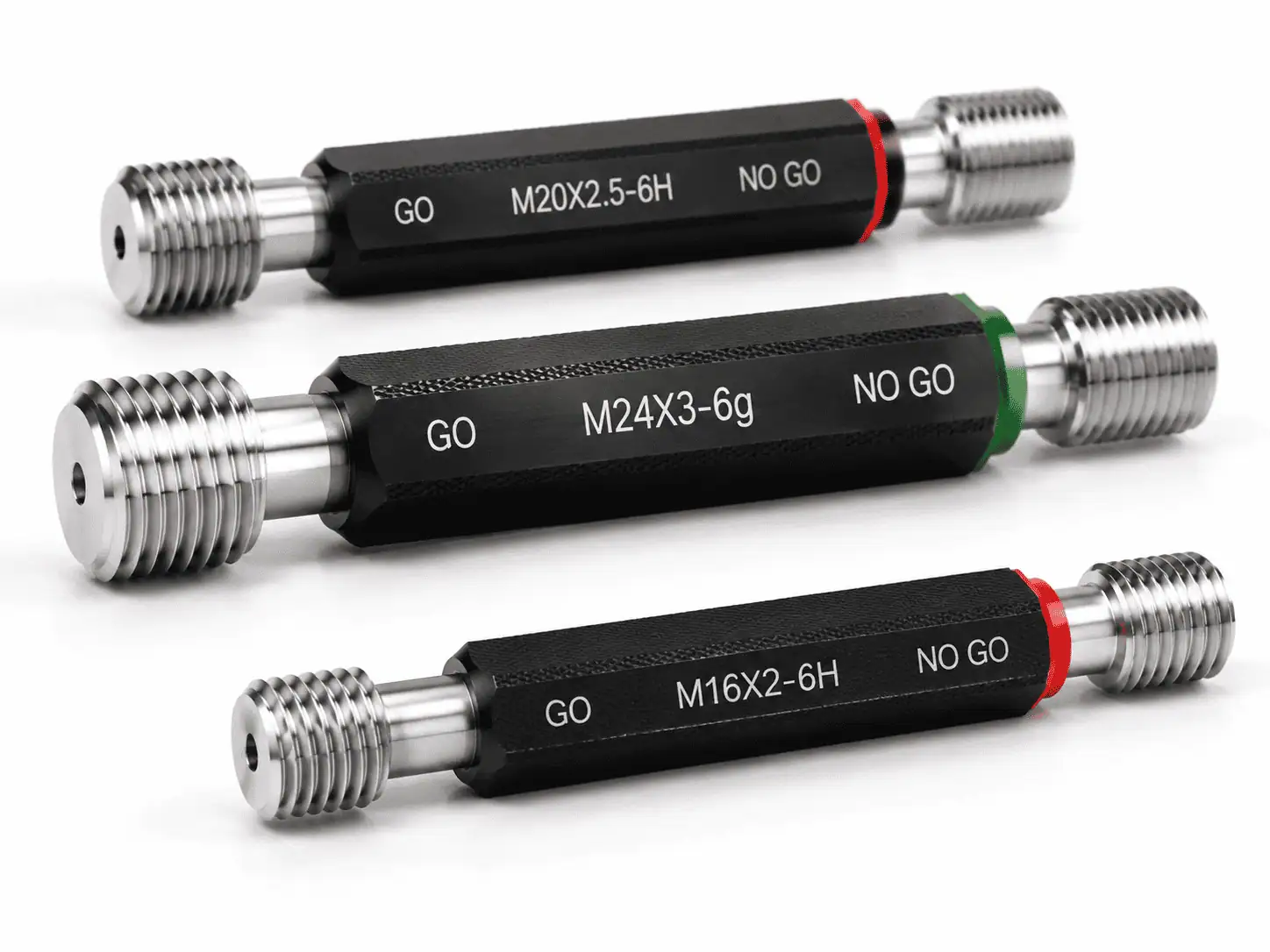
Need gauges for this? GageTools manufactures metric GO/NO-GO thread gauges, including thread plug gauges and thread ring gauges in Dongguan, China. Standard sizes ship from stock within 72 hours, MOQ is 1 piece, and every RFQ gets a reply within 24 hours — request a quote.
Metric Fine Thread Chart
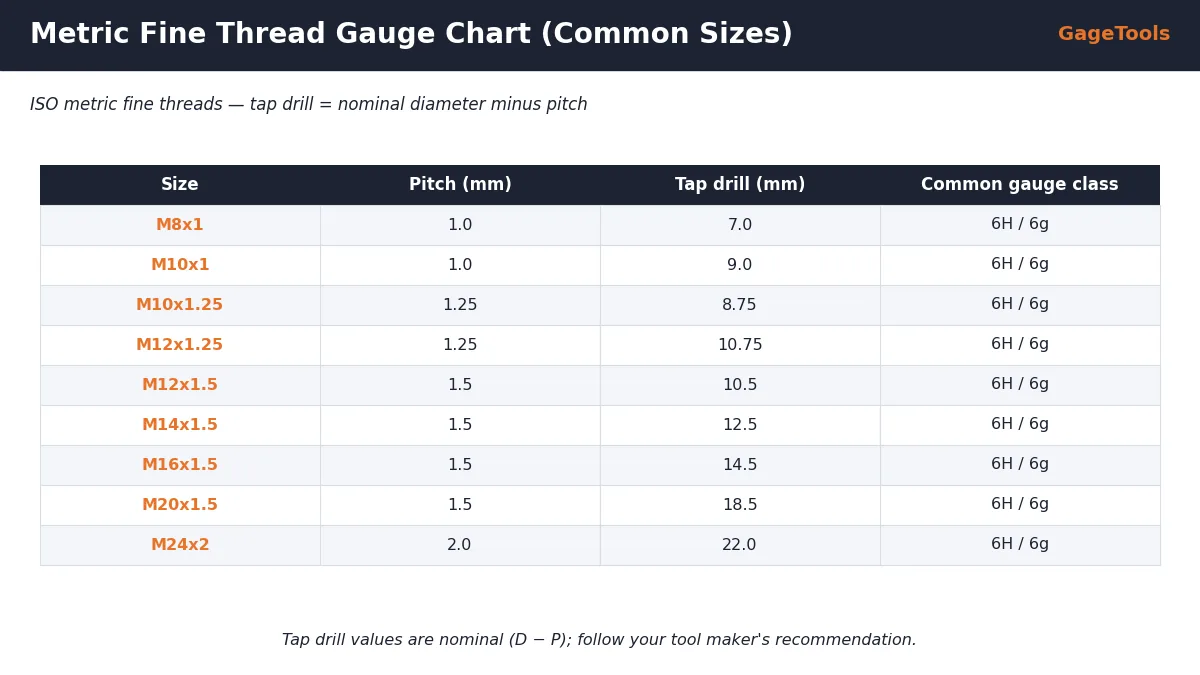
| Size | Pitch (mm) | Coarse pitch for comparison | Tap drill (mm) | Typical classes |
|---|---|---|---|---|
| M8x1 | 1.0 | 1.25 | 7.0 | 6H / 6g |
| M10x1 | 1.0 | 1.5 | 9.0 | 6H / 6g |
| M10x1.25 | 1.25 | 1.5 | 8.75 | 6H / 6g |
| M12x1.25 | 1.25 | 1.75 | 10.75 | 6H / 6g |
| M12x1.5 | 1.5 | 1.75 | 10.5 | 6H / 6g |
| M14x1.5 | 1.5 | 2.0 | 12.5 | 6H / 6g |
| M16x1.5 | 1.5 | 2.0 | 14.5 | 6H / 6g |
| M18x1.5 | 1.5 | 2.5 | 16.5 | 6H / 6g |
| M20x1.5 | 1.5 | 2.5 | 18.5 | 6H / 6g |
| M22x1.5 | 1.5 | 2.5 | 20.5 | 6H / 6g |
| M24x2 | 2.0 | 3.0 | 22.0 | 6H / 6g |
Tap drill values are nominal (diameter minus pitch). Follow your tap maker’s recommendation for the final drill size.
Why Engineers Choose Fine Threads
Fine threads are standard on many hydraulic ports (M14x1.5, M18x1.5, M22x1.5), spark plugs and sensors, wheel studs and precision adjusters.
Sizes That Are Easy to Confuse
| Size | Often confused with | Why it matters |
|---|---|---|
| M10x1.25 | M10x1 or M10x1.5 | Three pitches exist for M10 |
| M12x1.25 | M12x1.5 | Both are common “M12 fine” |
| M14x1.5 | M14x1.25 (spark plugs) | Different industries use different pitches |
| M18x1.5 | 3/4-16 UNF | Similar diameter, different system |
Always write the pitch. An RFQ for “M12 plug gauge” will be quoted as M12x1.75 coarse. For fine threads, always state the pitch: M12x1.5 or M12x1.25.
When to Specify a Fine Thread Instead of Coarse
Coarse threads are the default for general fasteners because they assemble quickly, tolerate dirt and damage better, and are less likely to strip in soft materials. Fine threads are chosen when one of their advantages matters more than these conveniences.
| Design need | Better choice | Why |
|---|---|---|
| Vibration resistance | Fine | Smaller helix angle resists self-loosening |
| High tensile strength in the same diameter | Fine | Larger tensile stress area |
| Thin-wall tubes and housings | Fine | Shallower thread depth |
| Fine adjustment | Fine | Less movement per turn |
| Fast assembly | Coarse | Fewer turns |
| Soft materials (aluminium, cast iron) | Coarse | Less risk of stripping |
| Dirty or damaged environments | Coarse | Less sensitive to debris |
Metric Fine Threads in Hydraulic Ports
Metric hydraulic ports to ISO 6149 and ISO 9974 use fine threads. The port thread is usually 6H, and the stud end of the fitting 6g. Typical sizes include:
| Port thread | Typical use |
|---|---|
| M10x1 | Small pilot and gauge ports |
| M12x1.5 | Small ports |
| M14x1.5 | Common small–medium port |
| M16x1.5 | Medium port |
| M18x1.5 | Medium port |
| M22x1.5 | Medium–large port |
| M27x2 | Large port |
Hydraulic ports also have a sealing spot face or O-ring cone that the thread gauge does not check — include it in your inspection plan.
Gauging Fine Threads Correctly
- Fine threads have shallow flanks, so small burrs have a big effect — deburr before gauging.
- Start gauges carefully; fine threads cross-thread more easily than coarse threads.
- Gauge blind holes to full depth — the last threads are often the tightest.
- Keep coarse and fine gauges of the same diameter in separate, clearly labelled places.
Fine Threads and Plating
Coatings take up a larger share of the tolerance on a fine thread than on a coarse one, because the tolerance band of a fine pitch is smaller. A zinc layer that is harmless on M12x1.75 can make an M12x1.25 bolt tight in a 6H nut.
- For plated external fine threads, the drawing often specifies 6g or 6e before plating so there is room for the coating.
- For plated internal threads, 6G is used to leave space for the coating in the nut.
- Tell your gauge supplier whether you gauge before or after coating, so the gauge limits match your inspection point.
| Condition | Typical external class | Typical internal class |
|---|---|---|
| No coating | 6g | 6H |
| Thin coating | 6g (before plating) | 6H |
| Thicker coating | 6e / 6f (before plating) | 6G |
How to Use This Chart When Ordering
- Find the size on your drawing, including pitch (e.g. M16x1.5).
- Confirm internal or external, and the class.
- Order a thread plug (internal) or ring (external) gauge for that exact size and class.
- If the size is not in the chart, it can still be made — send the callout.
The chart covers the most common fine pitches. ISO 261 lists many more combinations, including extra-fine pitches such as M10x0.75 and M20x1.0; gauges can be made for any standard or special pitch.
Stress Area: Coarse vs Fine
The tensile stress area is the effective cross-section used to calculate a bolt’s strength. For the same nominal diameter, a fine thread has a slightly larger stress area because its minor diameter is larger.
| Size | Coarse stress area (mm²) | Fine stress area (mm²) | Increase |
|---|---|---|---|
| M8 | 36.6 (x1.25) | 39.2 (x1) | ≈ 7% |
| M10 | 58.0 (x1.5) | 64.5 (x1) | ≈ 11% |
| M12 | 84.3 (x1.75) | 88.1 (x1.5) | ≈ 5% |
| M16 | 157 (x2) | 167 (x1.5) | ≈ 6% |
| M20 | 245 (x2.5) | 272 (x1.5) | ≈ 11% |
The gain is useful but modest. The main reasons to choose fine threads are usually vibration resistance, adjustment and wall thickness rather than strength alone.
Building a Fine-Thread Gauge Set
Workshops that produce hydraulic, automotive or instrument parts often keep a standard set of fine-thread gauges:
Start with the sizes your drawings use most, then add others as projects require. Common fine sizes are often in stock and ship within 72 hours.
Extra-Fine Metric Pitches
ISO 261 also lists extra-fine pitches, such as M10x0.75, M12x1.0, M16x1.0 and M20x1.0. They are used for thin-wall tubes, optical and instrument parts, and fine adjusters. Gauges for these sizes are normally made to order. When you see an unusual pitch on a drawing, confirm it is intentional before ordering gauges.
Inspection Plan for Fine-Thread Parts
Because fine threads are more sensitive to burrs, tool wear and coatings, a clear inspection plan pays off:
| Stage | Check | Gauge / method |
|---|---|---|
| First article | Size and class | GO/NO-GO + thread micrometer on external threads |
| In-process | Every N parts or at tool change | GO/NO-GO gauge |
| After coating | If drawing specifies post-coat limits | Post-coat GO/NO-GO gauge |
| Final | Sample or 100% per plan | GO/NO-GO gauge |
| Blind ports | Full-depth engagement | Depth-marked GO plug |
Adjust the frequency to your process capability. Stable processes can reduce sampling; new or unstable ones need more frequent checks.
Tapping Tips for Fine Threads
- Use the correct tap drill — fine threads leave little room for error.
- Choose taps designed for the material; form taps work well for fine threads in ductile materials.
- Replace worn taps early; fine threads show tap wear quickly as tight GO gauging.
- Clear chips from blind holes before gauging.
Key Terms
Quick definitions of the terms used in this guide:
| Term | Meaning |
|---|---|
| Coarse thread | Default ISO pitch for a diameter (e.g. M12x1.75) |
| Fine thread | Smaller pitch for the same diameter (e.g. M12x1.5) |
| Extra-fine | Even smaller pitches, e.g. M10x0.75 |
| 6H | Standard internal thread class |
| 6g | Standard external thread class |
| 6G / 6e | Classes with room for coatings |
| Tensile stress area | Effective area used for bolt strength |
| Tap drill | Drill size before tapping; sets minor diameter |
| ISO 261 | General plan of ISO metric thread sizes and pitches |
| ISO 965 | ISO metric thread tolerances |
Summary
Metric fine threads trade quick assembly for vibration resistance, fine adjustment and suitability for thin walls. Always specify the pitch, choose 6H/6g unless the drawing says otherwise, account for coatings, and keep coarse and fine gauges of the same diameter clearly separated. Common fine sizes are often in stock and ship within 72 hours.
Practical Tip: Keep a Pitch Card at the Bench
Print a small card showing the coarse and fine pitches for each diameter you use, and keep it at every inspection bench. Operators can check at a glance that the gauge in their hand matches the pitch on the drawing — the simplest way to avoid mixing M12x1.75 and M12x1.5 gauges.
Ordering Fine-Pitch Thread Gauges
- Write the full size with pitch:
M16x1.5-6H - Choose plug (internal) and/or ring (external)
- Give quantity and certificate needs
- Say whether parts are gauged before or after plating
Need Metric Fine Thread Gauges?
Send your list of fine-pitch sizes and classes. Common sizes are often in stock and ship within 72 hours.
Related: Metric thread gauges · M1–M100 plug gauge chart · Tolerance classes
Frequently Asked Questions
✓ 20+ years gauge manufacturing
✓ ISO 9001:2015 certified
✓ In-house CNC grinding & inspection
✓ Drawing / RFQ reply within 24h
Order Metric Fine Thread Plug and Ring Gauges
GageTools supplies GO/NO-GO plug and ring gauges for metric fine threads from M1 upward, in 4H, 6H, 7H, 6g, 6e and other classes. ISO/IEC 17025 calibration certificate available on request. Standard sizes ship from stock within 72 hours; custom gauges in 10–15 working days. MOQ 1 piece. WhatsApp for fastest response.
💬 WhatsApp Quote 📐 Send Drawing for Quote