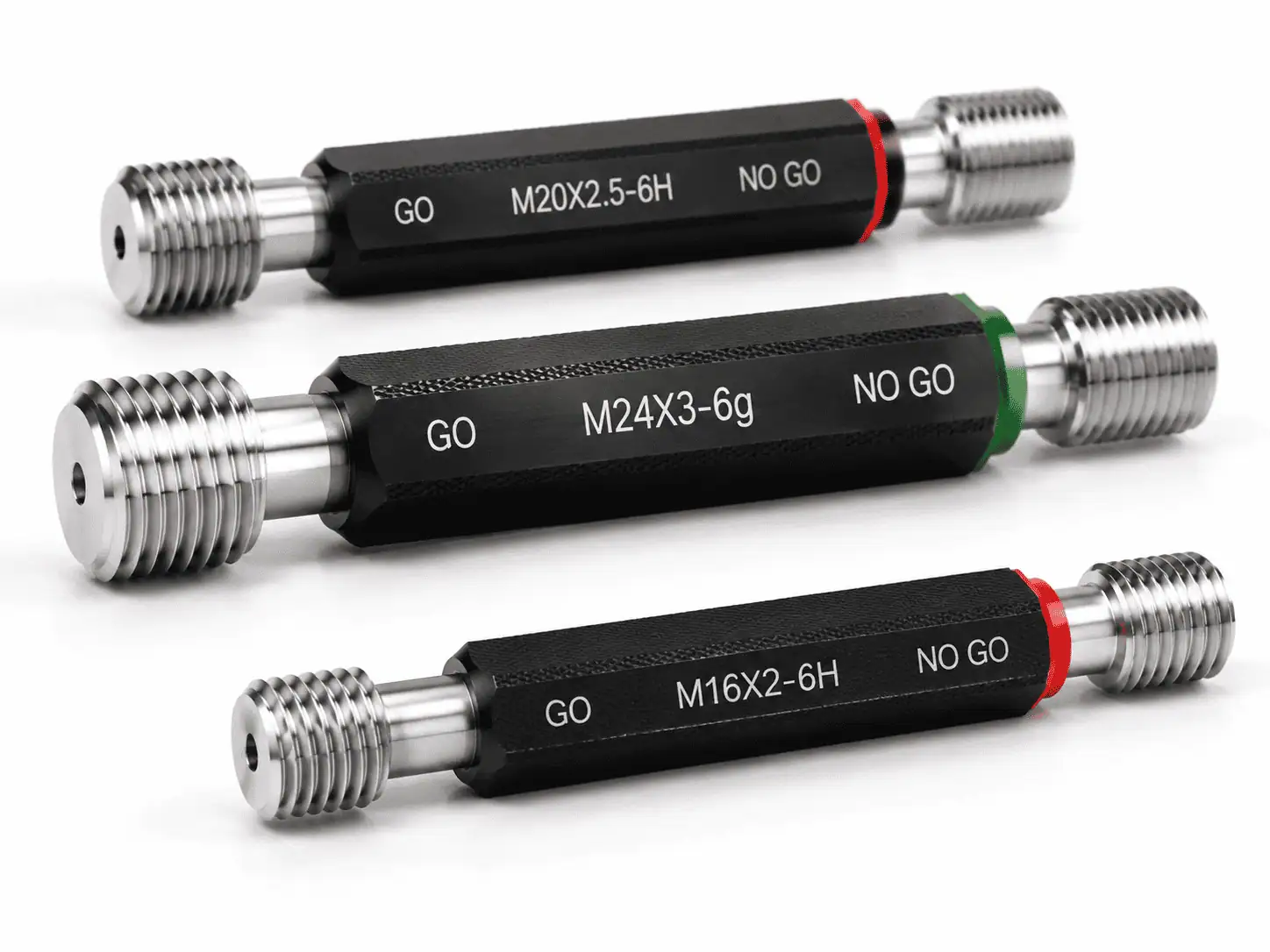
Why Taper Threads Are Gauged Differently
On a straight thread, a gauge that is too big simply will not go on. On a taper thread, a gauge always screws in — the question is how far. An oversize internal NPT thread lets the plug go in deeper; an undersize one stops it early. So NPT gauges measure stand-off: the position of the part relative to a reference mark on the gauge.
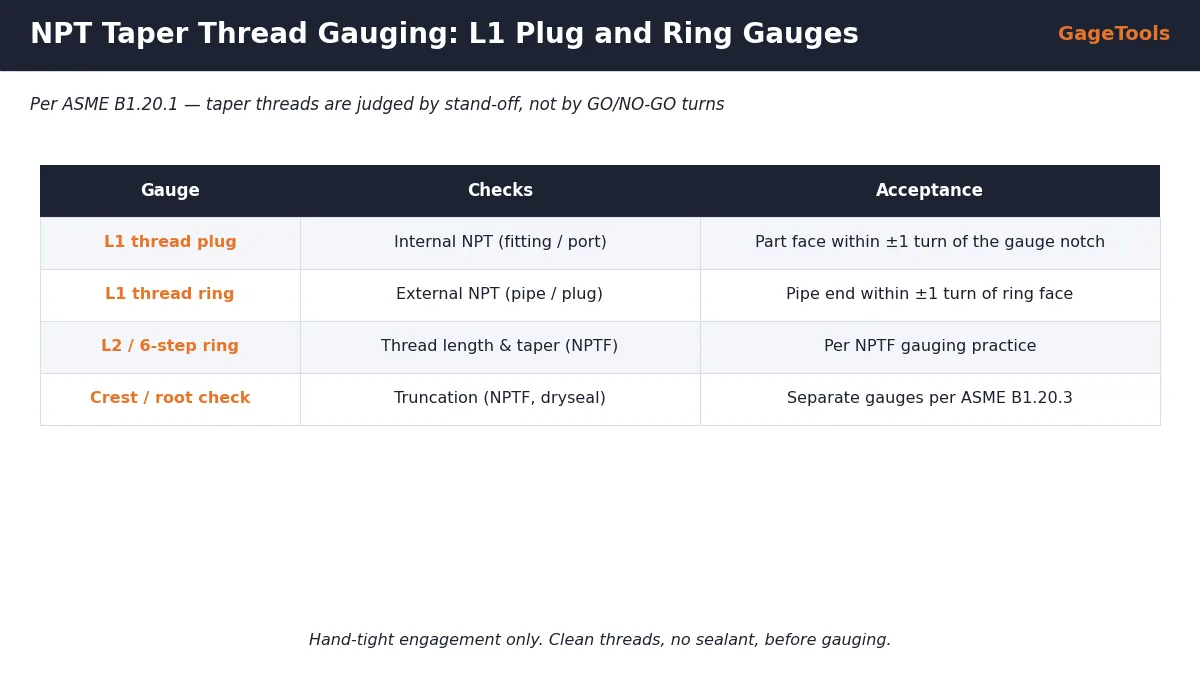
How to Gauge an Internal NPT Thread
- Clean the thread. Remove chips, tape and sealant.
- Screw the L1 plug gauge in by hand until it is hand-tight. Do not use a wrench.
- Look at where the face of the part lines up with the notch on the gauge.
- Accept if the face is within one turn above or below the notch; reject if outside.
Never wrench a taper gauge. Extra torque forces the gauge deeper, makes a tight thread look good and can damage both the part and the gauge.
How to Gauge an External NPT Thread
- Clean the pipe thread and remove any burr on the end.
- Screw the L1 ring gauge on hand-tight.
- Compare the end of the pipe with the face of the ring.
- Accept if the pipe end is within one turn of the ring face (flush, or up to one turn above or below).
NPT vs NPTF: Why Dryseal Needs More Gauges
| Feature | NPT | NPTF (dryseal) |
|---|---|---|
| Sealing | Tape or sealant | Metal-to-metal crest/root interference |
| Standard | ASME B1.20.1 | ASME B1.20.3 |
| Thread gauges | L1 plug and ring | L1 and L2 (or 6-step) gauges |
| Extra checks | — | Crest and root truncation |
| Typical use | General plumbing and industrial | Hydraulic and fuel systems |
If your drawing says NPTF, standard NPT L1 gauges alone cannot prove the thread will seal. Order the NPTF gauge set your customer specifies.
NPT Geometry in Plain Terms
NPT threads taper at 1 in 16 on the diameter — about 1°47′ on each side. The thread is defined at a reference plane called the gauging plane, and two lengths matter for gauging:
| Size | TPI | Approx. OD of pipe (in) | Typical use |
|---|---|---|---|
| 1/8 NPT | 27 | 0.405 | Instruments, small fittings |
| 1/4 NPT | 18 | 0.540 | Air and hydraulic fittings |
| 3/8 NPT | 18 | 0.675 | Fittings, valves |
| 1/2 NPT | 14 | 0.840 | Plumbing, process piping |
| 3/4 NPT | 14 | 1.050 | Plumbing, process piping |
| 1 NPT | 11.5 | 1.315 | Process piping |
| 2 NPT | 11.5 | 2.375 | Large process piping |
Because each size has its own TPI and gauging plane, every NPT size needs its own gauges. A 1/2 NPT plug cannot be used for 3/4 NPT, even though both are 14 TPI.
Common NPT Gauging Mistakes
| Mistake | Consequence | How to avoid |
|---|---|---|
| Wrenching the gauge | Tight threads look good; gauge damaged | Hand-tight only |
| Gauging with tape or sealant in the thread | False stand-off | Clean threads first |
| Using BSPT gauges on NPT (or vice versa) | Meaningless result | Check angle and TPI |
| Reading stand-off from a burred face | Wrong reading by a turn or more | Deburr the reference face |
| NPTF parts checked with NPT gauges only | Leaking dryseal joints | Use full NPTF gauging set |
Also remember that a thread can pass the L1 gauge and still leak if the taper or lead is wrong. For pressure-critical parts, add the L2 or 6-step checks your customer specifies.
Calibrating NPT Working Gauges
NPT working plugs and rings are calibrated against reference (master) gauges or measured by a lab. The calibration records the stand-off of the working gauge relative to the reference, so any wear that changes the gauging position can be seen. Set calibration intervals by usage — taper gauges in high-volume fitting production wear faster than you might expect, because every part is screwed in to full hand-tight engagement.
NPT vs BSPT Taper Threads
BSPT (R / Rc) threads are also tapered at 1 in 16, which is why they are often confused with NPT. They are not interchangeable, and each needs its own gauges.
| Feature | NPT | BSPT (R / Rc) |
|---|---|---|
| Thread angle | 60° | 55° |
| Crests and roots | Flat | Rounded |
| Standard | ASME B1.20.1 | ISO 7-1 / BS EN 10226 |
| 1/2″ TPI | 14 | 14 |
| 1/4″ TPI | 18 | 19 |
| Gauges | NPT L1 plug / ring | ISO 7 plug / ring |
1/2″ and 3/4″ share 14 TPI. An NPT fitting may start in a BSPT port of the same size, but the 55°/60° mismatch leaves leak paths. Always gauge with the correct system.
Setting Up an NPT Gauging Program
- List every NPT and NPTF size you machine or buy, and whether it is internal or external.
- Assign L1 plugs to tapped-port stations and L1 rings to pipe and plug stations.
- For NPTF parts, add the gauges your customer’s dryseal specification requires.
- Define hand-tight engagement in the work instruction, with pictures of the notch or ring face alignment.
- Set calibration intervals based on volume — high-volume fitting lines may need monthly checks.
- Keep a small stock of spare plugs for the most-used sizes.
A clear work instruction matters as much as the gauge. Most NPT disputes come from different people reading stand-off differently, not from gauge error.
Sealants, Tape and Gauging
NPT joints are sealed with PTFE tape or thread sealant because the thread form leaves a small spiral leak path at the crests and roots. That sealant must never be present when gauging. Even one wrap of tape changes stand-off by a significant fraction of a turn.
- Gauge immediately after machining, before any sealant is applied.
- If parts come in with sealant, clean them fully with a suitable solvent and brush.
- Never “add a turn” mentally to compensate for tape — clean and re-gauge.
NPTF dryseal threads are designed to seal without sealant, but in practice many assemblers still use a light compound. Gauging rules are the same: clean thread, hand-tight gauge.
Which NPT Sizes Are Most Common?
In industrial fittings and valves, a handful of sizes cover most demand. A practical starter set of L1 gauges is:
| Size | Plug gauge | Ring gauge | Typical products |
|---|---|---|---|
| 1/8-27 NPT | ✓ | ✓ | Instrument and gauge ports |
| 1/4-18 NPT | ✓ | ✓ | Air fittings, valves |
| 3/8-18 NPT | ✓ | ✓ | Fittings, valves |
| 1/2-14 NPT | ✓ | ✓ | Plumbing, process |
| 3/4-14 NPT | ✓ | ✓ | Plumbing, process |
| 1-11.5 NPT | ✓ | ✓ | Process piping |
Why L1 Is Called “Hand-Tight Engagement”
L1 is the length of thread that engages when an external and internal NPT thread are screwed together by hand, before wrench make-up. The L1 gauges represent a perfect mating part at that condition. When you screw an L1 plug into a fitting by hand, you are simulating how a perfect pipe would engage. If the fitting is on size, the gauge stops at its reference mark; if not, it stops early or late.
After hand-tight engagement, a real joint is wrench-tightened a further few turns (the wrench make-up) to deform the threads and seal with the help of sealant. Gauging only covers the hand-tight condition, which is why consistent hand pressure is essential.
Key Terms
Quick definitions of the terms used in this guide:
| Term | Meaning |
|---|---|
| NPT | National Pipe Taper — general-purpose US taper pipe thread (ASME B1.20.1) |
| NPTF | National Pipe Taper Fuel — dryseal taper thread (ASME B1.20.3) |
| Taper | 1 in 16 on diameter, about 1°47′ per side |
| Gauging plane | Reference plane where the thread size is defined |
| L1 | Hand-tight engagement length |
| L2 | Effective (full-form) thread length |
| Stand-off | Position of the part relative to the gauge reference |
| Wrench make-up | Additional turns after hand-tight to seal the joint |
| Truncation | Flattening of crests and roots; controlled on NPTF |
| BSPT | British taper pipe thread (55°), not interchangeable with NPT |
What to Specify When Ordering NPT Gauges
- Size and thread, e.g.
1/2-14 NPTor1/4-18 NPTF - Plug, ring or both, and quantity
- Certificate requirement (ISO/IEC 17025 available on request)
Need NPT or NPTF Thread Gauges?
Send the sizes, NPT or NPTF, plug or ring, and quantity. We reply with price and lead time within 24 hours.
Related: NPT vs BSP gauges · Thread plug gauges · Thread ring gauges
Frequently Asked Questions
✓ 20+ years gauge manufacturing
✓ ISO 9001:2015 certified
✓ In-house CNC grinding & inspection
✓ Drawing / RFQ reply within 24h
Order NPT and NPTF Taper Thread Gauges
GageTools supplies L1 plug and ring gauges for NPT and NPTF pipe threads, plus BSPT and other taper thread gauges. ISO/IEC 17025 calibration certificate available on request. Standard sizes ship from stock within 72 hours; custom gauges in 10–15 working days. MOQ 1 piece. WhatsApp for fastest response.
💬 WhatsApp Quote 📐 Send Drawing for Quote