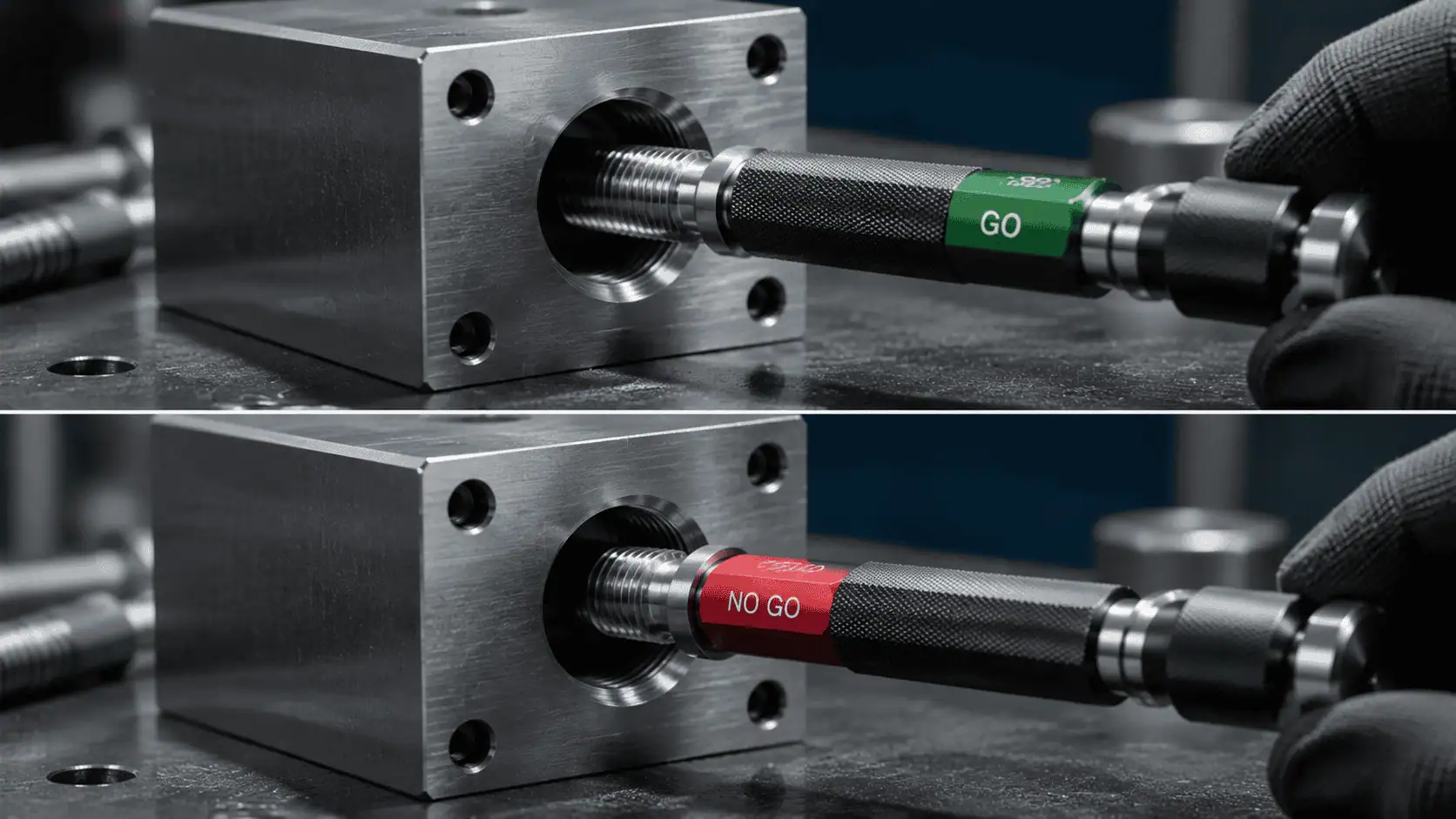
Need the exact metric or inch gauge? GageTools manufactures ISO metric, unified inch (UNC/UNF/UNEF), and pipe (NPT/BSP) GO/NO-GO plug and ring gauges with MOQ 1 piece, 72hr stock dispatch, and ISO/IEC 17025 certs on request. Send your callout for a 24hr quote →
The Substitution Problem
Shops that work with both metric and inch drawings eventually face the same question: the exact gauge is not on the shelf, but there is one “close enough” in the other system. Can it be used, at least for a quick check?
The answer is no. Metric and unified inch threads share the same basic 60° profile, so they can look almost identical on the bench. But the numbers that decide whether a thread is good — pitch, pitch diameter limits and the rules for using the NO-GO gauge — are different. A gauge from the wrong system will give a result, but it will be the answer to the wrong question.
This article explains where the two systems differ, which pairs of sizes cause the most confusion and what to do when a drawing uses one system and your gauge cabinet is built around the other.
Pitch vs Threads per Inch
Metric threads are specified by pitch in millimetres, the distance from one thread to the next. Inch threads are specified by threads per inch (TPI). To compare them, convert TPI to pitch: pitch (mm) = 25.4 ÷ TPI.
| TPI | Equivalent pitch (mm) | Nearest metric pitch | Difference per thread |
|---|---|---|---|
| 13 | 1.954 | 2.0 | 0.046 mm |
| 16 | 1.5875 | 1.5 | 0.0875 mm |
| 18 | 1.411 | 1.5 / 1.25 | 0.089 / 0.161 mm |
| 20 | 1.270 | 1.25 | 0.020 mm |
| 24 | 1.058 | 1.0 | 0.058 mm |
| 28 | 0.907 | 1.0 / 0.8 | 0.093 / 0.107 mm |
A difference of a few hundredths of a millimetre per thread looks small, but it accumulates along the length of engagement. Ten threads of 20 TPI against a 1.25 mm pitch gauge are already 0.2 mm out of step. That is far more than a typical pitch diameter tolerance, so the flanks bind and the GO gauge stops, or, worse, a forced gauge damages the part or the gauge.
A gauge that “goes on a couple of turns” proves nothing. With near-miss pitches, a few threads may engage before the accumulated lead difference makes them bind. Partial engagement is not a pass.
Near-Miss Sizes That Cause Trouble
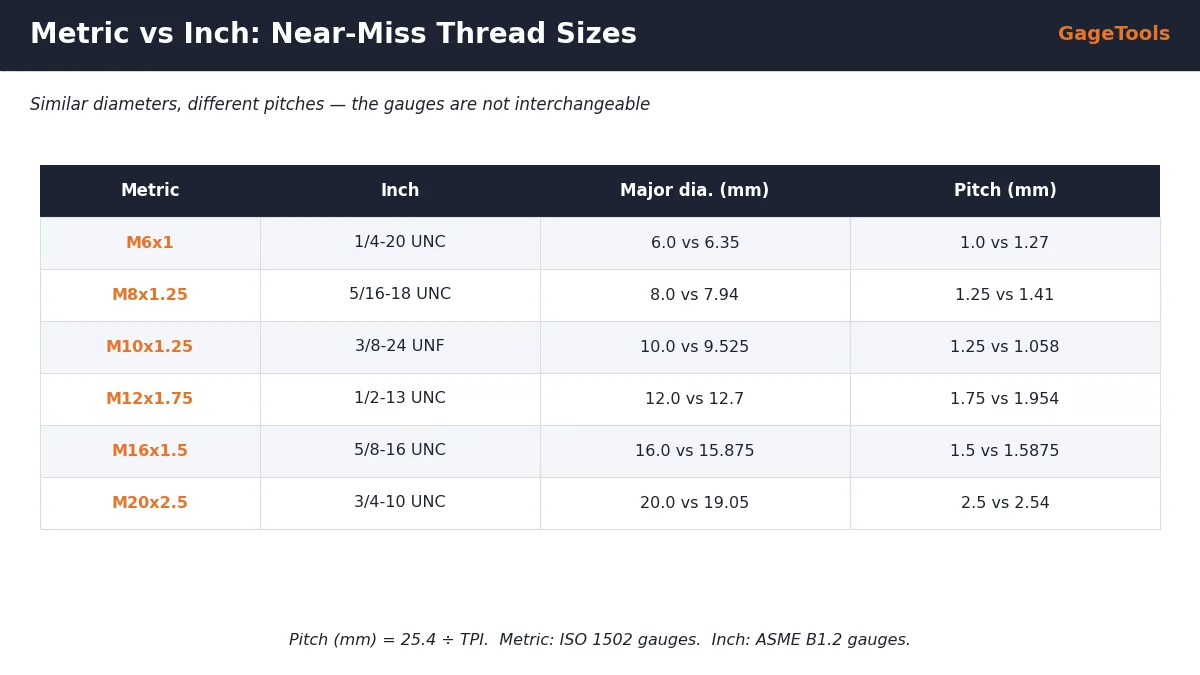
Some metric and inch sizes are close enough in diameter to be mixed up, especially when parts, drawings or gauges are poorly marked. These are the pairs that come up most often in mixed shops.
| Metric size | Nearby inch size | Major diameter (mm) | Pitch (mm) |
|---|---|---|---|
| M6x1 | 1/4-20 UNC | 6.0 vs 6.35 | 1.0 vs 1.27 |
| M8x1.25 | 5/16-18 UNC | 8.0 vs 7.94 | 1.25 vs 1.41 |
| M10x1.25 | 3/8-24 UNF | 10.0 vs 9.525 | 1.25 vs 1.058 |
| M12x1.75 | 1/2-13 UNC | 12.0 vs 12.7 | 1.75 vs 1.954 |
| M16x1.5 | 5/8-16 UNC | 16.0 vs 15.875 | 1.5 vs 1.5875 |
| M20x2.5 | 3/4-10 UNC | 20.0 vs 19.05 | 2.5 vs 2.54 |
Look at M8x1.25 and 5/16-18: the diameters are within about 0.06 mm, so a bolt may start in the wrong hole. M20x2.5 and 3/4-10 have pitches within 0.04 mm, but the diameters differ by almost a millimetre. In every pair, at least one number is far outside any thread tolerance.
When parts arrive with no clear marking, measure the pitch with a pitch gauge or thread comparator and the major diameter with a caliper before choosing the GO/NO-GO gauge. Our UNC vs UNF vs UNEF guide and metric thread chart help you identify the thread first.
Different Tolerance Systems
Even if pitch and diameter matched perfectly, the gauges would still differ, because the tolerance systems are built differently.
ISO metric classes combine a tolerance grade (a number such as 4, 6 or 8) with a tolerance position (a letter such as H, G, g or e). Unified classes use 1A/2A/3A for external threads and 1B/2B/3B for internal threads. The two systems do not map one-to-one: 6g is often described as “similar” to 2A in practice, but the actual pitch diameter limits are calculated differently and are not equal.
The acceptance rules also differ. Under ISO 1502, a NO-GO gauge may enter no more than two turns; under ASME B1.2, a NOT GO gauge may enter no more than three complete turns. A metric NO-GO judged with the inch rule, or the reverse, is not a valid inspection. See the two-turn rule for details.
Free PDF: Thread Gauge Selection Guide & Tolerance Chart
4H–7H / 6g–6e chart, fundamental deviations, 2A/2B vs 3A/3B, gauges by standard and an ordering checklist.
Download Free GuidePipe Threads: Same TPI, Different Angle
Pipe threads add another trap. NPT (ASME B1.20.1) and BSPT (ISO 7) often use the same number of threads per inch for a given nominal size — for example, 1/2 inch is 14 TPI in both. Both are tapered 1:16. Yet they are not interchangeable.
- Flank angle: NPT uses a 60° thread angle; BSP threads (ISO 7 and ISO 228) use 55°.
- Crest and root form: NPT has flat crests and roots; BSP has rounded ones.
- Gauging: NPT is gauged with L1 plugs and rings to ASME B1.20.1; BSPT with gauges to ISO 7 requirements; parallel G threads with ISO 228 gauges.
A 1/2 NPT gauge may seem to enter a 1/2 BSPT fitting, but contact happens on the wrong part of the flank and the reading has no meaning. For a full comparison, see NPT vs NPTF vs BSPP vs BSPT thread gauges.
What Goes Wrong When Gauges Are Substituted
Substituting gauges does not just give a wrong answer; it can create real cost and risk.
| Substitution | Likely result | Consequence |
|---|---|---|
| Inch GO plug in a metric hole | Binds or enters partially | Good parts rejected, or hole damaged |
| Metric ring on an inch bolt | Stops after a few turns | Good parts rejected or forced |
| Forcing a near-miss gauge | Flanks galled, gauge worn | Gauge ruined, parts damaged |
| NPT gauge on BSPT thread | Misleading stand-off | Leaking joints in service |
| Metric NO-GO judged by 3-turn rule | Undersize parts accepted | Loose fit, stripping risk |
The most dangerous case is not the obvious reject; it is a false accept. If an operator forces a wrong gauge and then uses a loose rule to interpret the NO-GO result, bad parts can pass. That is why the gauge, the thread callout and the acceptance rule must all belong to the same system.
Running Metric and Inch Work in the Same Shop
Mixed shops can avoid most substitution problems with a few simple controls.
- Separate storage: keep metric and inch gauges in different, clearly labelled cases or drawers.
- Colour or label by system: a visible tag or case label reduces pick-up errors.
- Put the callout on the traveller: operators should read “M8x1.25-6H” or “5/16-18 UNC-2B”, not just “M8” or “5/16”.
- Check before the first part: confirm that the gauge ID matches the drawing callout before running the job.
- Stop if the gauge is missing: do not run the job until the correct gauge is available.
When a Customer Changes From Inch to Metric
Sometimes a product is redesigned from inch to metric threads, or the reverse, and old and new versions run in parallel for a period. That is when substitution errors peak, because both versions look similar on the shop floor.
- Buy the new gauges before the first production order of the new design.
- Keep old and new gauges on separate, clearly marked shelves.
- Update travellers, inspection plans and gauge lists at the same time.
- Retire old gauges formally when the old design ends, instead of leaving them in circulation.
If you are reordering gauges for a converted design, send both the old and new callouts so the supplier can confirm there is no mix-up. For our full metric range, see metric thread gauges.
What to Send When Ordering Metric or Inch Thread Gauges
Select your thread system below to pre-fill your RFQ, and include the full callout from your drawing:
- Full thread callout: size, pitch or TPI, series and class (e.g. M16x1.5-6H or 5/8-16 UNC-2B)
- Internal or external thread (plug or ring)
- Thread hand, if left-hand
- Standard to follow (ISO 1502, ASME B1.2, ASME B1.20.1, ISO 7, ISO 228)
- Quantity and whether setting plugs are needed for rings
- Certificate requirement (ISO/IEC 17025 available on request)
- A drawing for any non-standard thread
If you are not sure which system a part uses, send a photo, the drawing and your measurements. We confirm the thread before quoting and reply within 24 hours.
Frequently Asked Questions
Order Metric and Inch Thread Gauges
GageTools makes GO/NO-GO thread gauges for ISO metric, unified inch, NPT, BSP and special threads, each made to its own standard. ISO/IEC 17025 calibration certificate available on request. Standard sizes ship from stock within 72 hours; custom gauges in 10–15 working days. MOQ 1 piece.
Get Instant Quote → 💬 WhatsApp QuoteNeed Metric or Inch Thread Gauges? Get a Quote
Send your thread callout (metric, UNC/UNF, NPT or BSP), gauge type and quantity. MOQ is 1 piece; standard stock sizes ship in 72 hours. Prefer chat? WhatsApp us.