Why Replace One Member Instead of the Whole Gauge
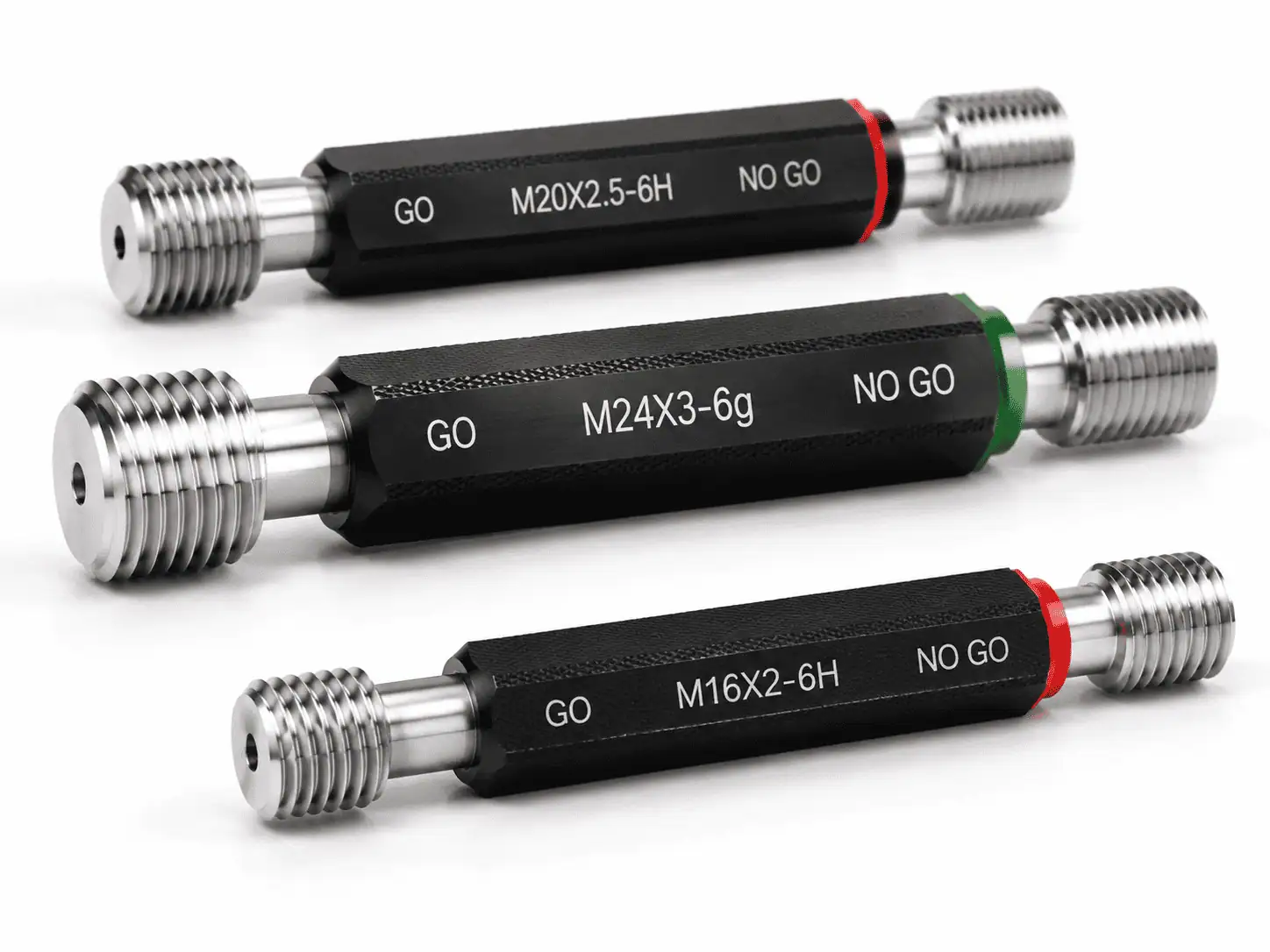
A double-ended thread plug gauge has a GO member and a NO-GO member fitted to a handle. They do not wear at the same rate. The GO member runs the full length of every good part; the NO-GO member engages only briefly. In most production use, the GO end reaches its wear limit well before the NO-GO end.
If the NO-GO end, handle and records are all fine, replacing only the GO member saves cost and keeps the rest of the gauge in service. The same logic applies in reverse when a NO-GO member is damaged by a drop, or when one ring of a GO/NO-GO ring pair is worn or lost.
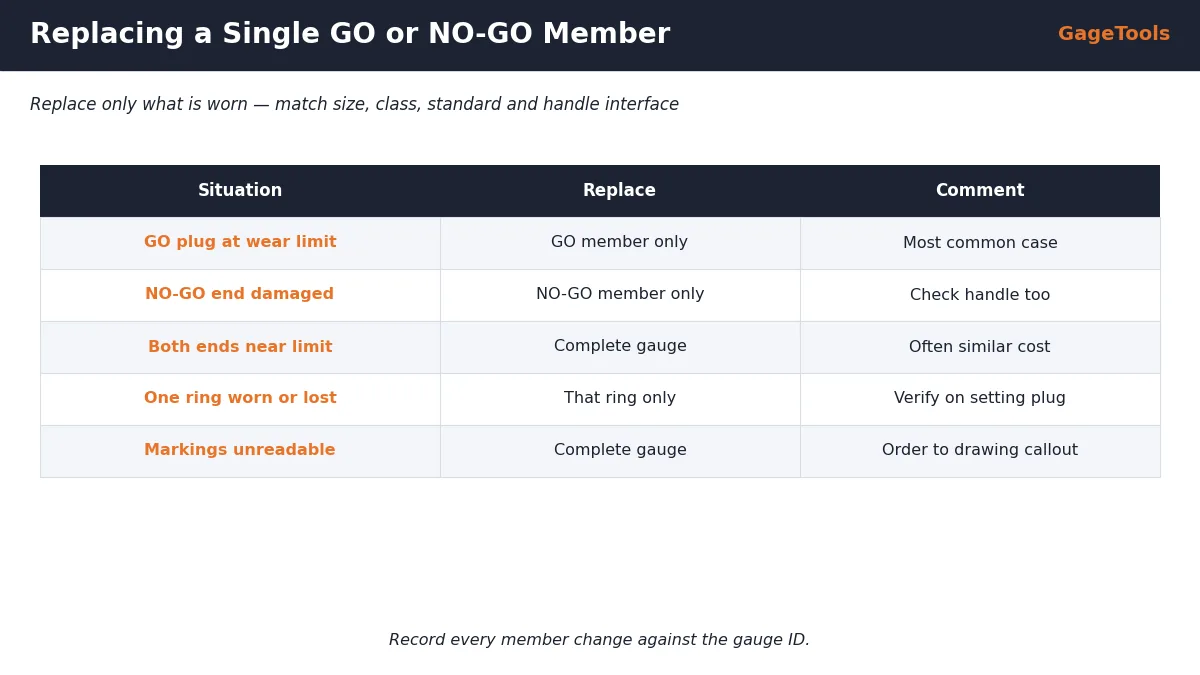
When Replacing One Member Makes Sense
| Situation | Replace | Comment |
|---|---|---|
| GO plug at wear limit, NO-GO fine | GO member only | Most common case |
| NO-GO end damaged by a drop | NO-GO member only | Check handle for damage too |
| Both ends near limit | Complete gauge | Usually simpler and similar cost |
| Handle cracked or loose fit | Complete gauge or handle | Members may still be usable |
| One ring of a ring pair worn or lost | That ring only | Rings are separate pieces |
| Gauge from unknown source, no records | Complete gauge | Unclear design and history |
A worn GO plug is identified by calibration, not by feel. Our guide to thread plug gauge wear limits explains how wear is measured and when a GO member should be retired.
Do not mix members from different standards or classes. A GO member for 6H and a NO-GO member for 6H must both be made for 6H under the same standard. A replacement from a different class may fit the handle perfectly and still be the wrong gauge.
Handle Interfaces: Why Fit Matters
Plug gauge members are held in the handle in several ways, depending on size and maker. Common designs include taper-lock members, which have a tapered shank pressed into the handle, and tri-lock style members, which are held by a screw through the member into the handle, typically used on larger sizes. Some smaller gauges are made in one piece with no replaceable members at all.
If you are not sure what interface your handle uses, send clear photos of the gauge, the handle end and the markings, plus basic dimensions. We confirm whether a replacement member will fit before quoting. If the existing handle is non-standard, a complete new gauge may be the cleaner choice.
Replacing One Ring of a GO/NO-GO Pair
Thread ring gauges are separate pieces, so replacing one is straightforward. The new ring must match the size, class and standard of its partner, and the type — solid or adjustable — should normally match your existing practice.
- A new GO ring is normally ordered with its own calibration record.
- If you set adjustable rings in-house, the new ring must be verified on your GO or NO-GO setting plug before use.
- Engraving should follow the same convention as the old ring so operators are not confused.
For ring gauge options, see our thread ring gauges; for setting practice, see whether ring gauges need setting plugs.
Keeping Gauge Records Correct
A gauge ID usually belongs to the complete gauge. When one member changes, the record must show it, or the calibration history becomes misleading.
- Record the replacement: date, which member, reason (wear limit, damage).
- Keep the new member’s certificate with the gauge record.
- Decide on ID rules: keep the gauge ID and note the member change, or assign member IDs.
- Recalibrate the assembled gauge if your procedure requires it after any change.
- Quarantine the removed member so it cannot return to use by mistake.
If you are setting up or tidying a gauge register, our thread gauge calibration guide covers what records should show. An ISO/IEC 17025 calibration certificate is available on request for replacement members.
Cost and Lead Time Compared
| Option | Typical relative cost | Lead time |
|---|---|---|
| Single standard member | Lower than a complete gauge | Stock sizes: within 72 hours |
| Complete standard gauge | Higher; includes handle and both ends | Stock sizes: within 72 hours |
| Single custom member | Depends on design | 10–15 working days |
| Complete custom gauge | Higher | 10–15 working days |
For small sizes, the difference between one member and a complete gauge is often small, and a new complete gauge brings a fresh NO-GO member and handle too. For larger sizes, where members are heavier and more expensive, a single-member replacement usually saves more. We quote both options when that helps you decide. Our thread gauge price guide explains what drives cost.
Planning Spare Members for Production
If a production line uses one thread size heavily, waiting for a replacement GO member every time the old one reaches its wear limit costs inspection time. Many quality teams keep one spare GO member, or a complete spare gauge, for their busiest sizes.
- Use calibration history to see how fast GO members wear on each line.
- Order a spare when the current member approaches its wear limit, not after it fails.
- Keep spares sealed and identified, with their certificates, in the gauge store.
- Review the list once a year as products and volumes change.
Because GO members wear faster, a sensible ratio for high-volume sizes is more spare GO members than NO-GO members. Your own wear data is the best guide. For low-volume sizes, keeping no spares and ordering a complete gauge when needed is usually more economical.
Standard spare members follow the same stock and lead time rules as complete gauges, so for common sizes a short lead time is normal. For custom threads, plan further ahead, because a spare member is made to order in 10–15 working days, the same as a complete custom gauge.
When You Do Not Know the Original Gauge Details
Old gauges sometimes have worn or missing markings. If you cannot confirm the size, class or standard from the gauge, do not guess. Go back to the part drawing: the thread callout on the drawing defines which gauge you need. The gauge must follow the part, not the other way round.
If the drawing is not available, our article on replacing a gauge without a drawing explains what information can still be used and its limits.
Which Replacement Do You Need?
What to Send When Ordering a Spare Gauge Member
- Full thread callout and class (e.g. M12x1.75-6H, 5/16-18 UNC-2B)
- Standard the gauge is made to (e.g. ISO 1502, ASME B1.2)
- Which member: GO or NO-GO; plug or ring
- Handle type, with photos of the handle end and markings
- Gauge ID, so the certificate can reference it
- Quantity and certificate requirement (ISO/IEC 17025 available on request)
Single members and single rings can be ordered from 1 piece. For complete gauges, see our GO/NO-GO thread gauges.
Need a Replacement GO or NO-GO Member?
Send the thread callout, the member you need and photos of the handle. We confirm fit and reply with price and lead time within 24 hours.
Related: Plug gauge wear limits · Thread plug gauges · Replace without a drawing
Frequently Asked Questions
✓ 20+ years gauge manufacturing
✓ ISO 9001:2015 certified
✓ In-house CNC grinding & inspection
✓ Drawing / RFQ reply within 24h
Spare GO and NO-GO Members from MOQ 1
GageTools supplies replacement GO and NO-GO plug members, single ring gauges and complete gauges for metric, unified and pipe threads. ISO/IEC 17025 calibration certificate available on request. Standard sizes ship from stock within 72 hours; custom gauges in 10–15 working days. MOQ 1 piece. WhatsApp for fastest response.
💬 WhatsApp Quote 📐 Send Drawing for Quote