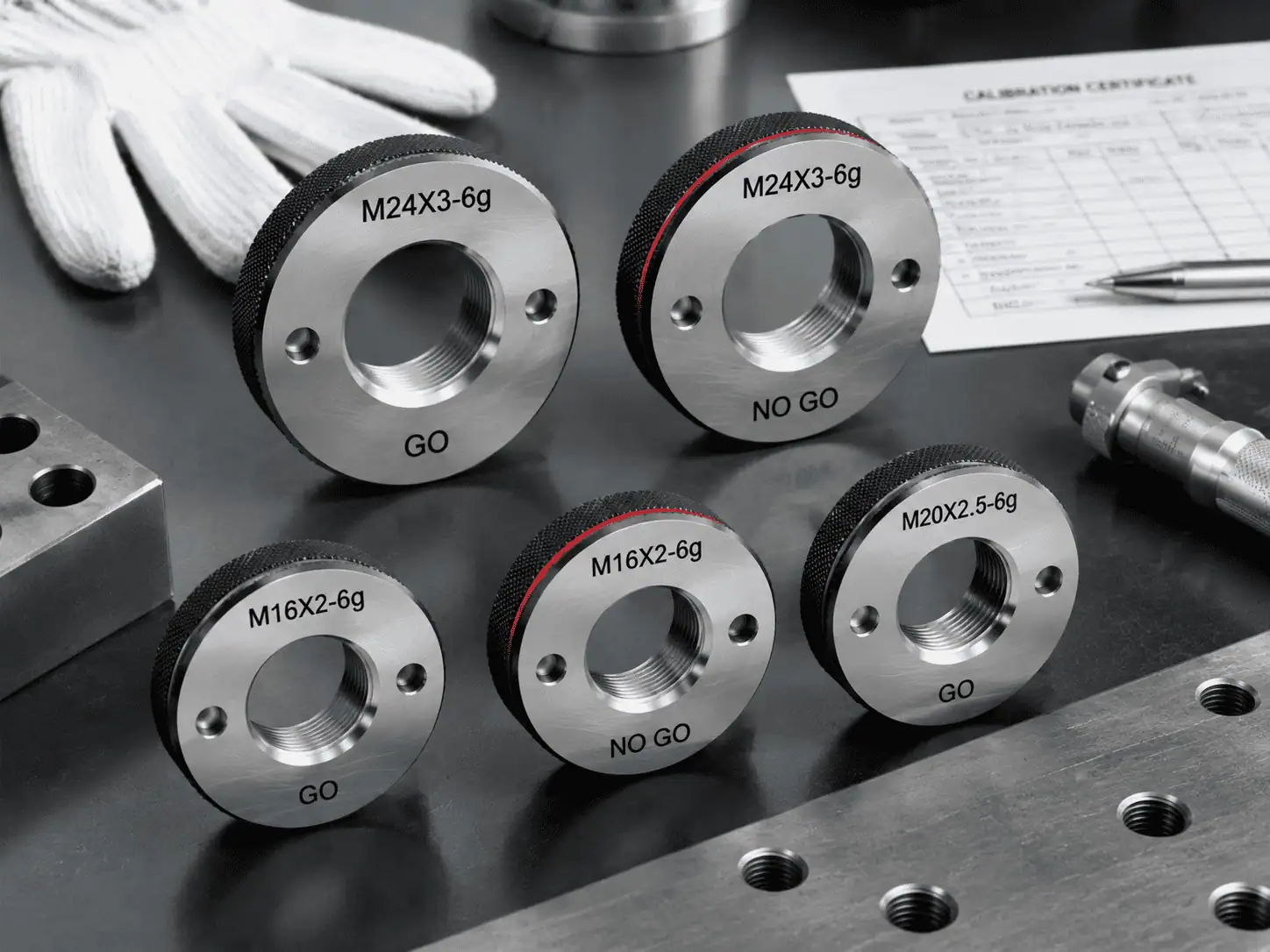
Why Ring Gauges Need Setting Plugs
A thread ring gauge cannot be measured with a micrometer or bore gauge the way a plain ring can. Its critical size — pitch diameter — sits on the flanks inside the ring. The practical way to set an adjustable ring, or verify a solid one, is to fit it to a threaded plug of known, precisely controlled size. That plug is the setting plug.
Our guide on whether thread ring gauges need setting plugs covers when you should buy them. This article explains the next question buyers ask: what are the two different sections on a setting plug, and which do you need?
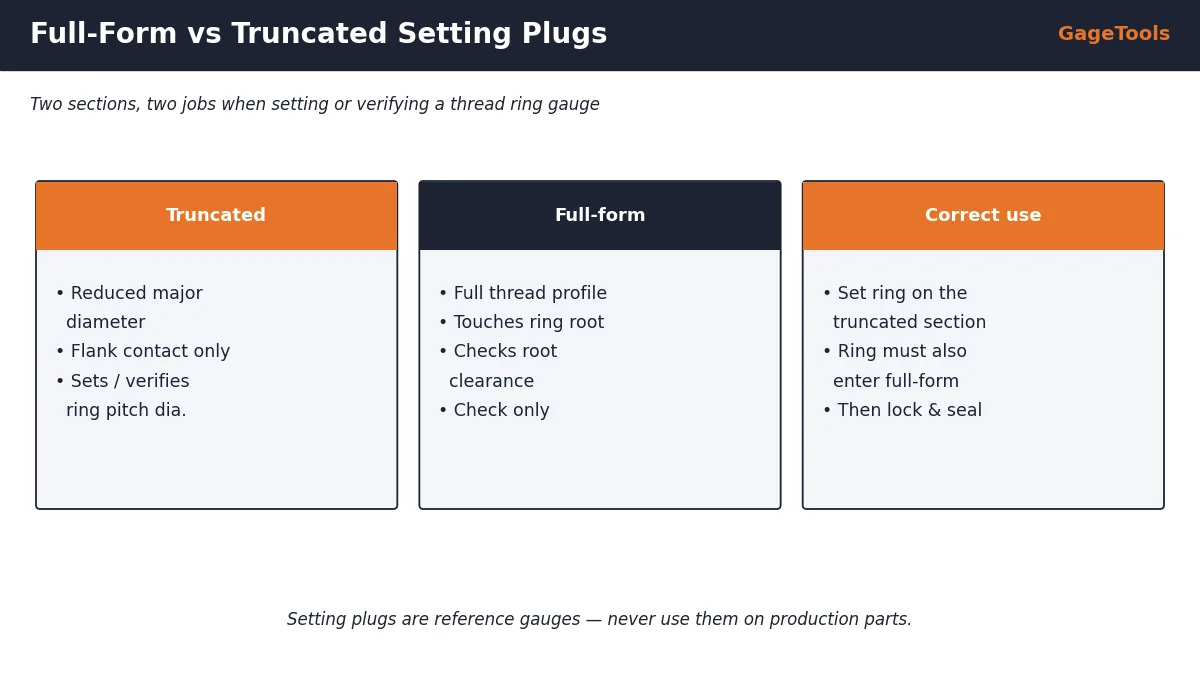
The Truncated Section: Setting Pitch Diameter
On the truncated section, the crest of the plug thread is cut down so its major diameter is smaller than the full thread form. When a ring is screwed onto this section, the plug touches the ring only on the flanks, around the pitch line. The ring’s root — its major diameter — does not touch the plug crest.
That matters because it separates two ring features. If the plug crest touched the ring root, a ring with a slightly small root could feel tight even with correct pitch diameter, and the operator setting it would open the ring too far. The truncated section removes that interference so the fit you feel reflects pitch diameter.
- Sets or verifies ring pitch diameter
- Avoids contact at the ring root
- Gives a clean flank “feel” when setting
- Used for the main setting fit
Adjustable rings are closed or opened until they fit the truncated section with the specified feel, then locked and sealed. Solid rings are checked for the same fit.
The Full-Form Section: Checking Root Clearance
The full-form section has the complete thread profile with the full major diameter. When the ring, already set on the truncated section, is moved to the full-form section, it must still enter. If it does not, the ring’s root is too small: it would interfere with the crest of a correctly made external thread even though its pitch diameter is right.
- Checks ring root (major) clearance
- Confirms the ring clears the part crest
- Detects rings with insufficient root
- Not the main pitch diameter setting
A ring that fits the truncated section but will not accept the full-form section has a root problem and should not be used until corrected or replaced.
Do not set a ring on the full-form section. If the ring is adjusted to fit the full-form section, root contact may mask the pitch diameter. Set on the truncated section, then use the full-form section as a clearance check.
Full-Form vs Truncated: Side-by-Side
| Feature | Truncated section | Full-form section |
|---|---|---|
| Major diameter | Reduced (truncated crest) | Full thread form |
| Contact with ring | Flanks only | Flanks and ring root |
| Main purpose | Set / verify pitch diameter | Check root clearance |
| Used to adjust ring? | Yes | No — check only |
| Typical failure found | Ring PD out of size | Ring root too small |
Some setting plugs are made with both sections on one body, one after the other. Others are separate. The gauge standard and your calibration procedure decide which design applies; if your procedure calls for a particular type, state it on the order.
GO and NO-GO Setting Plugs
Each ring member has its own setting plug, made to that ring’s size:
Because the NO-GO ring itself has a truncated thread form with root clearance, its setting needs differ from the GO ring. Your gauge supplier should match setting plug design to the ring design. For how the two ring members work in inspection, see our page on thread ring gauges.
Adjustable vs Solid Rings: How Setting Plugs Are Used
Adjustable rings are split and have adjusting and locking screws. The calibration technician fits the ring to the setting plug, adjusts until the fit is correct, locks the screws and seals them. Setting plugs are essential here: without them there is no reference to set to.
Solid rings have a fixed size. They are verified against the setting plug or measured by a calibration lab by other means. If out of tolerance, they are replaced rather than reset.
In both cases, setting the ring is a calibration-room task. Operators on the shop floor should never adjust a ring because it “feels tight” on production parts. That is how undersize parts get accepted.
Setting Plug Care and Calibration
Setting plugs are reference gauges. They are used far less than working gauges but any error in them passes straight into every ring set on them.
- Store them separately from working gauges, protected and lightly oiled.
- Use them only in the calibration room, never as working plug gauges on parts.
- Calibrate them on their own schedule, traceable to national standards; see what NIST traceability means for thread gauges.
- Inspect for burrs or damage at the start of the thread before every use.
- Record which setting plug set which ring, so a later plug error can be traced.
An ISO/IEC 17025 calibration certificate is available on request for setting plugs, as for working gauges.
Setting plugs also wear, although slowly. Every ring set on them rubs the flanks, and a burr raised by a careless insertion affects the next ring. If a setting plug is found out of tolerance at calibration, review which rings were set on it since its last good calibration and re-verify them. This is the main reason to record plug-to-ring links.
Which Setting Plugs Do You Need?
For special threads, we make setting plugs as custom thread gauges from drawing together with the matching rings, so the pair is consistent.
What to Send When Ordering Setting Plugs
- Thread callout and class of the ring gauges they will set
- GO, NO-GO or both
- Required design: truncated, full-form or combined sections, and the gauge standard (e.g. ASME B1.2 or ISO 1502)
- Whether the rings are adjustable or solid
- Quantity and certificate requirement (ISO/IEC 17025 available on request)
- Serial numbers of existing rings, if the plugs are for rings you already own
Ordering plugs and rings together is simpler than matching them later. Our GO/NO-GO thread gauges can be supplied as ring sets with matching setting plugs.
Need Thread Setting Plugs?
Send the thread size, class, ring type and required plug design. We confirm the design and reply with price and lead time within 24 hours.
Related: Do ring gauges need setting plugs? · Thread ring gauges · Master vs working plug gauges
Frequently Asked Questions
✓ 20+ years gauge manufacturing
✓ ISO 9001:2015 certified
✓ In-house CNC grinding & inspection
✓ Drawing / RFQ reply within 24h
Order Setting Plugs and Ring Gauges Together
GageTools manufactures GO and NO-GO thread ring gauges and matching setting plugs for metric, unified and special threads in Dongguan, China. ISO/IEC 17025 calibration certificate available on request. Standard sizes ship from stock within 72 hours; custom gauges in 10–15 working days. MOQ 1 piece. WhatsApp for fastest response.
💬 WhatsApp Quote 📐 Send Drawing for QuoteNeed These Gauges? Get a Quote
Send your thread size or drawing, gauge type and quantity. MOQ is 1 piece; standard catalogue sizes in stock ship within 72 hours. Prefer chat? WhatsApp us.