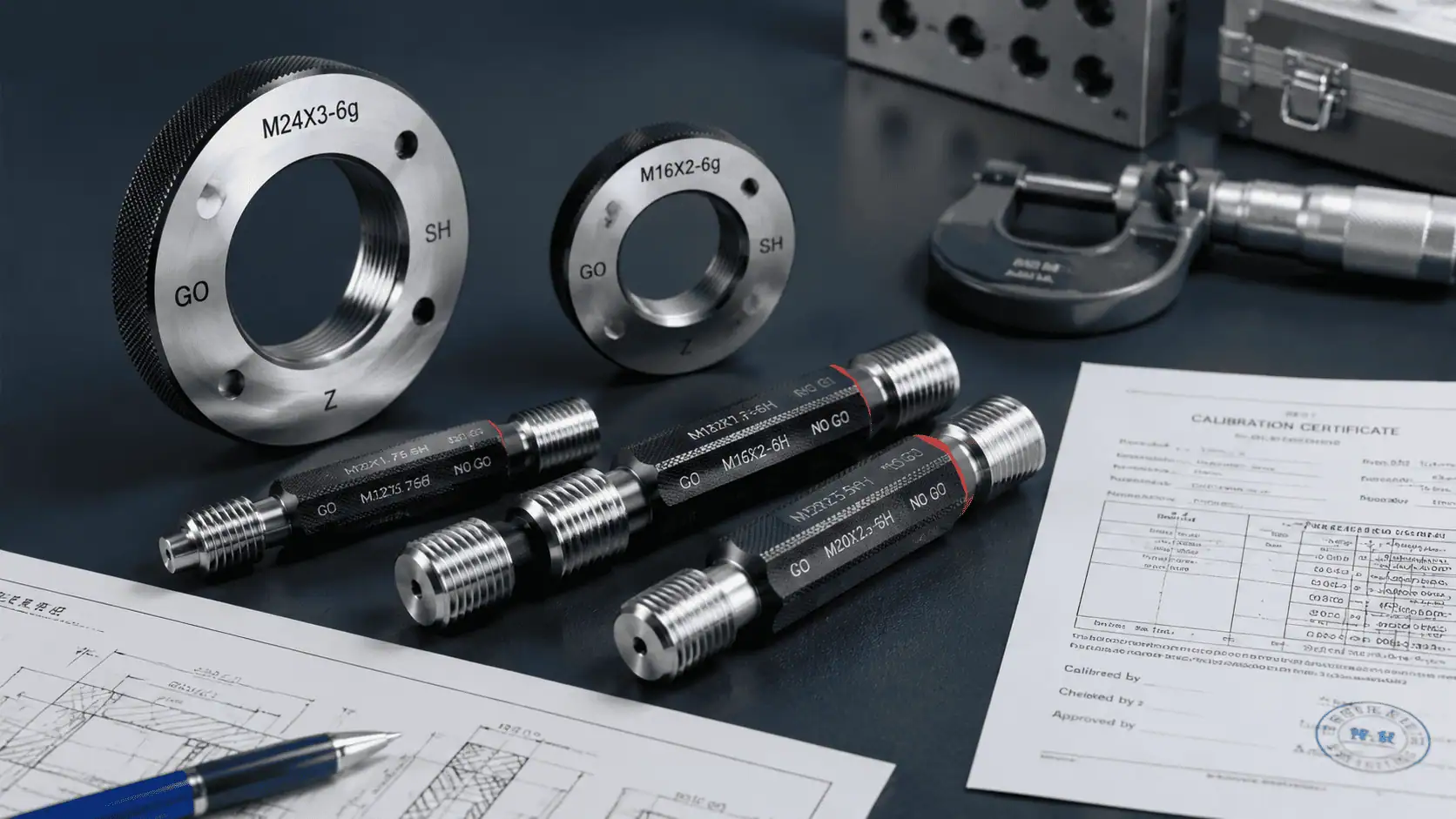
Need gauges for this? GageTools manufactures GO/NO-GO thread plug gauges and thread ring gauges in Dongguan, China. Standard sizes ship from stock within 72 hours, MOQ is 1 piece, and every RFQ gets a reply within 24 hours — request a quote.
What Buyers Mean by “Set” and “Individual”
The word “set” is used in two different ways in thread gauge purchasing, and mixing them up causes a lot of confused RFQs.
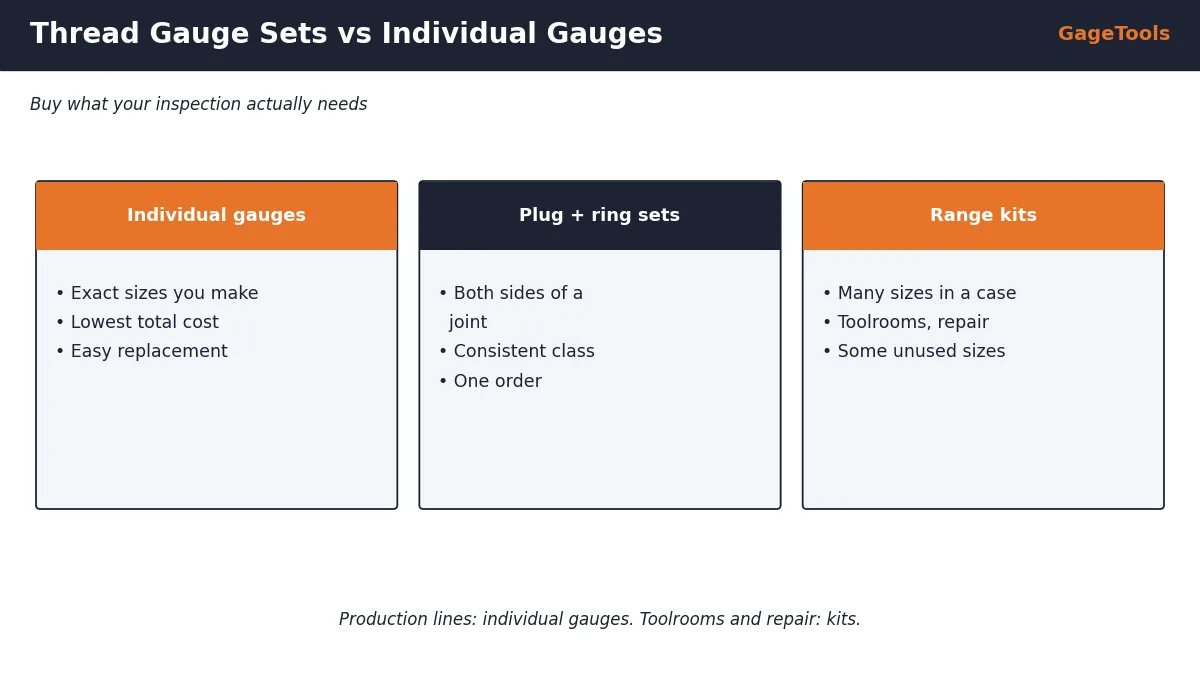
- A GO/NO-GO set for one size — for example, an M10×1.5-6H GO plug and NO-GO plug, often combined on one double-ended handle. This is the normal unit for inspecting one thread.
- A multi-size kit — several GO/NO-GO gauges covering a range of sizes, for example common metric coarse sizes, stored together in one case.
- A screw pitch gauge — a fan of thin leaves used to identify pitch. This is not a GO/NO-GO gauge and cannot accept or reject a thread.
This article compares the first two: buying single-size GO/NO-GO gauges one by one, versus buying a multi-size collection at once. For a refresher on what each gauge type does, see what is a thread gauge.
Side-by-Side Comparison
| Factor | Multi-size set | Individual gauges |
|---|---|---|
| Upfront cost | Higher, includes sizes you may not use | Lower, only sizes you need |
| Cost per used size | Often higher if many sizes sit idle | Matched to real usage |
| Coverage | Broad; good for mixed or unknown work | Narrow; matched to your drawings |
| Replacing a worn gauge | Replace one gauge; case stays | Replace one gauge |
| Storage | One case, easy to see if a gauge is missing | Several cases or a gauge cabinet |
| Calibration | Every gauge still calibrated individually | Every gauge calibrated individually |
| Best fit | Toolroom, maintenance, incoming inspection | Production cells, high-volume lines |
The table shows the main point: a set changes how gauges are bought and stored, but not how they are controlled. Each gauge in a set still has its own size, wear and calibration status.
When a Multi-Size Set Makes Sense
- You inspect many sizes but each only occasionally
- Your toolroom or maintenance team repairs threads of many sizes
- Incoming inspection sees a wide range of purchased parts
- You are setting up a new inspection area and do not yet know usage
Sets often include sizes that are never used. Check the size list against your drawings before buying, and do not pay for a large case of gauges that will sit on a shelf.
A set also helps discipline on the shop floor. When every gauge has a fixed pocket, an empty pocket is visible at once, and missing gauges are noticed before a shift ends rather than at the next audit.
When Individual Gauges Are the Better Choice
- Production uses a few sizes in large volumes
- Different cells need the same size at the same time
- Your drawings use specific classes (e.g. 6H, 2B, 3A)
- You need special, pipe or left-hand threads
You can buy two or three GO gauges of a heavily used size, keep them at each machine, and replace them as they wear, without buying sizes you never check.
Individual buying also makes it easier to match the tolerance class on the drawing. Many off-the-shelf kits cover a single common class. If your parts call for 4H, 5H, 7H or a 3B class, you will need gauges made for that class anyway. Note that for metric internal threads with tolerance position H the GO plug is the same for 4H, 5H, 6H and 7H — only the NO-GO plug changes — so a GO plug from a 6H set can serve, but the NO-GO cannot. Our guide to thread tolerance classes explains this in detail.
Cost: Look at Cost per Useful Gauge
A set usually looks cheaper per gauge than buying the same sizes one at a time. The better measure is cost per gauge that you actually use. If a set covers twelve sizes and your drawings use four, most of the purchase price buys idle gauges that still need calibration.
Remember calibration in the total cost. An unused gauge in a set usually still has to be calibrated on schedule, or formally marked as out of use, to keep your gauge list consistent. For a wider view on pricing, see our thread gauge price guide.
Gauge Control and Calibration Logistics
Quality systems such as ISO 9001 and IATF 16949 require that each measuring device is identified, calibrated and traceable. That applies to every gauge in a set, not to the case.
- Identify every gauge. Each GO and NO-GO member needs its own serial number, linked to its record.
- Plan calibration by gauge. Heavily used GO gauges may need shorter intervals than rarely used sizes in the same case.
- Avoid taking the whole set out of service. If the whole case goes to the lab at once, every size is unavailable. Stagger calibration or keep spare gauges for critical sizes.
- Handle a failed gauge on its own. Replace only the worn gauge, and update the set’s contents list.
- Keep certificates per gauge. A single certificate for “a set” is harder to audit than one per serial number.
A set is not one calibrated instrument. If one gauge in a set fails calibration, only that gauge is out of tolerance — but you must check which parts were accepted with it since its last good calibration. Record gauge serial numbers on inspection records so this search is possible.
For interval planning, see our thread gauge calibration guide.
A Practical Mixed Approach
Many plants end up with both. A typical pattern is a multi-size set in the toolroom or quality lab for occasional checks, plus individual gauges at the machines for the sizes that run every day. Busy sizes get two or three GO gauges so one can be in calibration while the others stay in use.
| Location | Typical choice | Reason |
|---|---|---|
| Production cell | Individual gauges, duplicates for busy sizes | High usage, fast replacement |
| Final inspection | Individual gauges matching drawings | Correct class, clear records |
| Incoming inspection | Set or individual, depending on supplier mix | Broad range of parts |
| Toolroom / maintenance | Multi-size set | Occasional, varied checks |
What to Send When Ordering Sets or Individual Gauges
- List of thread sizes with tolerance class for each (e.g. M8×1.25-6H, 3/8-16 UNC-2A)
- Plug, ring or both for each size
- Quantity per size, including spares
- Which area of the plant each gauge is for, if you want the quotation grouped that way
- Certificate requirement (ISO/IEC 17025 calibration certificate available on request, one per gauge)
Because our MOQ is one piece, you can build exactly the collection your drawings need. Browse GO/NO-GO thread gauges or send the size list for a single quotation.
Planning a Set or a List of Individual Gauges?
Send your list of thread sizes, classes and quantities. We reply with one quotation covering every gauge, with price and lead time, within 24 hours.
Related: GO/NO-GO thread gauges · Metric thread gauges · Bulk thread gauges for OEM buyers
Frequently Asked Questions
✓ 20+ years gauge manufacturing
✓ ISO 9001:2015 certified
✓ In-house CNC grinding & inspection
✓ Drawing / RFQ reply within 24h
Build the Right Thread Gauge Collection
GageTools supplies individual GO/NO-GO thread plug and ring gauges from MOQ 1, in metric, unified, pipe and special threads, so you buy exactly the sizes your drawings need. ISO/IEC 17025 calibration certificate available on request. Standard sizes ship from stock within 72 hours; custom gauges in 10–15 working days. MOQ 1 piece. WhatsApp for fastest response.
💬 WhatsApp Quote 📐 Send Drawing for Quote