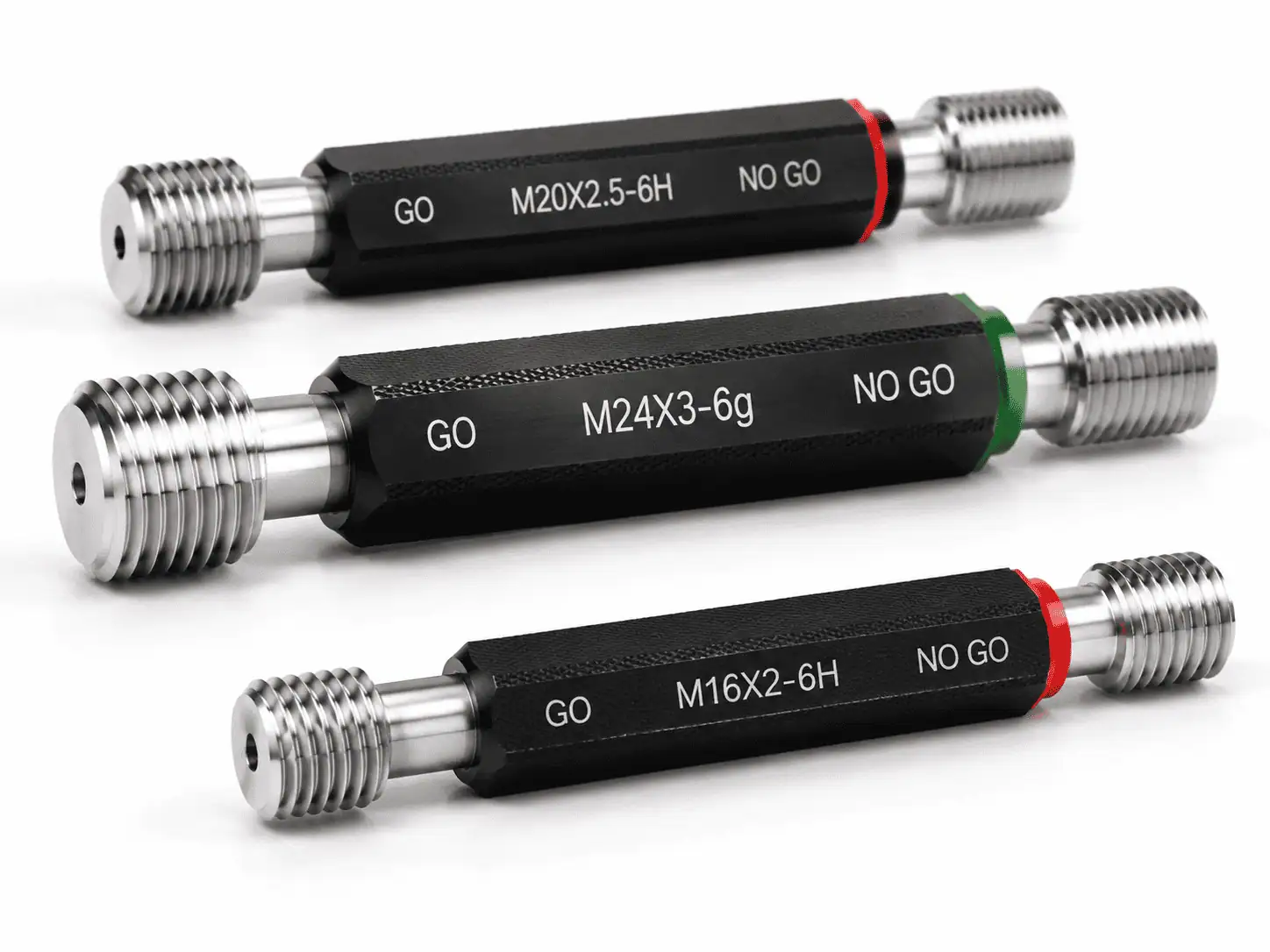
Need standard or extended-length gauges? GageTools manufactures GO/NO-GO thread plug and ring gauges, including custom long-reach and blind-hole depth-marked plugs. MOQ 1 piece, stock sizes ship in 72 hours. Send your depth or drawing for a 24hr quote →
What Thread Engagement Length Means
Length of thread engagement is the axial distance over which the threads of the bolt and the nut (or tapped hole) are fully in contact. It excludes chamfers, the incomplete threads at the end of a tap and the runout of an external thread. It is not the same as the drill depth or the overall thread length on the drawing.
Engagement length matters twice: once for the strength of the joint, and once for inspection, because the gauge has to prove that the thread is good over the length that will actually carry load.
How Much Engagement Is Needed?
The goal is usually that, if the joint is overloaded, the bolt breaks before the threads strip. Stripping is harder to detect and more dangerous. The engagement needed depends mainly on the relative strength of the two materials.
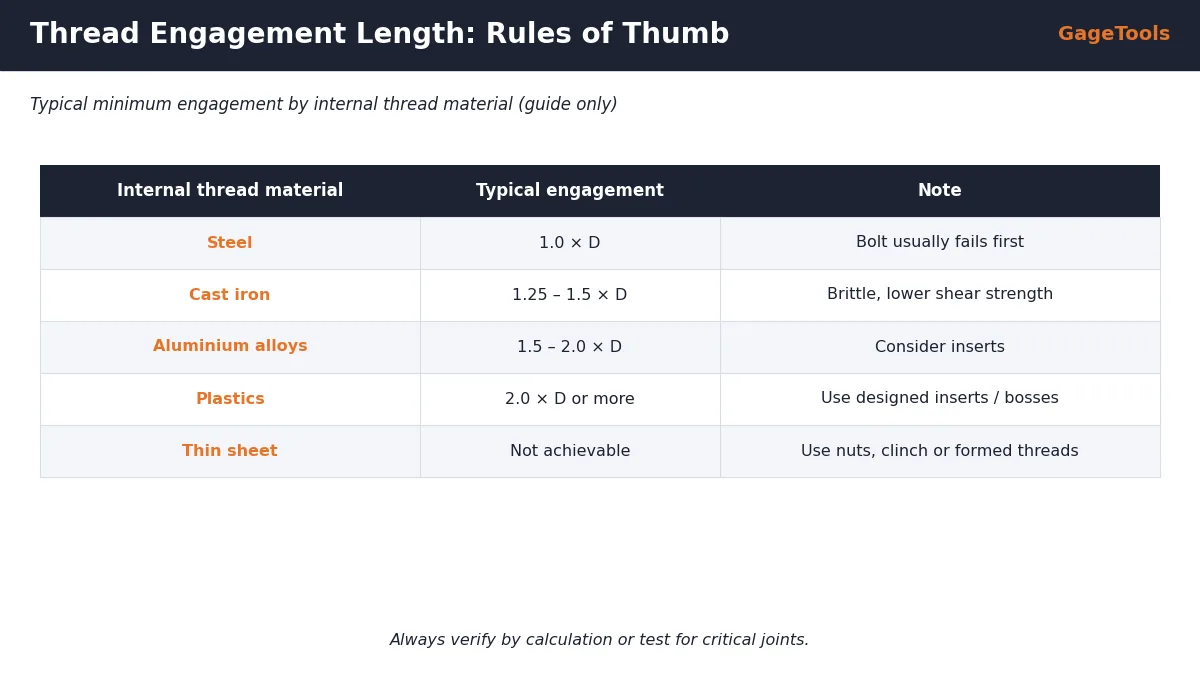
| Internal thread material | Common design guide | Comment |
|---|---|---|
| Steel nut or steel part, similar strength to bolt | About 1×D | Standard nuts are designed around this |
| Cast iron | About 1.5×D | Weaker, more brittle internal thread |
| Aluminium alloys | About 1.5–2×D | Soft material; consider thread inserts for frequent assembly |
| Plastics and soft metals | 2×D or more, or inserts | Follow the material or insert maker’s data |
These are general design guides, not guarantees. The required engagement for a critical joint should be calculated from the loads, materials and thread tolerances, or taken from the applicable design standard.
More engagement does not give unlimited extra strength. The first few engaged threads carry a large share of the load, so beyond a certain length extra thread adds little strength but adds cost, tapping time and inspection difficulty.
Engagement Groups and Tolerance Class (ISO 965)
ISO 965-1 divides lengths of thread engagement into three groups: short (S), normal (N) and long (L). The limits of each group depend on diameter and pitch. The recommended tolerance class is linked to the group.
The reason is simple: over a long engagement, small pitch (lead) and flank angle errors add up and increase the effective size of the thread. A coarser tolerance class leaves room for that. For example, in the medium tolerance quality ISO 965-1 recommends a coarser class for long engagement than the 6H/6g used for normal engagement. If the designer keeps a normal-engagement class on a long thread, parts become harder to make and harder to pass the GO gauge.
For internal threads with position H, remember that the GO plug is the same for 4H, 5H, 6H and 7H; changing the class for long engagement changes the NO-GO plug, not the GO plug. See our tolerance classes guide.
Free PDF: Thread Gauge Selection Guide & Tolerance Chart
4H–7H / 6g–6e chart, fundamental deviations, 2A/2B vs 3A/3B, gauges by standard and an ordering checklist.
Download Free GuideWhy the GO Gauge Must Cover the Engaged Length
Under Taylor’s principle, the GO gauge represents the mating part. It is full-form and should check the thread over the full length of engagement, because that is where accumulated lead error shows up.
- A thread can have pitch diameter inside limits at every point but still have a lead error that prevents a long bolt from assembling.
- A short GO gauge only proves the thread over its own length. If the engagement is longer than the gauge, part of the thread is not proven.
- Standard GO plugs have a length suited to normal engagement. For long engagement, a longer GO plug or ring may be needed so the gauge covers the full engaged length.
A GO plug that enters freely for its own length does not prove a deep thread. If the engaged length on the drawing is longer than the gauging length of the GO plug, the gauge must be screwed in to the full required depth, or a longer gauge must be ordered.
What the NO-GO Gauge Does on a Long Thread
The NO-GO gauge is short and truncated by design. It checks pitch diameter at the point where it engages, which on an internal thread is the entry end. It does not check the whole length.
That is normally enough, but on long threads the pitch diameter can vary along the length: a bell-mouthed entry, a taper caused by tap deflection, or a size change as the tap heats up. The NO-GO turn limit, not more than two turns under ISO 1502 and not more than three complete turns under ASME B1.2, applies at the entry.
| Thread condition | GO result | NO-GO result | What to do |
|---|---|---|---|
| Uniform, in tolerance | Enters full length | Stops within limit | Accept |
| Oversize at entry only (bell-mouth) | Enters | May exceed limit | Reject; check tapping alignment |
| Undersize deep in the hole | Stops before full depth | Stops | Reject; check tap wear or chips |
| Lead error over long length | Tightens with depth | Stops | Reject; check tap and feed synchronisation |
For through holes where the thread size may vary along the length, some users check the NO-GO from both ends. State this in the inspection instruction if the customer requires it.
Blind Holes: Full-Thread Depth and Gauge Reach
Blind holes are where engagement length and gauging meet most directly. A tap cannot cut full thread to the bottom of the hole: its chamfer leaves several incomplete threads, and there must be room below for chips.
- The drawing should give the minimum full-thread depth and the drill depth separately.
- The GO plug must reach the minimum full-thread depth without force.
- The GO plug should have little or no lead chamfer so it can gauge close to the last full thread.
- Depth can be read from a mark or step on the GO plug, or checked separately.
- Chips must be removed before gauging, or the GO plug will stop short and reject a good part.
If the GO plug stops short, check first for chips and coolant, then for a worn or broken tap, and finally for a drill that was too shallow. Our guide to thread gauges for blind holes covers depth marking and gauge design.
Design Tips That Make Gauging Easier
- Do not specify more engagement than the joint needs; deep threads cost more to tap and to gauge.
- Give a drill depth that leaves room for chips and tap chamfer below the full-thread depth.
- Use the tolerance class that matches the engagement group.
- State the full-thread depth as a minimum, not as a nominal value.
What to Send When Ordering Gauges for Long or Deep Threads
Standard thread plug gauges ship from stock within 72 hours. Gauges with extra length, depth marks or special reach are made to order in 10–15 working days. Select an option below to pre-fill your RFQ:
- Full thread designation and class, e.g. M10x1.5-6H or 3/8-16 UNC-2B
- Minimum full-thread depth or engaged length
- Drill depth and hole diameter for blind holes
- Required gauging length of the GO plug, or the part drawing so we can confirm it
- Any depth mark, step or extension handle required
- Quantity and certificate requirement (ISO/IEC 17025 available on request)
For non-standard lengths, see custom thread gauges from drawing. Send the drawing and we will confirm the gauge design before quoting.
Frequently Asked Questions
Order Thread Gauges for Any Engagement Length
GageTools manufactures GO/NO-GO thread plug and ring gauges for metric, unified, pipe and special threads, including extended-length gauges for deep and blind holes. ISO/IEC 17025 calibration certificate available on request. Standard sizes ship from stock within 72 hours; custom gauges in 10–15 working days. MOQ 1 piece.
Get Instant Quote → 💬 WhatsApp QuoteNeed Deep-Hole or Extended-Length Gauges? Get a Quote
Send your thread callout, required engagement depth or part drawing, and quantity. MOQ is 1 piece. Prefer chat? WhatsApp us.