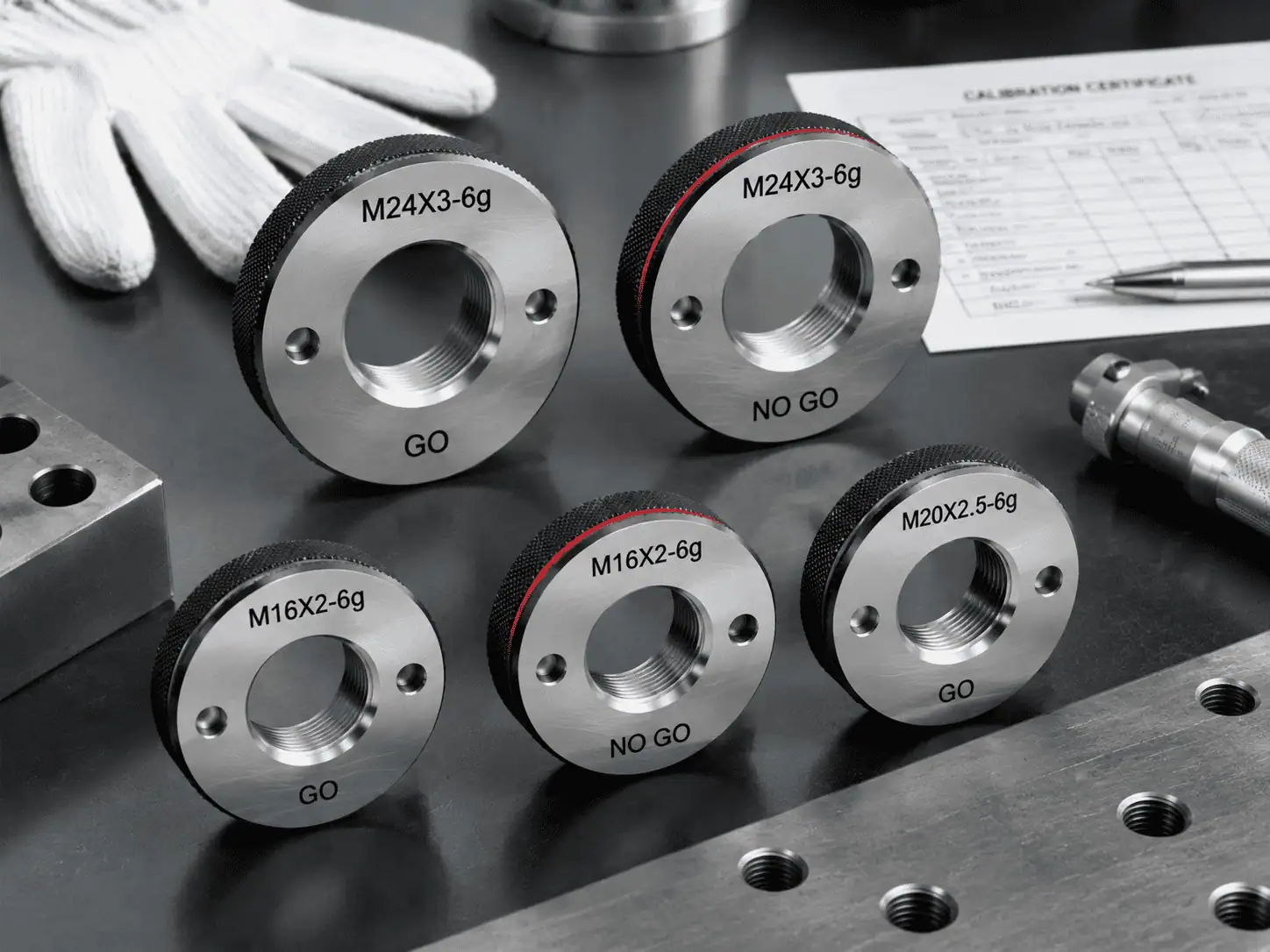
Why Lead Screws Need Their Own Inspection Plan
A fastener thread holds parts together. A lead screw thread moves them. Lead screws in machine slides, jacks, valves, presses and lifting equipment turn rotation into linear motion, and that changes what matters in inspection.
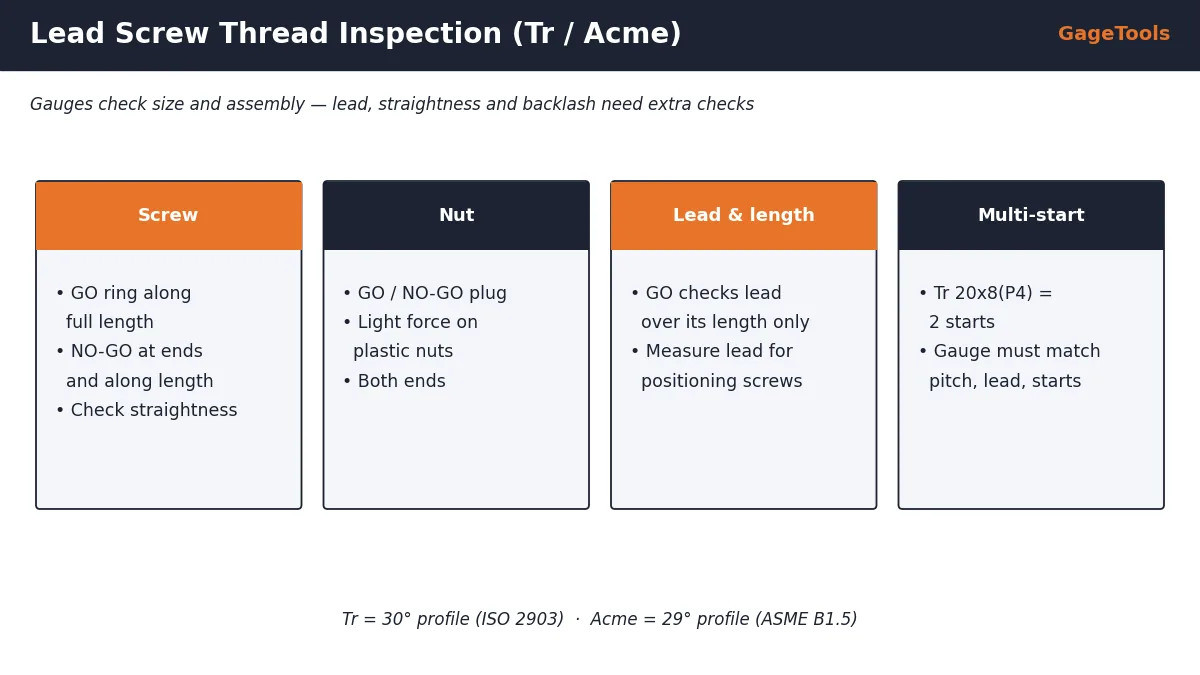
- Length: screws are often much longer than any gauge, so one check at one end says little about the rest.
- Lead: positioning accuracy depends on lead over the travel, not only on size at one point.
- Multi-start threads: fast-travel screws have two or more starts, and gauges must match them exactly.
- Backlash: the fit between screw and nut sets the free play in the drive.
- Nut materials: bronze and plastic nuts behave differently from steel parts under a gauge.
This guide covers inspection of the screw and nut as a working pair. For thread sizes, profiles and standards, see our trapezoidal thread gauge guide and the Acme thread gauge guide.
Tr and Acme Standards and Classes in Brief
Metric trapezoidal threads have a 30° profile and are covered by the ISO 2901 to ISO 2904 series (tolerances in ISO 2903) and by DIN 103 in many drawings. Acme threads have a 29° profile and are covered in the US by ASME B1.5, with general-purpose (G) and centralizing (C) classes.
| System | Example callout | Typical nut class | Typical screw class |
|---|---|---|---|
| Metric trapezoidal | Tr 20×4-7H/7e | 7H (8H coarser) | 7e (8e, 8c coarser) |
| Tr multi-start | Tr 20×8(P4)-7H/7e | 7H | 7e |
| Acme general purpose | 3/4-6 ACME-2G | 2G | 2G |
| Acme centralizing | 3/4-6 ACME-3C | 3C | 3C |
Classes with more clearance, such as 8c for Tr screws, are used where the screw may be dirty, hot or misaligned. General-purpose Acme classes rely on the nut and screw being guided elsewhere; centralizing classes limit radial movement on the major diameter. The class on the drawing decides every gauge limit, so read it carefully before ordering.
Gauging the Screw
External Tr and Acme threads are checked with GO and NO-GO thread ring gauges. On a long screw, where you check is as important as how.
- Clean the screw and remove burrs at the thread ends.
- Run the GO ring along the full threaded length by hand. It should turn freely; tight spots show local oversize, lead error or bending.
- Check with the NO-GO ring at both ends and at points along the length where the process could vary.
- Record the result for each position, not just a single pass/fail.
- Check straightness separately on long screws, for example between centres.
Running a GO ring along a long screw is slow but valuable. A screw that is bent, or whose lead varies along its length, will often pass a short check at the end and then bind in the nut half-way along. Thread whirling, rolling and turning each leave different patterns, so first-article checks along the whole length are worth the time.
Never force a GO ring along a tight screw. Forcing damages the ring and hides the fault. A ring that stops part-way is telling you where to look.
Gauging the Nut
Internal Tr and Acme threads are checked with GO and NO-GO thread plug gauges. Lead screw nuts are often long, flanged or split, and many are made from bronze or engineering plastics.
Plastic nuts can deform under gauging force and can change size after moulding or machining. Agree a gauging time and temperature with your supplier, and use light hand force only. Split nuts and anti-backlash nuts may need a gauging fixture that holds the halves in their working position.
Standard single-start sizes use normal thread plug gauges. Long nuts may need a GO plug with a longer gauging length, which is specified on the order.
Lead Accuracy: What Gauges Cannot Tell You
A GO gauge checks the thread form, including lead, over its own gauging length. If the lead error inside that length is large, the GO gauge will not enter. But a GO gauge does not give a number, and it cannot see how lead error builds up over a screw that is many times longer than the gauge.
For transport screws, where the screw only has to move a load, GO/NO-GO gauging plus a straightness check is usually enough. For positioning screws, where the travel per revolution must be accurate over the whole length, the drawing normally specifies a lead tolerance over a stated length. That needs measurement, for example on a thread measuring machine or a lead measuring set-up, not gauges.
Multi-Start Lead Screws
Multi-start lead screws give faster travel per revolution. In a Tr callout, the lead comes first and the pitch in brackets: Tr 20×8(P4) is a two-start thread with 4 mm pitch and 8 mm lead. Acme multi-start callouts state pitch, lead and number of starts.
- The gauge must have the same number of starts, pitch and lead as the part.
- Each start must be checked; a GO gauge that enters one start proves nothing about the others on a damaged part.
- Mark the starts on the gauge and on the part if position matters for assembly.
- Left-hand lead screws need left-hand gauges; see our left-hand thread gauges page.
Multi-start gauges are always made to order. Send the full callout or the drawing so the gauge maker can confirm pitch, lead and start arrangement before production.
Backlash and Screw-Nut Fit
Backlash is the axial free play between screw and nut. It comes from the clearance allowed by the two classes plus wear in service. Gauges confirm that each part is inside its limits, but they do not measure the play of a particular pair.
If backlash is a functional requirement, specify it on the assembly drawing and check it on the assembled pair, for example with a dial indicator while reversing the screw under a light load.
Common Lead Screw Inspection Mistakes
| Mistake | Result | Better practice |
|---|---|---|
| Checking only the screw end | Bent or lead-varied screws pass | Run GO ring full length |
| Using a single-start gauge on a multi-start thread | Gauge will not enter; parts wrongly rejected | Order gauges matching starts and lead |
| Forcing gauges into plastic nuts | Nuts deformed; false pass | Light force; agree gauging time |
| Expecting gauges to control lead accuracy | Positioning errors reach assembly | Measure lead over length |
| Mixing Tr 30° and Acme 29° gauges | Wrong flank contact | Match the thread system on the drawing |
What to Send When Ordering Lead Screw Thread Gauges
- Full thread callout, e.g. Tr 24×5-7H/7e or 1-5 ACME-2G
- Pitch, lead and number of starts for multi-start threads
- Right- or left-hand thread
- Which gauges: screw rings, nut plugs, or both
- Nut length if a longer GO gauging length is needed
- Setting plugs if rings are adjustable
- Drawing, if limits differ from the standard class
- Certificate requirement (ISO/IEC 17025 available on request)
Tr and Acme thread ring gauges and plugs in special sizes are made through our custom thread gauges from drawing service. We confirm the gauge design before quoting.
Need Gauges for Tr or Acme Lead Screws?
Send the thread callout, starts, hand and nut length. We confirm the gauge design and reply with price and lead time within 24 hours.
Related: Trapezoidal thread guide · Acme thread guide · Custom gauges from drawing
Frequently Asked Questions
✓ 20+ years gauge manufacturing
✓ ISO 9001:2015 certified
✓ In-house CNC grinding & inspection
✓ Drawing / RFQ reply within 24h
Order Tr and Acme Lead Screw Gauges
GageTools makes GO/NO-GO thread ring and plug gauges for trapezoidal and Acme lead screws, single and multi-start, right- and left-hand, from your drawing. ISO/IEC 17025 calibration certificate available on request. Standard sizes ship from stock within 72 hours; custom gauges in 10–15 working days. MOQ 1 piece. WhatsApp for fastest response.
💬 WhatsApp Quote 📐 Send Drawing for QuoteNeed These Gauges? Get a Quote
Send your thread size or drawing, gauge type and quantity. MOQ is 1 piece; standard catalogue sizes in stock ship within 72 hours. Prefer chat? WhatsApp us.