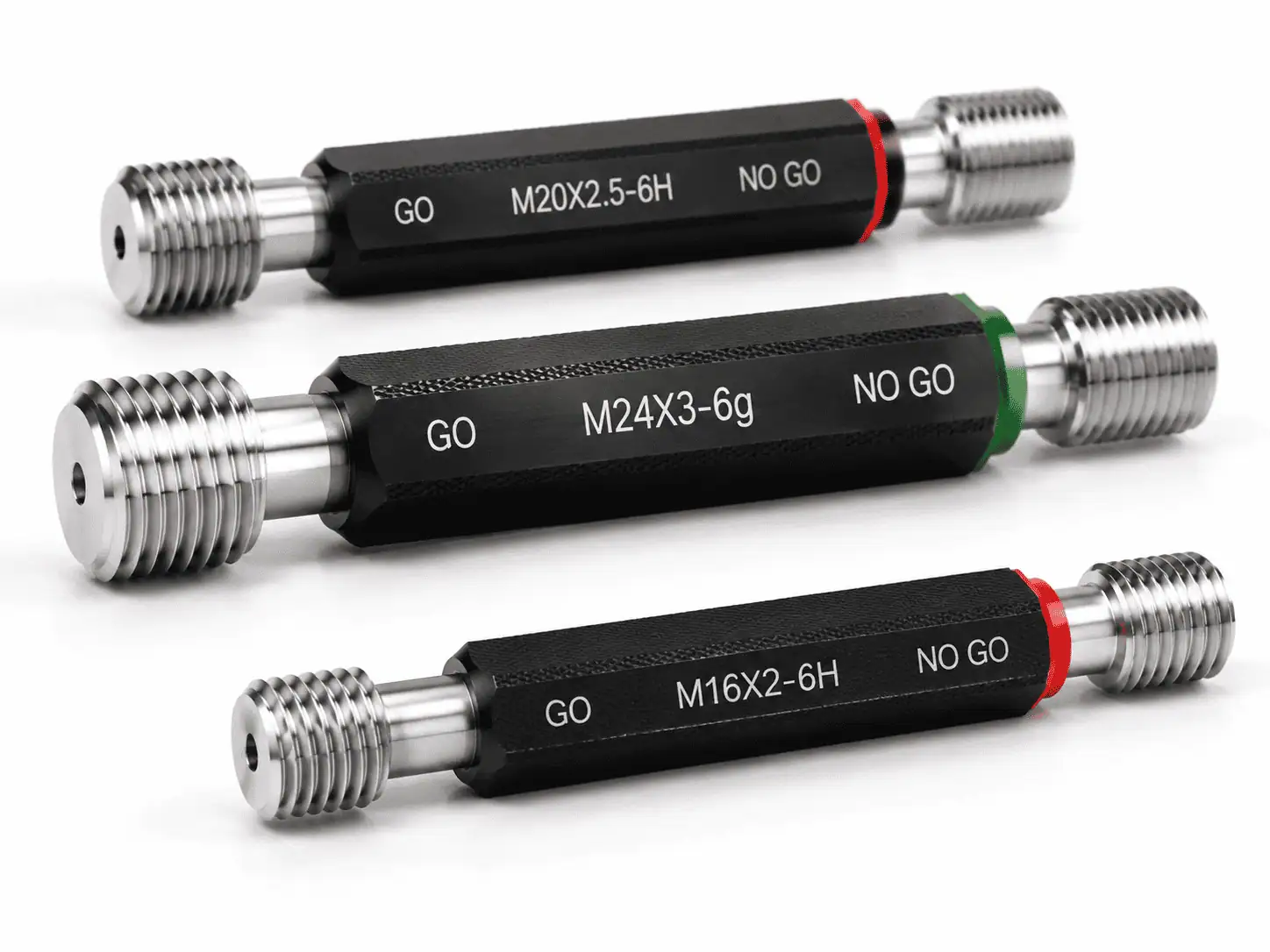
Need gauges for this? GageTools manufactures GO/NO-GO thread plug gauges and thread ring gauges in Dongguan, China. Standard sizes ship from stock within 72 hours, MOQ is 1 piece, and every RFQ gets a reply within 24 hours — request a quote.
What Form Tapping Is
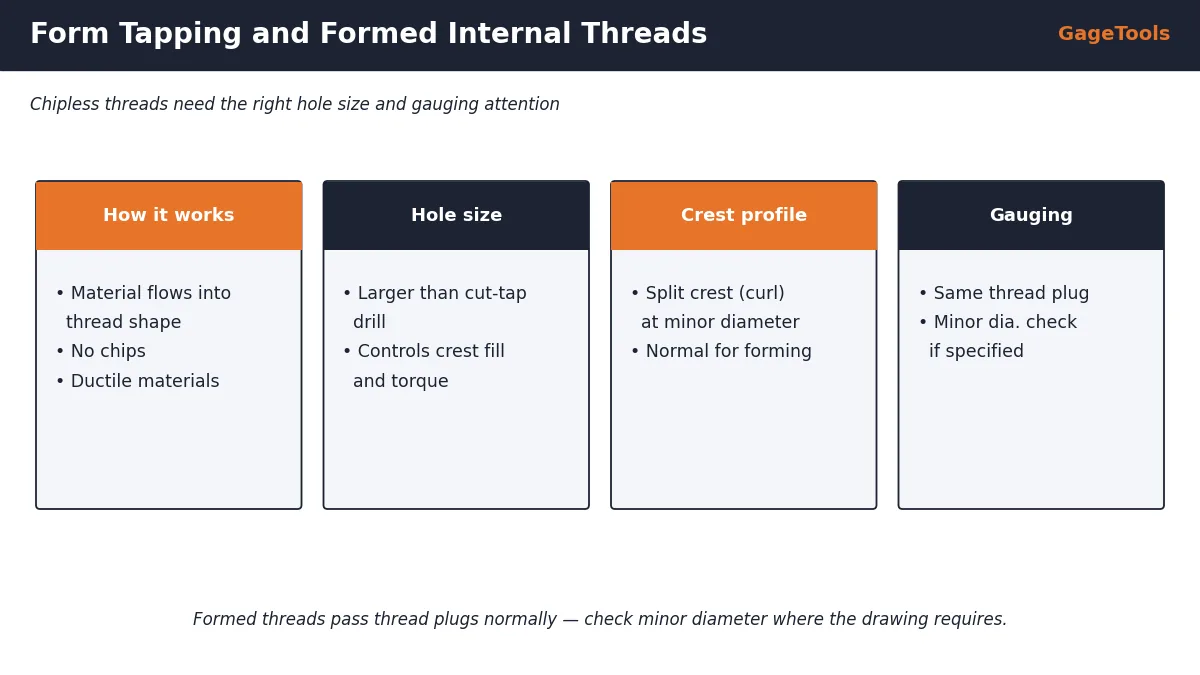
A form tap has no flutes for cutting. Its cross-section is slightly polygonal, with lobes that press into the wall of the hole. As the tap turns, each lobe pushes material outward and upward along the flanks. The material flows toward the centre of the hole and forms the crests of the internal thread. No chips are produced.
Because the thread is formed rather than cut, the result is similar to an external rolled thread: the surface is burnished, the grain follows the profile and the thread is work-hardened. Form tapping is widely used in aluminium, low- and medium-carbon steels, stainless steels, copper alloys and other ductile materials. It is not suitable for brittle materials such as grey cast iron.
Form Tapping vs Cut Tapping
| Aspect | Cut tapping | Form tapping |
|---|---|---|
| Chips | Yes — must be evacuated | None |
| Hole size | Cut tap drill (smaller) | Larger form tap hole |
| Minor diameter | Set by drill | Set by hole size and material flow |
| Crest at minor diameter | Clean, drilled surface | Split crest / seam |
| Thread strength | Baseline | Often higher (work-hardened) |
| Torque | Lower | Higher |
| Materials | Almost any | Ductile materials only |
| Blind holes | Chip packing risk | No chips to pack |
Hole Size for Form Tapping
Hole size is the most important setting in form tapping. The drilled hole must hold enough material to fill the crests, but not so much that the tap is overloaded or the thread overfills. It is always larger than the drill for a cutting tap of the same size.
A common starting point is a hole of about the nominal diameter minus half the pitch. For example, M6x1 is often form tapped from a hole close to 5.5 mm, compared with about 5.0 mm for a cutting tap. Treat this only as a guide: tap makers publish recommended form tap hole sizes, and the best value depends on the material, the tap geometry and the thread depth required.
| Hole condition | Effect on formed thread | What the gauges show |
|---|---|---|
| Correct hole | Crests well formed, small split | GO enters, NO-GO stops; minor in tolerance |
| Hole too small | Overfilled crests, high torque, tap breakage risk | GO may be tight; minor diameter small |
| Hole too large | Incomplete crests, low thread height | GO/NO-GO may pass; minor diameter oversize |
| Hole tapered or bell-mouthed | Uneven crest fill along depth | Minor diameter varies; check at depth |
Do not use the cutting tap drill for a form tap. The hole is too small, torque rises sharply and the tap is likely to break. Always use the form tap hole size, and prove it on trial parts.
The Split Crest and Minor Diameter
When material flows up both flanks during form tapping, the two flows meet at the crest of the internal thread — the minor diameter. The result is a small groove or seam running along the crest, often called a split crest or “claw”. It is a normal feature of formed threads, not a defect.
The minor diameter of a formed thread depends on how much material was available to flow, which is set by the hole size. It is not controlled by the tap in the same way as a cut thread. For this reason, the standard minor diameter tolerance for an internal thread can be hard to hold with form tapping. Many drawings and customer specifications allow a larger minor diameter for formed threads, or specify the hole size instead.
- Plain GO/NO-GO plug gauge at minor diameter limits
- Drilled hole size check before tapping
- Sectioning of sample parts for crest fill
- Agreed relaxed minor limits for formed threads
Agree with your customer how minor diameter is controlled on formed threads before production. If the drawing gives the standard cut-thread minor limits, raise it at the quotation stage rather than after the first rejection.
Gauging Formed Threads with GO/NO-GO Plugs
A formed internal thread is gauged with exactly the same GO/NO-GO thread plug gauges as a cut thread of the same size and class. The GO plug has a full form and checks the functional size — pitch diameter combined with lead and flank errors. The NO-GO plug is truncated and checks pitch diameter alone.
Thread plug gauges are made with clearance at their roots, so they do not touch the crest of the internal thread. That means the split crest does not normally affect the plug result. It also means the plug cannot tell you whether the crest is well filled. This is the same gap as with rolled external threads, and the answer is the same: add a separate minor diameter or hole size check.
- Clean the hole. Formed threads have no chips, but lubricant and debris can still mislead the gauge.
- Enter the GO plug by hand. It should pass the full thread length without force.
- Enter the NO-GO plug by hand. It may start, but must stop within two turns (ISO 1502) or three complete turns (ASME B1.2).
- Check minor diameter or hole size according to the agreed method.
- Look for burrs or raised material at the hole entry, which can stop the GO plug even when the thread is good.
Tap Classes for Form Taps
Formed threads spring back slightly after the tap leaves the hole, so the finished pitch diameter is often smaller than the tap. Form taps are therefore commonly made slightly oversize compared with cutting taps for the same thread class. Metric form taps are often marked with an “X” class such as 6HX, and inch form taps with a suitable H-limit.
The gauge always stays at the drawing class. If formed holes fail the GO plug because they are tight, the fix is an oversize form tap or a hole size adjustment, not a different gauge. For more on how tap classes relate to thread classes, read thread tolerance classes 4H to 7H, 6G and 6E.
Common Form Tapping Problems Seen at the Gauge
| Gauge result | Likely cause | Fix |
|---|---|---|
| GO plug tight or will not enter | Hole too small; tap undersize for material; springback | Enlarge hole within limits; use oversize form tap |
| NO-GO plug enters too far | Tap oversize or worn in a soft material | Use a smaller tap class; check alignment |
| GO stops at entry only | Raised burr or displaced material at the hole mouth | Countersink or chamfer the hole before tapping |
| Plugs pass, minor diameter oversize | Hole too large; poor crest fill | Reduce hole size; check drill wear |
| Plugs pass, thread strips in use | Low thread height from large hole | Section parts; tighten hole size control |
| GO tight near the bottom of a blind hole | Tap not reaching full depth; lubrication | Check depth setting; improve lubrication |
For blind holes, make sure the gauge length and any thread depth requirement match. Our guide to thread gauges for blind holes explains how to specify depth and clearance.
Quick Selector
What to Send When Ordering Gauges for Formed Threads
Formed threads use standard thread plug gauges, so most sizes ship from stock. To quote, please send:
- Thread callout and class (e.g.
M5x0.8-6H,#10-32 UNF-2B) - Thread depth and whether holes are blind or through
- Whether you also need plain plug gauges for minor diameter limits (state the limits)
- Condition inspected: before or after coating
- Quantity and certificate requirement (ISO/IEC 17025 on request)
For special sizes or non-standard minor limits, send the drawing and we will confirm the gauge design before quoting. See custom thread gauges from drawing.
Need Thread Plug Gauges for Formed Threads?
Send the thread callout, class, depth and quantity. We confirm the GO and NO-GO plugs and any plain plugs you need, and reply within 24 hours.
Related: Thread plug gauges · What is a GO gauge? · Pitch diameter in gauging
Frequently Asked Questions
✓ 20+ years gauge manufacturing
✓ ISO 9001:2015 certified
✓ In-house CNC grinding & inspection
✓ Drawing / RFQ reply within 24h
Order Thread Plug Gauges for Formed and Cut Threads
GageTools supplies GO/NO-GO thread plug gauges and plain plug gauges for metric, unified and special internal threads. ISO/IEC 17025 calibration certificate available on request. Standard sizes ship from stock within 72 hours; custom gauges in 10–15 working days. MOQ 1 piece. WhatsApp for fastest response.
💬 WhatsApp Quote 📐 Send Drawing for QuoteNeed These Gauges? Get a Quote
Send your thread size or drawing, gauge type and quantity. MOQ is 1 piece; standard catalogue sizes in stock ship within 72 hours. Prefer chat? WhatsApp us.