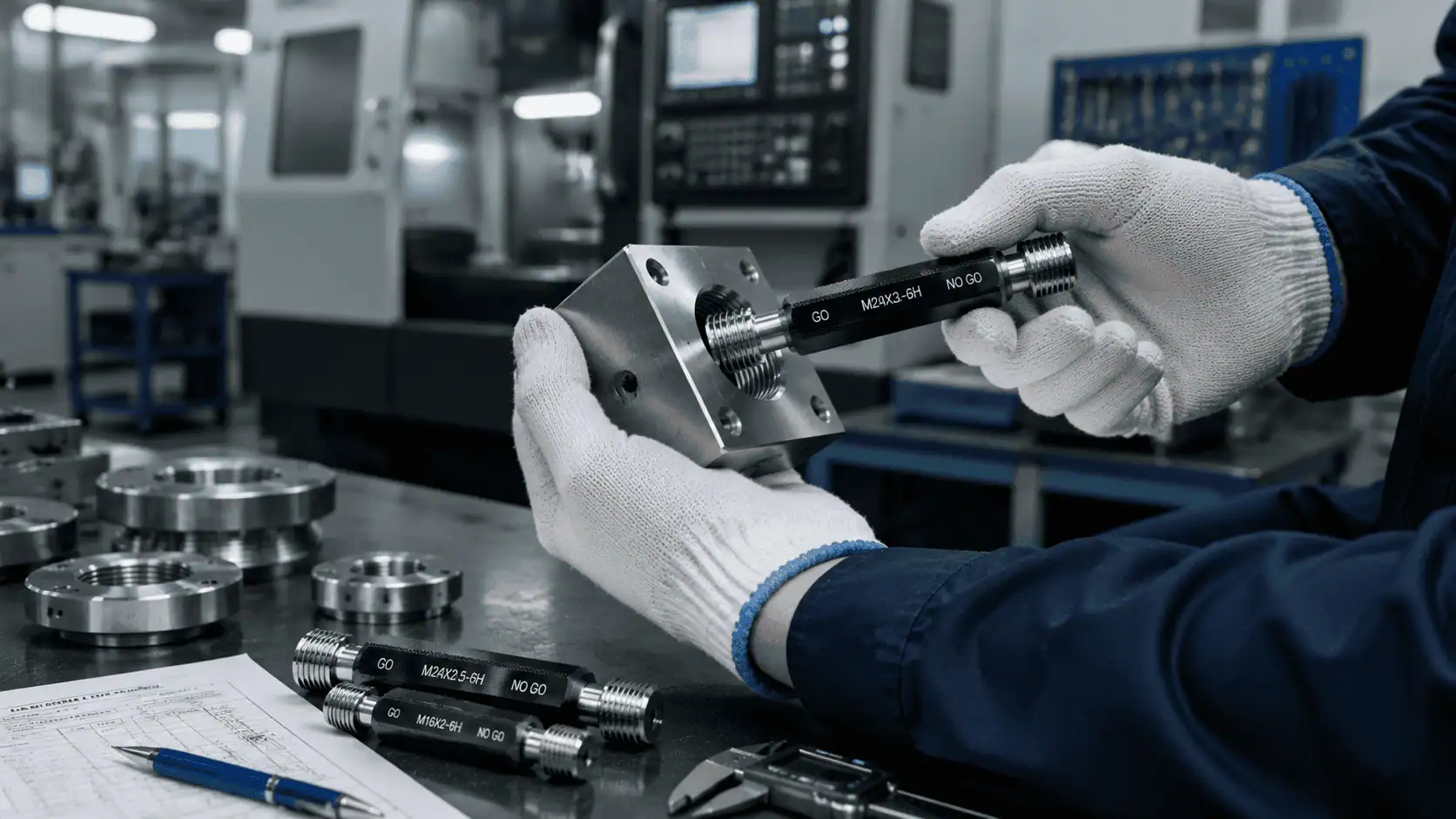
Need gauges for this? GageTools manufactures GO/NO-GO thread plug gauges and thread ring gauges in Dongguan, China. Standard sizes ship from stock within 72 hours, MOQ is 1 piece, and every RFQ gets a reply within 24 hours — request a quote.
What Heat Treatment Does to a Thread
A thread is a precise geometry: pitch diameter, pitch, flank angle and form must all stay within narrow limits for GO and NO-GO gauges to accept it. Heat treatment works on the whole part, and the thread goes along for the ride. Three effects matter for gauging:
- Size change: phase transformations during hardening change the volume of the steel, so diameters and pitch can grow or shrink slightly.
- Distortion: uneven heating, cooling or residual stress can make a thread slightly oval, tapered or bent, and can change lead over a long thread.
- Surface condition: scale, oxide, soot and quench residue add a layer to the flanks and fill the roots.
The size of each effect depends on material, part geometry, process and furnace practice. There is no universal number, which is why the reliable approach is to measure what happens on your own parts.
Typical Gauge Symptoms After Hardening
| Symptom | Likely cause | First action |
|---|---|---|
| GO ring or plug will not run on after HT | Scale, growth or distortion | Clean, then re-gauge |
| GO runs on only part of the length | Local distortion or lead change | Check straightness and lead |
| GO passes but feels tight in one spot | Ovality, local scale | Rotate part; inspect visually |
| NO-GO enters further than before | Shrinkage (internal thread growth) | Compare pre- and post-HT results |
| Results vary within one batch | Load position, uneven quench | Review furnace loading |
Pre- and post-heat-treatment gauge results on the same serialised parts are the fastest way to separate true size change from surface contamination. Without that comparison, teams often blame the gauge or the machining when the cause is the furnace.
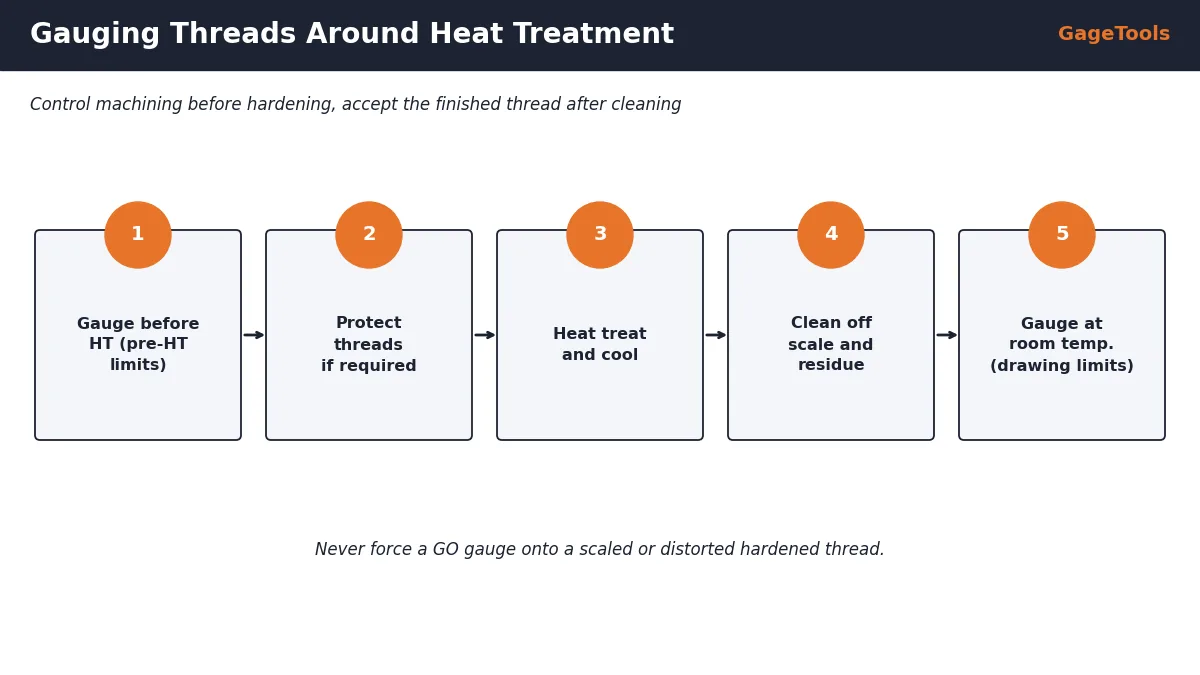
Never force a GO gauge onto a hardened thread. Hardened parts are close to the gauge in hardness and scale is abrasive. Forcing the gauge wears it quickly and can seize it on the part. If the GO gauge does not run freely by hand, stop and investigate.
Scale, Oxide and Residue: Clean Before You Judge
Scale is the most common reason a good thread fails the GO gauge after heat treatment. Even a thin oxide layer on both flanks reduces the effective size of an internal thread and increases that of an external thread. Quench oil residue and soot have a similar effect and also pick up dirt.
Cleaning must remove the layer without removing base metal or damaging the flanks:
- Degrease to remove quench oil before any other step.
- Use cleaning methods your process allows for threaded features; aggressive blasting can round crests or peen flanks.
- Brush threads with a suitable thread brush and blow out internal threads.
- Re-gauge only when the thread is clean, dry and at room temperature.
Where scale is unavoidable, many shops protect threads during heat treatment using stop-off coatings, controlled atmosphere or vacuum processes. The right choice depends on your heat treater and the material; discuss thread protection before the first batch.
When to Gauge: Before, After or Both?
The drawing decides which limits apply. The inspection plan decides where you check them.
Gauging only after heat treatment finds problems when the value added is already high. Gauging only before it assumes heat treatment never changes size, which is rarely safe. Most shops that make hardened threaded parts gauge at both stages, with different gauges if the limits differ.
Setting Pre-Heat-Treatment Thread Limits
If finished threads must meet a standard class such as 6H, 6g, 2B or 2A after hardening, and your process shows a consistent size change, the machined thread must be aimed to compensate. That means a pre-heat-treatment tolerance that is shifted and often narrower than the final class.
- Run a trial batch: machine threads to the final limits, serialise the parts and record gauge results.
- Heat treat under production conditions: same furnace, load pattern and cycle.
- Measure after cleaning: gauge again and, where possible, measure pitch diameter with the three-wire method or a lab instrument.
- Quantify the change: direction and spread, not just the average.
- Define pre-HT limits: put them on the process drawing or control plan.
- Order matching gauges: the pre-HT limits are non-standard, so the gauges are made to your limits.
Because pre-HT limits are specific to your process, the gauges are made to order. Send the limits or process drawing and we make custom thread gauges from your drawing, confirming the design before quoting. For how pitch diameter relates to gauge acceptance, see what pitch diameter is in thread gauging.
Process Differences: Through-Hardening, Case Hardening and Nitriding
| Process | Typical thread concern | Gauging note |
|---|---|---|
| Through-hardening + quench | Size change and distortion, scale | Gauge after cleaning; watch ovality |
| Carburising | Size change, distortion, brittle thread tips | Consider masking threads if not required hard |
| Carbonitriding | Similar to carburising, generally lower temperature | Establish size change by trial |
| Nitriding | Usually small dimensional growth | Surface layer can matter on fine threads |
| Induction hardening (local) | Local distortion near the hardened zone | Gauge threads near the zone after HT |
Treat the table as a guide to what to look for, not as a prediction for your parts. Only trials on your material and geometry show the real result.
Temperature and Stabilisation
Parts straight from tempering or cleaning can still be warm. Steel expands with temperature, and a warm external thread can fail a GO ring that it will pass an hour later; a warm internal thread can accept a NO-GO plug it should reject. Let parts reach room temperature before gauging, and keep gauges in the same environment as the parts.
Some materials continue to change slightly after hardening unless they are stabilised by tempering or other treatment. If thread size drifts between inspection and assembly, discuss stabilisation with your heat treater.
Protecting Your Gauges on Hardened Parts
Gauging hardened, possibly scaled threads is harder on gauges than gauging soft machined parts. A few habits extend gauge life:
- Gauge only clean parts; scale acts like grinding paste.
- Never force the GO member; investigate any tightness.
- Check GO gauges more often when used on hardened parts, and review thread plug gauge wear limits.
- Keep separate gauges for pre-HT and post-HT stages, clearly marked, if their limits differ.
What to Send When Ordering Gauges for Heat-Treated Threads
- Thread callout and final class from the drawing
- Pre-heat-treatment limits, if you use them, or the process drawing
- Plug, ring or both, and quantity
- Whether separate gauges are needed for each process stage
- Any coating after heat treatment
- Certificate requirement (ISO/IEC 17025 calibration certificate available on request)
Standard metric thread gauges ship from stock within 72 hours; custom pre-HT gauges are typically made in 10–15 working days.
Need Thread Gauges for Hardened Parts?
Send the final thread class and any pre-heat-treatment limits. We confirm the gauge design and reply with price and lead time within 24 hours.
Related: Custom gauges from drawing · Pitch diameter explained · Plug gauge wear limits
Frequently Asked Questions
✓ 20+ years gauge manufacturing
✓ ISO 9001:2015 certified
✓ In-house CNC grinding & inspection
✓ Drawing / RFQ reply within 24h
Gauges for Every Stage of Your Process
GageTools supplies standard GO/NO-GO thread gauges and custom gauges made to pre-heat-treatment limits from our factory in Dongguan, China. ISO/IEC 17025 calibration certificate available on request. Standard sizes ship from stock within 72 hours; custom gauges in 10–15 working days. MOQ 1 piece. WhatsApp for fastest response.
💬 WhatsApp Quote 📐 Send Drawing for QuoteNeed These Gauges? Get a Quote
Send your thread size or drawing, gauge type and quantity. MOQ is 1 piece; standard catalogue sizes in stock ship within 72 hours. Prefer chat? WhatsApp us.